

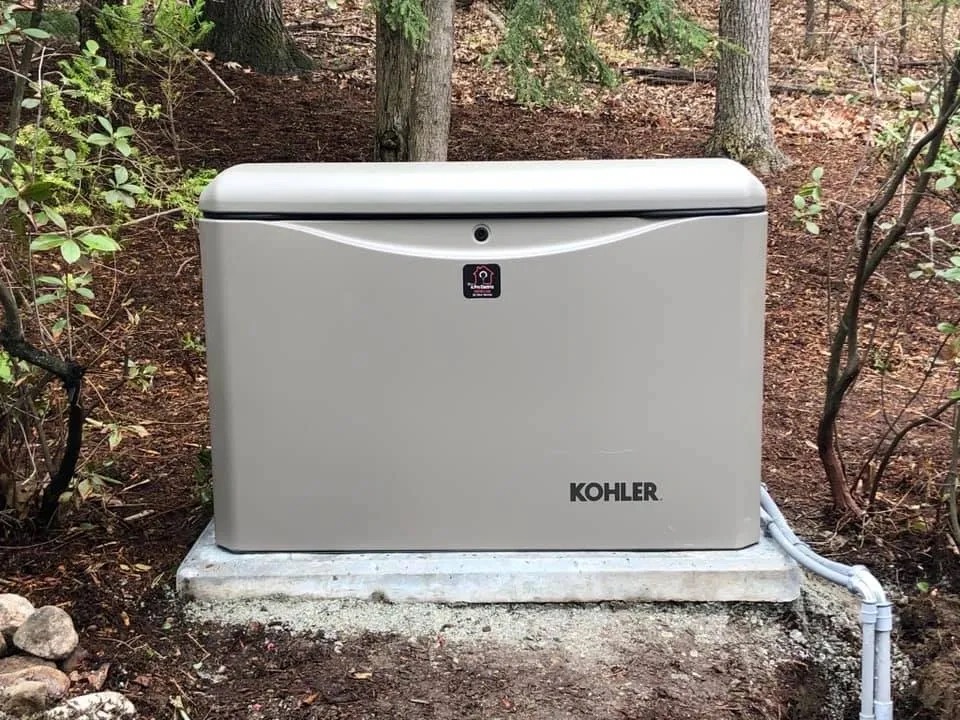
What Size Generator for a 150 Amp Service in NH, From the Loads You Keep On
What size generator for a 150 amp service in NH depends on three things more than the service, whether the house is on a well and septic, whether it has central air and whether someone works from home, and a 150 amp house can need anything from about nine to eighteen kilowatts before the margin.
How the Generator Size for a 150 Amp Service Is Worked Out in New Hampshire
What Size Generator a 150 Amp Service Needs, and Why It Varies
A 150 amp service at 240 volts can deliver up to 36,000 volt-amperes. It is a common size in houses that were upgraded from 100 amps when 200 was more than the owner needed, and in mid-sized houses wired with some headroom. It is a capable service, and the generator behind it is still sized from what the household chooses to run, not from the 36,000 figure.
What makes the 150 amp case interesting is that the houses vary so much. A rural house on a well, a septic pump and a sump pump has three motors to think about. A house with central air has one very large motor that sets the size on its own. A house where two people work from home has a list that stays on all day. The same 150 amp service can need a generator nearly twice the size of its neighbor's.
The examples that follow use the typical figures and the method in our generator sizing calculator, so each can be checked against the tool and then replaced with the nameplates on your own equipment. The full method is set out in standby generator sizing.
Generator Size for a 150 Amp Rural House on a Well, Septic and Sump
Rural New Hampshire houses often have three pumps, a well pump for water, a septic pump to move waste to the leach field and a sump pump in the basement. All three matter in an outage. No well pump means no water, no septic pump can mean a backup into the house and no sump pump can mean a flooded basement in a spring storm.
On the typical figures, the furnace or boiler runs at 800 watts, the refrigerator at 700, the freezer at 500, the well pump at 1,000, the septic pump at 600, the sump pump at 800, the lights and outlets at 1,000 and the internet at 300. That is 5,700 watts of running load. Three motors start at 3,000, 1,800 and 2,400 watts, but only the largest, the well pump, is added once, so the required size is 8,700 watts.
That figure surprises people who expect three pumps to need a large generator. The pumps run for short periods and rarely start together, which is exactly why only the largest start is counted. A generator sized near nine kilowatts with a sensible margin carries a rural house through an outage, and a critical loads panel is often the tidiest way to connect it.
Central Air Sets the Generator Size for a 150 Amp House
Central air conditioning changes the arithmetic more than any other single load. On the typical figures it runs at 3,500 watts and starts at 8,000, which is far above the well pump. A house that wants the air on during a summer outage has to size the generator around that start.
Add central air to the rural list of 5,700 watts and the running load is 9,200. The largest start is now the air conditioner at 8,000 watts, so the required size is 17,200 watts, nearly double the 8,700 without it. The running load has gone up by 3,500 watts, and the start has added another 5,000 on top of what the well pump needed.
So the question is whether the air needs to run in an outage. Most New Hampshire outages that last are in winter storms and ice, when nobody needs air conditioning, and a summer outage can often be ridden out with fans. Leaving the air off the generator, or letting load management keep it waiting until the well pump has finished, is the commonest way to keep a 150 amp house on a generator of about ten kilowatts.
Generator Size for a 150 Amp House With a Home Office and Mini-Splits
More houses now have someone working from home, and an outage on a working day is a lost day unless the office keeps running. The office itself is a small load, about 600 watts for a computer, monitors and a printer on the typical figures, but it changes how long the generator runs and what else comes with it.
Add the office at 600 watts and two mini-split heads at 1,200 watts each to the rural list of 5,700 and the running load is 8,700 watts. The mini-splits start at 2,900 watts each, just under the well pump's 3,000, so the well pump still sets the start and the required size is 11,700 watts. Mini-splits are gentler on a generator than central air, which is one reason they suit houses that want comfort on backup power.
The internet matters as much as the computer. A modem and router on the generator list are only 300 watts, but they are what makes the office work, and they belong on the essential list even in a house that leaves everything else off. A generator that starts within seconds of an outage keeps the connection up, which is something a portable started by hand cannot do.
Transfer Switches and Panel Space on a 150 Amp Service
A whole-house automatic transfer switch on a 150 amp service is rated for the service, because it sits in front of the panel and carries everything the service can deliver. That is true however small the generator behind it, and it is the one place in the job where the service rating sets the size of the equipment.
A critical loads arrangement works differently. The chosen circuits move from the main panel to a smaller backup panel, and only that panel is fed by the generator through its own transfer switch. On a 150 amp house with a clear essential list, such as the rural example, that is usually the cheaper arrangement and the one that keeps the generator small.
Before either, we open the main panel. A 150 amp panel installed in the 1970s or 1980s may be full, may be a brand we would replace and may have no room for the transfer equipment. The panel's condition can decide the arrangement before the generator size is even discussed.
Oil, Propane and Gas Houses and the Generator on a 150 Amp Service
About 39.5 percent of occupied homes in New Hampshire heat with fuel oil, 21.4 percent with utility gas and 19.2 percent with propane, according to the U.S. Census Bureau American Community Survey estimates for 2020 to 2024. In all three the heating system needs house power for its burner, igniter, blower or circulators, and a house that loses power in January loses its heat even with a full tank.
That is the strongest argument for a generator in this state, and it keeps the generator small, because a burner and a circulator draw only a few hundred watts. The fuel for the generator is a separate choice. A house on utility gas can run a standby generator from the same supply, and a propane house can run one from its tank or a second tank, while an oil house usually adds propane for the generator.
Natural gas ratings are lower than propane ratings for the same machine, so the size has to be read against the fuel in use. A unit that is just big enough on propane can come up short on gas, which is one more reason to keep a margin above the calculated figure.
Standby Generator Costs for a 150 Amp House and What Moves Them
A standby generator is typically $10,000 to $20,000 installed, with the unit included. On a 150 amp house the size is only one of the things that decide where in that range a job lands, and often not the largest.
The other drivers are the distance from the generator to the panel, the fuel line or tank, whether a whole-house switch or a critical loads panel is used and whether the panel needs work first. A ten kilowatt unit beside the panel on an existing gas line sits near the bottom of the range. A larger unit on a long run with a new propane tank and a panel replacement sits near the top.
That is why the visit comes before the price. A written scope that names the generator size, the transfer arrangement, the fuel and the position lets you check the size against the list and see what each part of the cost is for, and it keeps the number from moving once the work starts. Our standby generator installation page covers the full job.
Heat Pumps and EV Chargers Coming to a 150 Amp House and the Generator
Many 150 amp houses are about to add a large load. A heat pump in place of an oil or propane system is the commonest, and an EV charger is close behind, and both change the generator question as much as they change the service. A generator sized for the house as it is today can be too small a year later.
On the typical figures a whole-house heat pump runs at 4,500 watts and starts at 9,000, which would replace the well pump as the largest start and take the rural example from 8,700 watts to about 19,200. An EV charger at 48 amps and 240 volts draws 11,520 watts while it charges, more than the whole essential list. Neither has to be on the generator, but the decision is better made before the unit is bought than after.
The service is the other half of the question. A 150 amp service that takes on a heat pump and a charger may need an upgrade, and the transfer equipment follows the service. If both are planned, we look at the service and the generator together, so the transfer switch is bought once. Our guide to what size electrical service a house needs shows how that calculation is done.
A car on a charger can usually wait. Most households leave the charger off the generator, or let load management hold it until the house has room, and charge fully once the power is back. The heat pump is different if it is the only heat, because then it belongs on the list and the generator has to be sized around its start.
What We Measure Before Quoting a Generator for a 150 Amp Service
We start at the panel, with its size, brand, condition and free spaces, and then read the nameplates on the heating system, the well pump, the septic pump, the sump pump, the air conditioner and the main appliances. Those figures replace the typical ones in the examples, and on a house with three pumps and central air they can move the answer by several kilowatts.
We ask how the house is used in an outage. Whether the air needs to run, whether anyone works from home, whether the house is ever left empty and what is planned for the next few years, such as a heat pump or an EV charger. Each answer adds or removes a line from the list, and the list decides the size.
The scope is written down so the size can be checked line by line. For larger houses, what size generator for a 200 amp service works through the next size up, and the installation is permitted, inspected and tested under load before we hand it over.
What size generator for a 150 amp service in NH turns on the pumps, the central air and who works from home. A. Pro Electric, a licensed master electrician based in Henniker, reads every nameplate and writes the size down so it can be checked.
What Generator Sizing for a 150 Amp Service Includes in Our Quote
- A look at the panel and the space for transfer equipment
- Nameplate readings for every pump, the air conditioner and the heating system
- A written generator size from running watts plus the largest motor start
- Options with and without central air on the generator
- A whole-house or critical loads arrangement matched to the 150 amp service
- Permit, inspection and a load test before we leave
Signs a 150 Amp House Needs Generator Sizing Before You Choose a Unit
- A well, a septic pump and a sump pump that all need power
- Central air you are unsure about keeping on in an outage
- Someone in the house works from home
- An oil, gas or propane heating system that stops without power
- Dealers have given you very different generator sizes
Generator Size for a 150 Amp Service Questions, Answered
What Size Generator Do I Need for a 150 Amp Service?
On the typical figures, a rural house on a well, septic and sump needs about 8,700 watts before the margin. Adding central air takes it to about 17,200, and a home office with two mini-splits to about 11,700. Your nameplates give the real answer.
Do Three Pumps Mean I Need a Big Generator?
No. Pumps rarely start at the same moment, so only the largest start is counted once. A well, septic and sump pump together usually fit on a generator of about nine kilowatts with a margin.
Should Central Air Be on the Generator?
Usually not. Central air starts at about 8,000 watts and nearly doubles the generator size, and most long outages here are in winter. Leaving it off, or using load management, keeps the unit smaller.
Does a 150 Amp Service Need a 150 Amp Transfer Switch?
For a whole-house arrangement, yes, because the switch carries everything the service can deliver. A critical loads panel moves only chosen circuits and can use a smaller switch.
Can the Generator Keep My Home Office Running?
Yes. An office is about 600 watts and the internet about 300, both small loads. A standby generator restarts them within seconds, which a portable started by hand cannot do.
Will a Generator Run My Oil or Propane Heat?
Yes. The burner, igniter, blower and circulators need only a few hundred watts, which is why heat is on almost every generator list in New Hampshire.
Can a Generator Run a Heat Pump on a 150 Amp Service?
Yes, if it is sized for the heat pump start, which is about 9,000 watts on the typical figures and becomes the largest start in the house. If the heat pump is the only heat it belongs on the list. If a boiler or furnace can carry the house, the heat pump can be left off and the generator stays smaller.
Do I Need a Permit for a Generator on a 150 Amp Service?
Yes. It is permitted and inspected work in New Hampshire. We pull the permit, attend the inspection and test the generator under load before we leave.
Guides on Generators & Backup Power
Standby Generators: What They Cover and What They Do Not
Whole-house against essential circuits, automatic against manual, and what a transfer switch is for.
Getting a Home Ready for a New Hampshire Winter
Outage backup, heat cables for ice dams and frozen pipes, winter heating load, and outdoor power before the snow.
More Generators & Backup Power
Portable Generator Hookup
Inlet, interlock and permit, so a generator you own can run the house safely.
Automatic Transfer Switch Installation
The switch that moves the house onto the generator, sized to the service.
Critical Loads Panel
The subpanel that decides which circuits stay live in an outage.
Generator Servicing & Load Testing
The annual visit, tested under real load, with a written record.
Generac Generator Installation
The brand we fit most often, sized to the house and commissioned under load.
Generator Replacement & Upgrades
Replacing a set that is past parts, past repair or too small for the house.
Standby Generator Sizing
How to size a standby generator from the circuits you keep on, for 100 to 300 amp service.
Generator Size for a 100 or 125 Amp Service
What size generator a small-service house or camp needs, and when the service should come first.
Generator Size for a 200 Amp Service
What size generator a 200 amp house needs, worked from the circuits and not the service.
Generator Size for a 300 Amp Service
All-electric and heat pump homes, split services and workshops, sized with load management.
Generator Size for a 400 Amp Service
Sizing a generator for a large house, a second panel or a property with outbuildings.
All generators & backup power work, including what a full installation involves and what it costs.