

Standby Generators: What They Cover and What They Do Not
What a generator covers in a New Hampshire outage, why the transfer switch is not optional, and when a portable would do the same job.
Published
Choosing Standby Backup Power That Fits a New Hampshire Home
What Does a Standby Generator Actually Cover?
A standby generator in a New Hampshire home covers whatever it has been sized and wired to cover, which is a less obvious answer than it sounds and it is where most of the disappointment in this subject comes from. A generator does not simply "power the house". It powers the circuits connected to it, up to the capacity of the unit.
There are two common arrangements. A critical-loads panel feeds a chosen set of circuits, typically heat, well pump, refrigeration, some lighting and outlets, and the internet. Everything else stays dark. This is cheaper, needs a smaller unit, and covers what actually matters in an outage. Whole-house means the generator carries everything, which needs a larger unit and usually load management so it can shed heavy circuits when demand peaks.
The decision is worth making deliberately rather than by default, because it drives the size of the unit and therefore most of the cost. A household that genuinely only needs the heat on, the water running and the freezer cold in a two-day outage is buying a different machine from one that wants the house to behave normally. Where the critical loads include a well pump or a septic pump, those usually sit on dedicated circuits already, which makes the panel work simpler.
The one thing that is not optional in either arrangement is the transfer switch.
Where you are in New Hampshire changes the answer more than anything else, because a house in Manchester, Nashua or Concord is back on quickly and one out towards Henniker, Weare, Deering or the Lakes Region around Laconia and Meredith may not be.
Why Does a Standby Generator Need a Transfer Switch?
Because without one you can put power onto the utility line and kill somebody. That is not a dramatization. It is the specific failure that transfer switches exist to prevent, and it is why this is never a corner to cut.
When the grid is down, line crews work on conductors they have isolated and expect to be dead. A generator connected to a house without a transfer switch can backfeed through the service and out onto that line, where it is re-stepped up by the transformer to full distribution voltage. The crew has no way to know. This has killed people, and it is why backfeeding through a dryer outlet with a double-ended cord, which people genuinely do, is both illegal and lethal.
A transfer switch physically prevents the utility supply and the generator from ever being connected at the same time. An automatic transfer switch does it by itself, sensing the outage, starting the generator and switching over, typically within half a minute. A manual transfer switch or an interlock does the same thing mechanically, with you throwing the switch.
Both are legitimate and both are inspected. It is the first thing an inspector looks for, and rightly so. Generator wiring and transfer switches is the part of this work that actually needs an electrician.
Standby or Portable Generator, Which Is Better for a House?
They solve the same problem at very different levels of cost and convenience, and the right answer depends more on your situation than on the machines.
A portable generator is wheeled out, fueled with gasoline and started by hand. A portable generator hookup with a proper inlet and interlock runs about $650 for the electrical work, and that is a legitimate, code-compliant, inspected installation rather than a compromise. What you are accepting is that somebody has to be home, go outside in whatever weather caused the outage, start it, and refuel it every several hours.
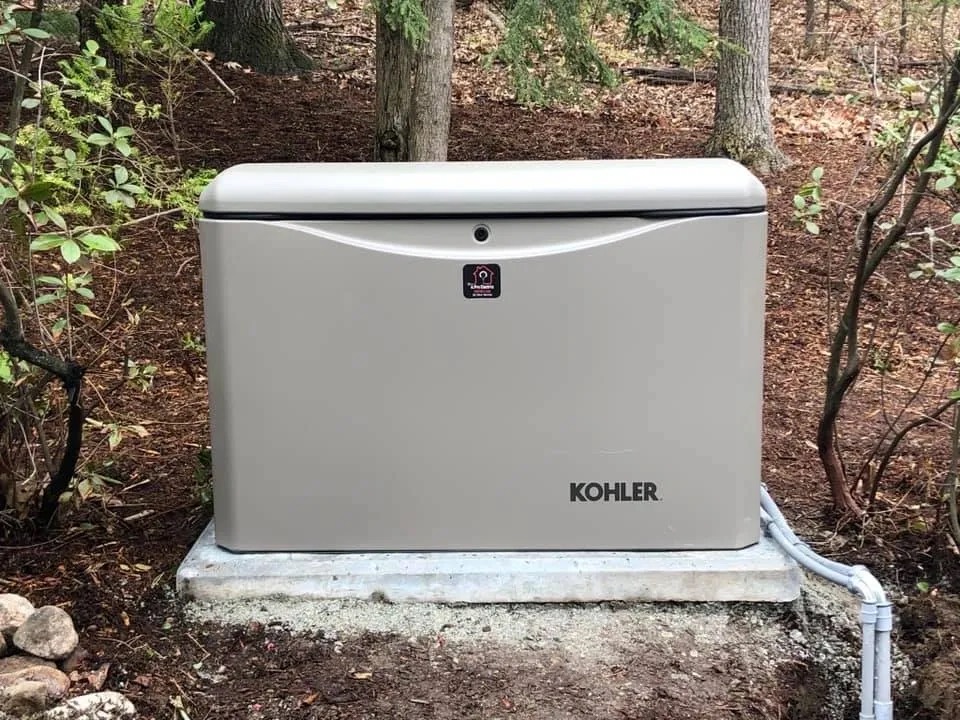
A standby generator sits on a pad, runs on propane or natural gas, starts itself when the power goes and shuts down when it returns. Installed, a standby system runs $10,000 to $20,000 depending on size and location, and that figure is the whole system with the unit included rather than the wiring alone.
The question that usually decides it is whether anyone is reliably home. A house that is empty during the week, or a Lakes Region property that sits unoccupied for months, gets nothing from a portable that nobody is there to start. That is also the case where the consequences of an unnoticed outage are worst, because a house with no heat in January does not stay undamaged for long.
What Size Standby Generator Does a New Hampshire House Need?
It is worked out from the running load of the circuits you want covered, plus the single largest starting surge, and that second part is where most oversizing happens.
Anything with a motor draws far more in its first second than it does once turning. A well pump that runs at a thousand watts can pull three thousand to start. The generator has to survive the worst moment, which is the largest motor starting while everything else is already running. So the correct sizing is running total plus the biggest single surge, not the running total plus every surge added together.
That distinction matters financially. Two motors almost never start in the same instant, and sizing as though they might buys thousands of watts of capacity that will never be used. It is the most common reason a showroom figure comes back larger than it needs to be.
Our generator sizing tool does exactly this calculation. Pick the circuits you want live and it gives the unit size that covers them, sized the way an electrician sizes it. What it cannot see is the nameplate on your actual well pump and furnace, the fuel supply, and where the unit can sensibly sit, which is why the real number comes from a visit.
Is a Standby Generator Worth It in New Hampshire?
It depends far more on where you are and how you live than on the state as a whole, and the honest answer for a house in the middle of Nashua is different from the answer for one at the end of a half-mile drive in Deering.
Outages here are a fact of winter. Ice storms take down conductors and limbs across the wooded parts of the state, and restoration is prioritized by the number of customers on a line. A dense street in Manchester or Concord gets attention early. A rural line serving a handful of houses in Weare, New Boston, Antrim or out towards Peterborough gets attention later, sometimes days later, and that difference is the entire argument.
The other multiplier is what the house depends on. A property on a private well has no water at all when the power goes, not reduced pressure but none, and a house with a septic pump has the same issue in the other direction. Add oil or propane heat that needs electricity to run the burner and circulators, and a rural New Hampshire house without power in February loses heat, water and waste at the same time.
Houses on municipal water and sewer in Manchester, Nashua and Concord have a genuinely lower stake in this. Rural properties around Henniker, Weare, Deering, Hillsborough and Antrim, Lakes Region houses at Meredith, Wolfeboro and Alton, and anything at the end of a long line, have a considerably higher one. If the outage also exposed how little capacity the panel had left, that is a service conversation rather than a generator one.
What Does a Standby Generator Cost to Install in New Hampshire?
A standby generator installed runs $10,000 to $20,000 depending on size and location, and that is the whole system rather than the electrical work in isolation. Location is doing real work in that sentence.
What moves it is the distance and difficulty between three points: where the unit sits, where the panel is, and where the fuel comes from. A unit on a pad beside the house, close to the panel, on an existing propane supply, is at the lower end. A unit that needs a long run to the panel, a new propane tank, a trench across a driveway, or a rock-heavy site for the pad, moves up.
Size is the other half. A unit covering a critical-loads panel in a modest house is a different machine from one carrying a large house with a heat pump, well pump and a full kitchen. Working out which one you need before pricing is worth doing, because the gap between them is substantial, and knowing the household load is the starting point for both questions.
There is also the fuel decision underneath it. Natural gas where it is available means no tank and no refueling. Propane, which is what most of rural New Hampshire uses, means a tank sized for a meaningful run time, and that is a real part of the planning rather than an afterthought.
Does a Standby Generator Need Maintenance?
Yes, and it is the part people underestimate when they buy one. A standby generator is an engine that sits outside doing nothing for months and is then expected to start, take load and run for days, in the worst weather of the year, usually unattended.
They self-exercise, typically running for a short period weekly or monthly to circulate oil and keep everything free. That is automatic and it is the minimum rather than the whole of it. Oil and filters need changing on a schedule, the battery needs replacing every few years and is the single most common reason a generator fails to start, the air filter needs attention, and the transfer switch and connections should be checked.
The failure nobody plans for is discovering the problem during the outage. A generator that has not been serviced is a generator you find out about at two in the morning in an ice storm, which is precisely when nobody is available to fix it and when emergency call-outs are at their busiest.
For a property that is unoccupied for stretches, whether a second home on Winnipesaukee or a house whose owners travel, remote monitoring is worth having. Knowing the generator failed is considerably better than arriving to find out what happened while it was failing.
How Do You Decide on a Standby Generator for a New Hampshire Home?
Work out what you actually need running, size the unit to that rather than to the house, and be honest about whether anyone will be home to start a portable.
For most houses the sequence is the same. Decide between critical loads and whole house, which is the decision that drives everything else. Size the unit from the circuits, not from the square footage. Establish the fuel, because propane tank sizing and natural gas availability change the plan. Then site it, which involves the distance to the panel, the noise, the neighbors and what the town requires.
The transfer switch is not part of the decision, because there is no version of this without one. It is the piece of the installation that makes everything else legal and safe, and it is what the inspector checks first.
A standby generator earns its cost in proportion to how long your power stays off and how much the house depends on it, which in practice means rural properties, houses on wells, and anything left unoccupied get far more from one than a house on a city street. We size, install and wire standby and portable systems across Henniker, Concord, Manchester, Nashua, Laconia, Meredith, Wolfeboro, Keene and the rural towns between them, and we will tell you when a portable and an interlock would do the job for a fraction of it.
Last updated
Standby Generator Questions, Answered
Can I Plug a Generator Into a Dryer Outlet?
No. Backfeeding a house through an outlet with a double-ended cord can push power onto the utility line and kill a line worker restoring your supply. It is illegal, it is lethal, and a proper inlet with an interlock costs around $650 and does the same job safely.
How Long Can a Standby Generator Run Continuously?
On natural gas, effectively indefinitely, since the fuel supply does not run out. On propane it is decided by tank size and load, which is why tank sizing is part of the planning rather than an afterthought. Either way they need an oil change at intervals during an extended run.
How Loud Is a Standby Generator?
Noticeable but not intolerable, and modern enclosures are considerably quieter than older units. It matters most for siting, particularly where houses are close together or where a bedroom window faces the pad. Weekly self-exercise is short but it happens at the same time every week, so the timing is worth setting deliberately.
Does a Generator Need to Be Serviced Every Year?
Yes. Oil and filters on a schedule, and a battery that needs replacing every few years, which is the single most common reason a standby generator fails to start when it is finally needed. A unit that has not been serviced is one you find out about during the outage.
Will a Generator Run a Well Pump?
Yes, provided it has been sized for the starting surge. A well pump running at a thousand watts can pull three thousand to start, and that surge is what the generator has to survive. On a rural New Hampshire property the well pump is usually the load that sets the size of the unit.
Do I Need a Permit for a Standby Generator?
Yes. The electrical work is permitted and inspected, and the transfer switch is the first thing an inspector checks. There may be siting requirements from the town as well, covering distance from the house and from the property line, and that is worth establishing before the pad goes in.
Is a Whole-House Generator Worth It Over a Critical Loads Panel?
Only if you genuinely want the house to behave normally during an outage, because it needs a larger unit and usually load management. A critical loads panel covering heat, water, refrigeration and some lighting handles what actually matters for a fraction of the size, and for most houses it is the better value.
The Work Behind This Guide
More Guides for Homeowners
How to Tell If Your Electrical Panel Needs Replacing
The signs worth acting on, the panel brands insurers flag, and how to tell a full panel from an unsafe one.
Knob and Tube Wiring in New Hampshire
How to recognize it, why insurers ask about it, and what removing it actually involves.
What Size Electrical Service Does a House Need?
100, 150 or 200 amps, what pushes a house from one to the next, and how to work out where yours sits.