

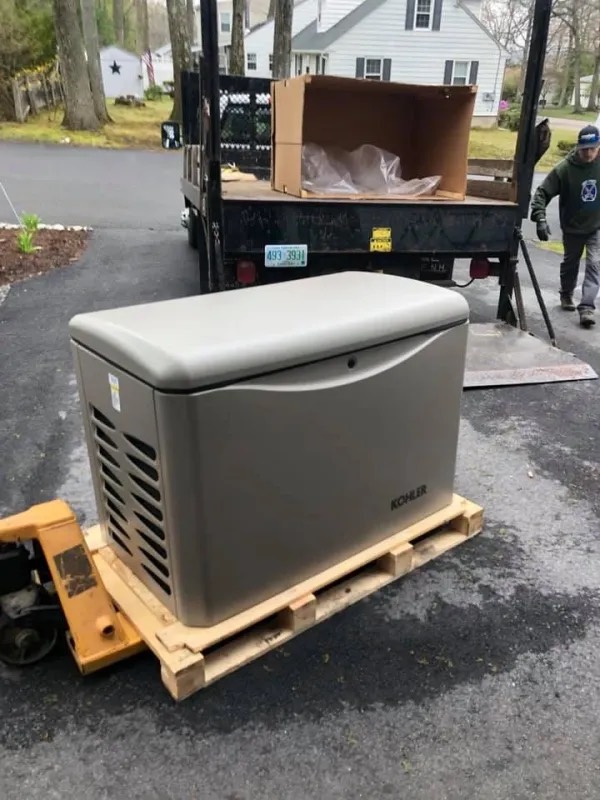
Standby Generator Replacement in New Hampshire
When a set is past economic repair, parts have dried up, or the house has outgrown it. Reusing what is sound, replacing what is not.
Replacing a Standby Generator at a New Hampshire Property
When a Standby Generator Is Worth Replacing
Three things end a generator’s working life, and only one of them is the engine wearing out.
Parts availability is the most common and the most frustrating. A set that runs perfectly well can become unmaintainable because a control board, a regulator or a specific switch is no longer made, and the point at which that happens has nothing to do with the condition of the machine. It is worth knowing a set is approaching that point before it fails rather than after.
Capacity is the second. Houses change. A heat pump, an addition, an EV charger, a hot tub or a finished basement all arrive after the generator was sized, and a set that comfortably carried the house in 2014 may not carry it now. That shows up as a generator that stalls or struggles during an outage rather than as a fault.
Genuine wear is the third and usually the latest to arrive. A well-maintained residential standby set has a long life, and the ones that fail early almost always did so because nothing was ever serviced.
There is a fourth that is worth naming because it is often the real trigger: confidence. A household that has watched a set fail to start during two consecutive outages stops trusting it, and no amount of arithmetic about remaining life addresses that. Where a generator exists specifically so nobody has to worry during a storm, a generator nobody believes in has already stopped doing its job.
Repair or Replace, and How That Decision Actually Goes
The arithmetic is usually clearer than people expect once the numbers are on the table.
A repair worth doing is one where the fault is identifiable, the parts exist, and the cost is a modest fraction of replacement on a set that is otherwise sound and adequately sized. Plenty of faults fall into that category, and replacing a generator that needs a battery and a regulator would be a waste.
The figure worth holding in mind is roughly half. Once a repair approaches half the cost of replacing the set, and the set is past the midpoint of its likely life, the money is usually better spent on the newer machine with a warranty behind it.
It stops being worth it when the parts are scarce, when the fault is one of several accumulating, or when the set was already undersized for the house. Spending meaningfully on a generator that will still be too small afterwards is the version of this that goes wrong most often.
Age on its own is not the test. A fifteen-year-old set that has been serviced and still suits the house is a different proposition from an eight-year-old one that was never touched, and the honest answer comes from looking at it rather than from the year on the plate.
Service history is what makes that assessment possible at all. A set with a record of load tests, battery replacements and hours run can be judged on evidence. One with no history is an unknown quantity, and the honest answer on those is frequently to service it properly once, see what that reveals, and decide afterwards rather than replacing on suspicion.
Reusing the Pad, the Conductors and the Transfer Switch
A replacement is usually cheaper than the original installation, because a good deal of the work was done the first time and does not need doing again.
The pad is frequently reusable if it is sound and the footprint matches, though modern sets are not always the same size as what they replace and clearances have to be re-checked rather than assumed. A pad that has heaved or cracked through a few New Hampshire freeze cycles is a different matter.
The conductors between the set and the transfer switch are often fine, subject to size and condition. Where the replacement is larger than the original, they may not be, and that is established before anything is ordered rather than discovered at commissioning.
The transfer switch is the one to look at hardest. It is the same age as the generator it came with, it has sat in one position for years, and it is the component most likely to be at the end of its life at the same moment. Sometimes the right answer is replacing the switch alongside the set, and it is cheaper done together than separately.
What does not carry over is the assumption the original installation was right. A set undersized from the start, or sited where clearances have since tightened, gets corrected at replacement rather than reproduced. The survey exists partly to catch that, because inheriting somebody else’s decision is the weakest reason to repeat it.
Sizing the Replacement to the House as It Is Now
A replacement is the natural moment to correct a size that was wrong or has been outgrown, and it is the cheapest time to do it.
The right approach is to size from scratch rather than matching the old plate. What the house demands now, what has been added since, and what is realistically coming in the next few years all belong in that calculation. Replacing like for like carries forward a decision made from a different house.
Motor starting current is the part that decides it on rural properties. A well pump, a septic pump and a furnace blower all draw several times their running current at the instant they start, and a set sized on running figures alone will stall trying to start them together.
Where the honest answer is that the house needs a larger set than the budget allows, a critical loads panel is frequently the resolution: a smaller generator carrying a deliberately limited set of circuits, rather than a larger one carrying everything. The generator sizing calculator gives an honest picture before the conversation.
Swapping a Set Without a Long Outage
A replacement is less disruptive than the first installation, because the infrastructure is already there.
The utility supply is untouched for most of the work. The old set is disconnected and removed, the new one is set and connected, and the house stays on utility power throughout apart from a short interruption while the transfer switch is worked on, if it is being worked on at all.
The scheduling constraint is usually the set rather than the electrician. Standby generators are ordered rather than stocked, and lead times move with demand, which rises sharply after a major storm across the region. A replacement planned in September is a different experience from one arranged in the week after an ice storm.
Access is the other practical constraint and it is easy to overlook on a property where the original set was rolled into position years ago. Landscaping matures, fences go up, decks get built, and a route that existed at the original installation may not exist now. Establishing how the old set leaves and the new one arrives belongs in the survey rather than on the morning of the swap.
Where a household cannot be without backup in the interval, a temporary arrangement through a portable generator hookup covers the gap, and on a house that already has the wiring it is a small job.
What Has Changed in Code Since the Original Install
A replacement is inspected against current requirements rather than the ones that applied when the first set went in, and that occasionally surprises people.
Clearances are the most common place it bites. Requirements for distance from openings, windows, doors and fresh air intakes have tightened, and a position that was acceptable when the original was installed may not place a new set legally. Where that happens the pad moves, and the conductor run changes with it.
Bonding and grounding arrangements are the other area that has moved on. What was acceptable practice on an older installation is not always what is required now, and it is one of the things an inspector will look at closely.
None of this is a reason to avoid replacing a set. It is a reason for the survey to happen before anything is ordered, so the quote reflects the installation that will actually pass rather than the one that is already there.
Removing and Disposing of the Old Set
The old generator has to leave, and it is not a skip item. Fuel, oil, coolant and a battery all have to be dealt with properly, and on a propane or natural gas set the fuel connection is disconnected and capped by whoever is qualified to do it.
Removal is part of the job rather than something left for the household to arrange. A disconnected generator sitting on a pad is a hazard and an eyesore, and moving one is not a two-person lift.
Timing it matters on a winter replacement. The house has no backup between the old set leaving and the new one being commissioned, and on a property where that gap falls in January it is worth covering with a temporary arrangement rather than hoping the weather holds for a fortnight.
Sets with genuine residual value occasionally find a second life, and where that is realistic it is worth raising, because it offsets a little of the replacement. A set that has reached the end of its parts availability rarely has much value beyond scrap, and saying so honestly is more useful than implying otherwise.
Either way the fuel connection is capped and made safe by whoever is qualified for that fuel, which on a propane or natural gas set is not the electrician. Coordinating that so it happens on the right day rather than a week later is part of running the job properly.
What remains afterwards is a pad, a conductor run and a working installation, which is most of what makes the next replacement cheaper than this one.
Documentation goes with it. The new set comes with its own manuals, warranty registration and service schedule, and the replacement is the right moment to start a record rather than inheriting a gap. On a house likely to be sold within the life of the generator, that record is worth more than it looks.
Keeping the Replacement Working Longer Than the Last One
The most common reason a residential standby generator reaches the end of its life early is that nothing was ever done to it.
A set that is serviced annually, load tested, and has its battery replaced on a schedule will considerably outlast one that self-exercised for a decade and was otherwise untouched. That is not a maintenance pitch so much as the difference between the two outcomes we see.
A replacement is the natural moment to start that, because the baseline is known from day one and everything afterwards is measured against a set that was working properly at handover.
Annual generator servicing covers what that involves, and the record it builds is what makes the next repair-or-replace conversation a matter of evidence rather than guesswork.
What a Generator Replacement Covers
- Survey of the existing set, pad, conductors and transfer switch
- Honest repair-or-replace assessment before anything is ordered
- Fresh load calculation sized to the house as it is now
- Removal and responsible disposal of the old set
- New generator set, positioned to current clearance requirements
- Reuse of sound pad and conductors where they suit the replacement
- Permit, inspection and a live load test at handover
When a Generator Needs Replacing
- Parts for it are getting scarce or no longer made
- It stalls or struggles when the house is on it
- The house has added heating, an EV charger or an addition since it went in
- Repairs are becoming frequent rather than occasional
- It failed during the last outage it was needed for
Generators & Backup Power Questions, Answered
How Long Does a Standby Generator Last?
A well-maintained residential set lasts a long time, and parts availability usually ends its life before the engine does. Sets that fail early have almost always never been serviced.
Can I Reuse My Existing Pad and Wiring?
Often yes, if the pad is sound and the footprint and clearances still work, and if the conductors suit the new set. Both are checked at the survey rather than assumed, because a larger replacement can change either.
Do I Have to Replace the Transfer Switch Too?
Not always, but it is the same age as the generator and it is the component most likely to be near the end of its life at the same time. Where it is, doing both together costs less than doing them a year apart.
How Long Will I Be Without Backup?
The house stays on utility power throughout apart from a short interruption if the switch is being worked on. The real wait is the lead time on the set itself, which lengthens sharply after a major regional storm.
Should I Buy the Same Brand Again?
Not necessarily. Sizing and parts availability matter more than the name, and a replacement is the right moment to reconsider rather than to default.
Is It Cheaper Than the Original Installation?
Usually, because the pad, the conductor run and often the switch already exist. How much cheaper depends on how much of that survives the survey.
Guides on Generators & Backup Power
Standby Generators: What They Cover and What They Do Not
Whole-house against essential circuits, automatic against manual, and what a transfer switch is for.
Getting a Home Ready for a New Hampshire Winter
Outage backup, heat cables for ice dams and frozen pipes, winter heating load, and outdoor power before the snow.
More Generators & Backup Power
Portable Generator Hookup
Inlet, interlock and permit, so a generator you own can run the house safely.
Automatic Transfer Switch Installation
The switch that moves the house onto the generator, sized to the service.
Critical Loads Panel
The subpanel that decides which circuits stay live in an outage.
Generator Servicing & Load Testing
The annual visit, tested under real load, with a written record.
Home Battery Backup
Grid-charged battery backup, silent and instant, sized in hours.
All generators & backup power work, including what a full installation involves and what it costs.