

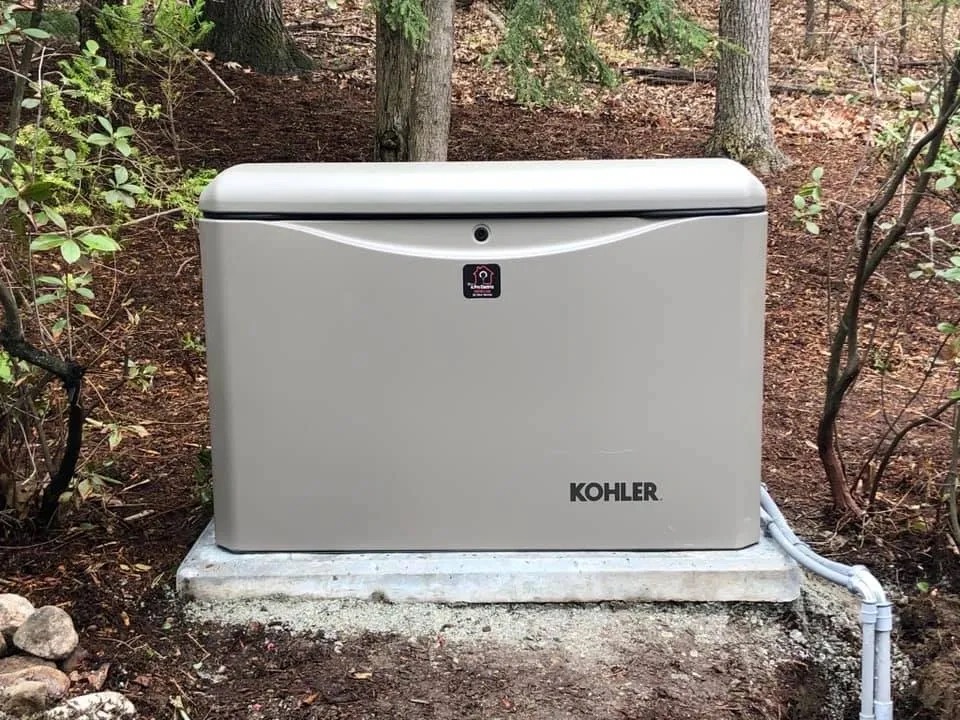
What Size Generator for a 400 Amp Service in NH, Sized From the Whole Property
What size generator for a 400 amp service in NH depends on what the property runs in an outage, and a 400 amp service usually means a large house, a second panel, a workshop or an outbuilding, so the answer starts with a list of buildings and circuits and not with the amp rating.
How to Work Out the Generator Size for a 400 Amp Service in New Hampshire
What a 400 Amp Service Means for Generator Size
A 400 amp service at 240 volts can deliver up to 96,000 volt-amperes, twice the 48,000 of a 200 amp service. The figure sounds like a reason to buy a very large generator and almost never is one. It describes the most the property could draw from the utility and says nothing about what you will want running when the utility is gone, which is why the sizing method is the same as for any service, a list of circuits, their running watts and the largest single motor start.
What a 400 amp service does tell you is something about the property. Nobody installs 400 amps for a modest house. It usually points to a large home with electric heat or a heat pump and an electric kitchen, or a main house with a second dwelling or a shop on the same supply, or a farm or small business with outbuildings. Those are the places where the list of circuits is long and where a careful list saves the most money.
Three realistic properties are worked through below, with the choices that follow from each. The method behind the numbers is explained in standby generator sizing, and generator size for a 200 amp service covers the single-panel house. Our guide to what size electrical service a house needs explains how a service rating is worked out, and the generator sizing calculator does the arithmetic for any list of circuits.
How a 400 Amp Service Is Built and Why It Matters for the Generator
Two arrangements both get called a 400 amp service. In the first, one 400 amp meter and main feeds two 200 amp panels, often a main house panel and a second panel for a wing, a garage or a shop. In the second, a single large panel is fed by a 400 amp main. Both can carry the same load, and they behave differently when a generator is added, because the transfer equipment follows the way the supply is divided.
With two panels, each panel can have its own transfer arrangement, so one can be on the generator and the other left off, which is a convenient way of splitting essential circuits from the rest. With a single large panel, the choice is between a large whole-house switch and a critical loads panel carrying a chosen set of circuits. We look at how the service is actually built before anything is specified, and we note whether the meter socket, the main and the panels are rated for what is being asked of them.
Where the original installation has been added to over the years, which is common at this size, it is worth knowing which loads sit on which panel before the circuit list is made. A well pump on the second panel and a furnace on the first needs a transfer arrangement that covers both, and that is easier to plan than to discover.
Generator Size for a 400 Amp Property With a House, an Apartment and a Workshop
Consider a large house with a small in-law apartment and a detached workshop, all on one 400 amp supply. On the typical figures in our sizing tool, the main house essentials, a boiler, refrigerator, freezer, well pump, lights, internet and a microwave, add up to 6,300 watts. The apartment needs a refrigerator at 700 watts, lights and outlets at 1,000, internet at 300 and a mini-split at 1,200, which is 3,200 watts. The workshop and garage door add 1,500.
The running load across the whole property is 11,000 watts. The largest single start is the well pump at 3,000, so the required size is 14,000 watts, or 14 kilowatts. A margin and a round up to a unit that is actually sold gives a generator a little above that. Set beside a 400 amp service that can deliver 96,000 volt-amperes, it is about a seventh of the supply, and it keeps heat, water, food and light on in every building on the property.
What makes this a 400 amp question rather than a 200 amp one is the number of places the generator has to reach. The house, the apartment and the workshop may be on different panels, and the cable between them has to carry the load without excessive voltage drop. We plan the feeders and the transfer arrangement for the whole property at once, so the generator serves all three and nothing has to be added later at a premium.
Generator Size for a 400 Amp House With Electric Heat and a Heat Pump
Now take a large, mostly electric house. The essentials are 6,300 watts. A whole-house heat pump adds 4,500 and an electric water heater 4,500, an electric range 5,000, a dryer 5,000 and a dishwasher 1,200, with a workshop and garage door at 1,500. The running load comes to 28,000 watts. The heat pump is the largest start at 9,000, so the required size is 37,000 watts, or 37 kilowatts.
That is a large generator, and a household that wants to run everything on it should know what it is buying. Units of that size tend to be liquid-cooled, which costs more to buy and to install, with a bigger fuel supply and a larger pad. Many households find, on reflection, that they do not need the range, the dryer and the water heater on at once, and they choose load management or a critical loads panel to bring the generator down to what actually runs together.
An EV charger deserves a separate mention. A charger drawing 48 amps at 240 volts is 11,520 watts, which is more than all the essentials in the first example put together, and it runs for hours. Most households leave it off the generator, and where it is on, load management makes it wait. Whatever is chosen, it is better decided before the generator is sized than after.
Transfer Switch Options for a 400 Amp Service
A 400 amp service gives three realistic options for connecting a generator. One is a single service-entrance rated automatic transfer switch rated for 400 amps, which puts the whole supply on the generator. A second is two smaller switches, one in front of each 200 amp panel, which lets each panel be treated separately. The third is a critical loads panel or two, which carry only the chosen circuits and let the generator be far smaller than the service.
The first suits a household that wants everything on and has a generator large enough to carry it, and it pairs naturally with load management. The second suits a property whose panels serve different buildings or different functions. The third suits the most common case, a large service with a modest essential load, and is covered in our page on the critical loads panel. Each is permitted, inspected and tested under load.
A switch rated for 400 amps is a substantial piece of equipment, and its cost and its physical size are part of the decision. A switch that large only makes sense if the generator behind it is large enough to use it, which is one more reason the circuit list comes first and the equipment second.
Load Management on a 400 Amp Property so One Generator Does More
Load management is the practice of letting large loads take turns on the generator so the unit does not have to be sized for all of them together. On a 400 amp property it is often the difference between a generator that fits and one that does not. The electric range, the dryer, the water heater, the heat pump and the EV charger are the large loads, and most of them are not needed in the same minute.
In a simple arrangement, a controller watches the generator and disconnects the large appliances when the total rises toward its limit, then reconnects them when there is room. In a more deliberate arrangement we set the priorities, so the well pump and the heat can never be dropped for the sake of the dryer. We choose the arrangement to suit the household and we label what is controlled, so the behavior in an outage is something the owner understands before it happens.
Load management does not cure an undersized generator, and we do not sell it as one. It lets a correctly sized unit cover a larger house in practice. The sizing figure is still the running load of what actually runs together plus the largest start, and the management decides what that is.
Fuel Supply and Siting for a Larger Generator on a 400 Amp Property
A larger generator draws more fuel, and fuel is where large installations are most often caught out. A natural gas unit needs a line and a meter that can supply it alongside the rest of the property, and a larger unit may call for a larger line or a new meter, which is coordinated with the gas supplier and a licensed gas fitter. A propane unit needs a tank large enough for the outage you are planning for, and delivery arrangements that do not rely on the road being clear.
Siting follows the same logic as fuel. The unit needs clearance from the building and from openings, space for air and service access, and a route to the panel short enough to hold voltage drop down. On a large property with several buildings, the best place for the generator may be central, and the cable then runs a long way in two directions. We plan the position with the cable runs and the fuel together, because a position that works electrically and not for fuel, or the reverse, is the commonest reason for a second visit.
Cold shapes it as well. A generator on an exposed New Hampshire site needs a housing that keeps drifting snow off the air intake and the exhaust, and an engine that starts in January, with a block heater and a battery kept warm. Those details are specified as part of the installation and not left as extras.
When a 400 Amp Property Needs More Than One Generator
A large property sometimes has a reason to run more than one generator. A barn or a shop a long way from the house is expensive to reach with a feeder that can carry a large load, and a small portable at the outbuilding with a proper portable generator hookup may serve it at a fraction of the cost. A second dwelling that is rented may want its own supply, so the tenant and the owner are not on the same switch.
The comparison is about distance. Cable is sized for current and for length, and a long run to carry a large load needs a large conductor, which is expensive. Where the distant building has a small essential load, a small local generator is often the better answer than a large one at the house and a long feeder. We price both on the same site walk so the comparison is real.
Whatever is chosen, each generator has its own transfer arrangement, so there is never a path for power to flow back to the utility. That is the one non-negotiable part of any generator connection, and it is the reason these installations are permitted and inspected.
What We Measure Before Quoting Generator Size for a 400 Amp Service
A 400 amp quote begins with a walk of the whole property and not only the house. We note how the service is built, how many panels there are and what each serves, the nameplates on every large motor and appliance, the distances between buildings, the fuel already on site and the places a generator could stand. We open each panel to see its brand, its condition and its free spaces, because a generator tied to a tired panel inherits its problems.
Then we ask what matters in an outage. Who lives where, what has to stay warm, whether animals or equipment depend on power, whether anyone works from home and what the property has to do on the worst night of the winter. The answers produce the circuit list, and the list produces the size, the transfer arrangement and the fuel plan.
The scope that results is a written description of the generator size, the number and position of transfer switches, the feeders and the fuel supply, checked against the load list. It forms part of a full standby generator installation in NH, permitted, inspected and tested under load.
Generator size for a 400 amp service in NH is set by what the whole property runs in an outage, and A. Pro Electric is a licensed master electrician in Henniker who walks the property and sizes it from the nameplates.
What a Generator Size for a 400 Amp Service Includes in Our Quote
- A walk of the whole property and a circuit list for every building
- A written generator size from running watts plus the largest motor start
- Transfer switch options for the way the 400 amp service is built
- Feeder routes and voltage drop worked out for outbuildings
- Fuel supply and position settled together
- Permit pulled, inspection attended and a load test before we leave
Signs You Need Generator Sizing for a 400 Amp Service in NH
- Your service is 400 amps and every dealer gives a different generator size
- The property has a house, a second dwelling, a shop or a barn on one supply
- The house has electric heat, a heat pump or an EV charger
- You are unsure whether one generator or two makes sense
- You want to know what a large generator would actually run
Generator Size for a 400 Amp Service Questions, Answered
Does a 400 Amp Service Need a 400 Amp Generator?
No. A generator is rated in watts or kilowatts, and a machine that matched a 400 amp service would be about 96 kilowatts, an industrial unit that no household needs. The size comes from the circuits you choose to run, which usually comes to a small fraction of that.
What Size Generator Runs a Large House on a 400 Amp Service?
It depends on the list. By the sizing method, a house with an apartment and a workshop on essential circuits comes to about 14 kilowatts, and a large all-electric house running everything at once comes to about 37. Load management brings the second figure down in practice.
Can I Put a Generator on Just One of Two 200 Amp Panels?
Yes. Each panel can have its own transfer arrangement, so one can be on the generator and the other left off. It is a tidy way of splitting essential circuits from the rest, provided we know which loads sit on which panel before the arrangement is chosen.
Will a 400 Amp Property Need a Bigger Gas Line for the Generator?
It can. A larger generator draws more fuel, and the gas line and meter have to supply it alongside everything else on the property. That is checked with the gas supplier and a licensed gas fitter before the unit is chosen, so the fuel is settled before the generator is ordered.
Is It Cheaper to Run Two Smaller Generators Than One Large One?
Sometimes, when a building is far from the house and has a small essential load. A long feeder to carry a large load costs a lot in cable, and a small local generator may cost less. Two units also mean two transfer arrangements and two servicing schedules, so we price both options on the same walk.
Do I Need a Liquid-Cooled Generator for a 400 Amp Property?
The amp rating does not decide it, the calculated size does. Larger units tend to be liquid-cooled, so a property that really needs to run everything may end up there, while a property sized for essentials usually does not. We choose after the load list is complete.
Can One Generator Run Both a House and a Barn?
Yes, with a feeder between them sized for the load and the distance, and a transfer arrangement that covers both. On a long run the voltage drop is the limit, which is the point at which a separate small generator at the barn can be the better answer.
How Do I Add an EV Charger to a Property That Has a Generator?
Decide early whether it is on the generator at all. A 48 amp charger is 11,520 watts for hours, so most households leave it off or let load management hold it back. If it has to run, it is counted in the size from the start rather than added afterward.
Guides on Generators & Backup Power
Standby Generators: What They Cover and What They Do Not
Whole-house against essential circuits, automatic against manual, and what a transfer switch is for.
Getting a Home Ready for a New Hampshire Winter
Outage backup, heat cables for ice dams and frozen pipes, winter heating load, and outdoor power before the snow.
More Generators & Backup Power
Portable Generator Hookup
Inlet, interlock and permit, so a generator you own can run the house safely.
Automatic Transfer Switch Installation
The switch that moves the house onto the generator, sized to the service.
Critical Loads Panel
The subpanel that decides which circuits stay live in an outage.
Generator Servicing & Load Testing
The annual visit, tested under real load, with a written record.
Generac Generator Installation
The brand we fit most often, sized to the house and commissioned under load.
Generator Replacement & Upgrades
Replacing a set that is past parts, past repair or too small for the house.
Standby Generator Sizing
How to size a standby generator from the circuits you keep on, for 100 to 300 amp service.
Generator Size for a 200 Amp Service
What size generator a 200 amp house needs, worked from the circuits and not the service.
All generators & backup power work, including what a full installation involves and what it costs.