

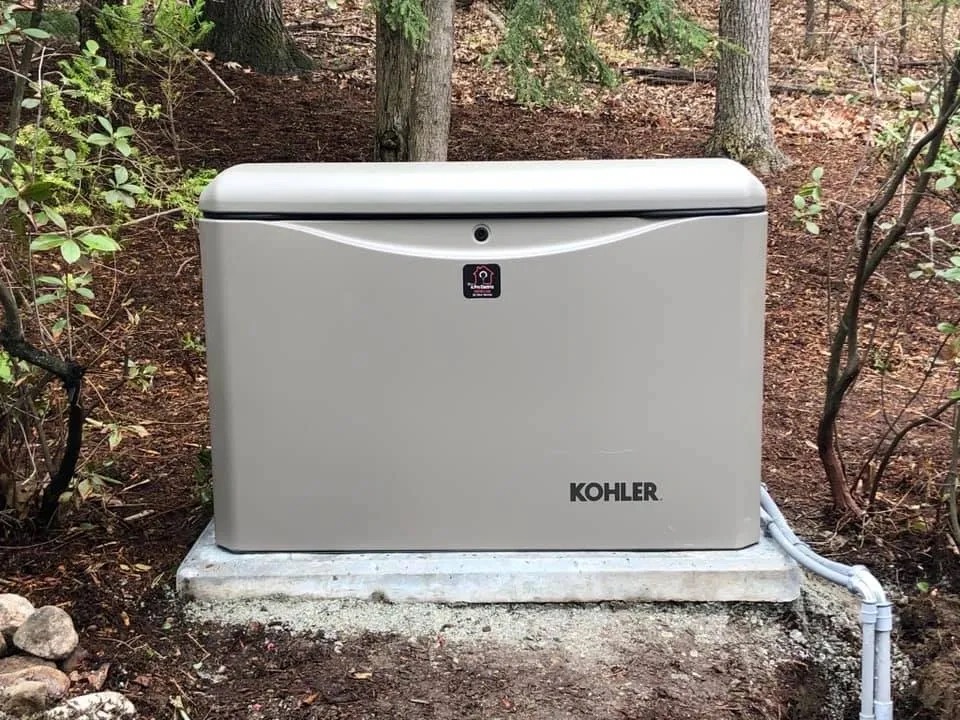
Standby Generator Sizing in NH, Worked Step by Step for 100 to 300 Amp Service
Standby generator sizing in NH starts with a list of what must keep running, then adds the running watts and the single largest motor start, and the same method works for a house with a 100, 125, 150, 200 or 300 amp service.
How Standby Generator Sizing Works for a New Hampshire Home
Standby Generator Sizing in NH, the Method in Four Steps
A standby generator is sized from the circuits you want to keep alive, and the work comes down to four steps that anyone can follow with a pencil and then check against the nameplates on the equipment in the house.
The first step is the list. Write down every circuit that has to work in an outage, usually the heating system, the well pump, the refrigerator and freezer, the sump pump, some lights and outlets and the internet. Then decide about the large appliances, the electric range, the dryer, the water heater and the air conditioning, one at a time.
The second step is the running watts. Each item has a running load in watts, found on the nameplate or, until then, taken from typical figures such as 800 for a furnace or boiler, 700 for a refrigerator and 1,000 for a well pump. Add them together.
The third step is the single largest start. Anything with a motor draws more for its first second, a well pump perhaps 3,000 watts against 1,000 running. Take the largest one, once, and add it. Two motors almost never start together.
The fourth step is the margin and the next real size. A generator should not run at its ceiling, so the total gets headroom and is rounded up to a unit that is actually sold, read against the rating for the fuel you will use. That is the generator size. Our generator sizing calculator does the arithmetic as you pick the circuits.
Standby Generator Sizing for 100, 125 and 150 Amp Service
A 100 amp service at 240 volts can deliver 24,000 volt-amperes, 125 amps is 30,000 and 150 amps is 36,000. Those services are common in older houses, and they matter for generator sizing in two ways that have little to do with the generator.
The first is the panel behind a small service, which is often old and full. A house with a 100 amp service and a fuse box, or a panel with no spare spaces, has less room for the transfer equipment and less capacity for loads you may want to add, and the honest advice may be to look at panel and service upgrades before the generator or alongside it. The second is the essential load on a small-service house, which is usually modest, since it often means a smaller house with an oil boiler, so a generator sized from the essential circuits can be small.
The worked example for essentials, 6,300 watts of running load plus a 3,000 watt well pump start for 9,300 watts, applies to a 100 amp house as much as to a 200 amp one, because the circuits are the same. What differs is that the 100 amp house has less spare capacity if it also wants a heat pump or a hot tub, which is a question for the service and not for the generator.
Standby Generator Sizing for a 300 Amp Service
A 300 amp service is 72,000 volt-amperes, an unusual size in ordinary houses and common in large homes with electric heat, two kitchens or a pool, and in small commercial buildings. The method does not change but the list does. A property at this size has more buildings, more large motors and more loads that can be separated.
Two companion pages work through the cases that come up most. Generator size for a 200 amp service covers the single-panel house, and generator size for a 400 amp service covers the large property with several buildings. A 300 amp service sits between them, and which one it resembles depends on whether it is one big house or several buildings.
Commercial properties at 300 amps have a different problem, which is that a business decides what an hour of downtime costs, and that decision sizes the system. For those we do commercial generators and standby power, sized the same way from connected load.
Do You Need a Standby Generator in New Hampshire
Not every house does, and a good installer says so. The case for one is strongest in a state where most houses cannot heat themselves without power. According to the U.S. Census Bureau American Community Survey estimates for 2020 to 2024, about 80 percent of occupied homes in New Hampshire heat with fuel oil, utility gas or propane, and the burner, igniter, blower and circulator pumps in every one of those systems need house power. Only about 11 percent heat with electricity and about 6 percent with wood.
Other reasons are about the house and not the heat. A house on a well has no water when the pump stops, a house with a basement sump can flood, and a house that is empty for the winter has nobody to notice any of it. The same estimates count about 10.1 percent of New Hampshire housing units as held for seasonal, recreational or occasional use, and those are the houses where a generator that starts by itself is worth the most.
The honest alternative for an occupied house is a portable generator with a proper portable generator hookup, which costs a fraction of a standby installation and does the same job while somebody is home to start it. It is the wrong answer for a house that stands empty and a good one for a house that does not. We say which we think fits, and the sizing method is the same either way. Our guide to standby generators explained sets out what a generator covers and what it does not.
Running Watts, Starting Watts and Why Generator Sizing Goes Wrong
Running watts are what a machine draws once it is going and starting watts are what it draws in its first second. For anything with a motor the two are far apart, and the gap is where undersized generators come from. On the typical figures in our sizing tool, a furnace or boiler runs at 800 watts and starts at 1,600, a refrigerator runs at 700 and starts at 2,200, a chest freezer runs at 500 and starts at 1,500, and a well pump runs at 1,000 and starts at 3,000.
A sump pump runs at 800 and starts at 2,400, a septic pump at 600 and 1,800. Central air conditioning runs at 3,500 and starts at 8,000, a mini-split at 1,200 and 2,900, and a whole-house heat pump at 4,500 and 9,000. Resistive loads such as a range, a dryer or a water heater have no starting surge, and run at about 5,000, 5,000 and 4,500 watts.
These are typical figures, conservative on purpose because undersizing is the failure that matters. The nameplate on your own equipment replaces them, and it is the reason a site visit comes before a quote. A well pump that runs at 800 and one that runs at 1,400 can sit in two houses on the same street.
Standby Generator Sizing Mistakes That Cost Money
Four mistakes account for most of the bad numbers, and each one pushes the size the wrong way.
The first is sizing from the amp rating of the service. A 200 amp service is 48,000 volt-amperes of delivery capacity and says nothing about what the house will run in an outage, so a generator chosen to match it is far larger than anyone needs.
The second is adding every starting surge together. Motors do not start at the same instant, so the sum of the surges describes an event that does not happen, and it inflates the size by thousands of watts. The largest single start, added once, is the figure that matters.
The third is sizing with no margin or on the wrong fuel rating. A generator that runs at its ceiling for hours wears quickly, and a natural gas rating is lower than a propane one, so a unit that is just big enough on propane can fall short on gas.
The fourth is forgetting what is coming. A heat pump or an EV charger added after the generator is installed can double the load, which is why we ask about plans for the next few years and count the likely ones in the calculation.
Natural Gas, Propane and the Rated Output of a Standby Generator
The nameplate size of a standby generator is a rating for a particular fuel, and the same machine produces less on natural gas than on propane. Manufacturers publish both figures, and the sizing has to be done against the one that applies. A house on utility gas should read the natural gas rating, and a house with a propane tank the propane one, and the two can differ enough to move a unit from adequate to short.
Fuel supply decides how long the unit can run and how large it can be. A natural gas unit needs a line and a meter that can feed it alongside the furnace and the range, which is checked with the gas supplier and a licensed gas fitter, and a propane unit needs a tank sized for the outage you are planning for, with a delivery arrangement that does not depend on the roads. The electrical work is ours, and the gas fitting is coordinated with the people licensed for it.
Keeping the unit ready matters as much as choosing it. Fuel, battery, oil and the transfer switch all need attention on a schedule, and our standby generator servicing covers the annual visit, tested under real load with a written record.
Whole-House Coverage or Essential Circuits for a Standby Generator
The biggest decision in standby generator sizing is not a number, it is whether the generator carries the whole house or a chosen set of circuits. A whole-house arrangement uses an automatic transfer switch in front of the panel, so every circuit is available and the generator is sized to what you will run at once. An essential-circuits arrangement uses a critical loads panel, so only the chosen circuits are ever on the generator and the unit can be much smaller.
Neither is wrong. The essential route costs less and suits households that will accept a house that runs the heat, the water, the food and the lights without running the dryer. The whole-house route suits households that want no decisions in an outage, and with load management it needs a smaller generator than the connected load would suggest.
We lay out both options with the generator size each one implies, so the choice is made with the cost of each in front of you. Most households that look closely at the circuit list find that the essential route covers what they actually care about.
What a Standby Generator Installation Costs and What Drives It
Austin quotes a standby generator at $10,000 to $20,000 installed, with the unit included, which is the whole system and not the electrical work alone. The spread is wide because the things that decide the price are specific to the house, and the size is only one of them.
The drivers are the generator size, the fuel and the length of the gas line or the propane arrangement, the distance from the generator to the panel, the transfer arrangement, and whether the panel needs work before the generator goes in. A larger unit on a long run with a new panel sits at the top of the range, and a smaller unit beside the panel on an existing gas line sits near the bottom.
That is the reason the visit and the written scope come before a price. A quote for a full standby generator installation in NH that names the generator size, the transfer arrangement, the fuel and the position can be checked line by line, and it keeps the number from moving after the work has started.
Standby generator sizing in NH is a list, a calculation and a site visit, and A. Pro Electric is a licensed master electrician in Henniker who does all three and installs the generator.
What Standby Generator Sizing Includes When You Ask Us for a Quote
- A circuit list worked out with you, from essentials to the large appliances
- Running watts and the largest motor start read from the nameplates
- A written generator size, with margin, against the rating for your fuel
- Whole-house or essential-circuits options with the size each one needs
- Fuel supply and position settled together
- Permit, inspection and a load test before we leave
Signs You Need Standby Generator Sizing Before You Buy a Unit
- You have two or three generator sizes from different dealers
- Your service is 100, 125, 150 or 300 amps and you are unsure what it means
- The house has a well, a sump pump or an oil or propane heating system
- The house stands empty for part of the winter
- You plan to add a heat pump, an electric range or an EV charger
Standby Generator Sizing Questions, Answered
What Is the Difference Between Generator Size and Service Size?
Service size is what the utility connection can deliver, measured in amps. Generator size is what the generator can produce, measured in watts or kilowatts, and it is chosen from the circuits you want to run in an outage. The two are related only through the transfer equipment, which has to suit the service.
How Do I Find Out How Many Watts My Furnace and Well Pump Use?
Read the nameplate, which shows the running current and voltage or the wattage. Multiply amps by volts if it shows only those. Until you have the readings, typical figures such as 800 watts for a furnace or boiler and 1,000 for a well pump give a reasonable first answer.
Can I Use the Sizing Calculator Instead of a Site Visit?
It is a good way to see the range and to compare options, and it uses the same method we do. A quote needs the real nameplates, the panel and the fuel and position, so we visit first, and the result is written down so you can check it.
Should I Buy the Biggest Standby Generator I Can Afford?
No. A larger unit costs more to buy, to fuel and to install, and it does nothing for loads you will not run. The better spend is a generator sized to the list with a sensible margin, and money kept for the transfer arrangement and the installation.
What Size Generator Runs a Well Pump?
The well pump is usually the largest single start in a house on a well. On the typical figures it runs at 1,000 watts and starts at 3,000, so a generator has to be able to carry the rest of the load and absorb that start. The pump nameplate gives the real figure.
How Long Will a Standby Generator Run Without Refueling?
On natural gas it runs as long as the gas is supplied. On propane it runs as long as the tank lasts, which depends on the unit, the load and the tank size. We size the tank against the outage you are planning for and say plainly what it gives you.
Who Should Size the Generator, the Dealer or the Electrician?
Ideally the person who will connect it, because the circuit list, the panel and the transfer arrangement decide the size as much as the machine does. A dealer sizing from a catalog and an electrician sizing from your house often disagree, and the second figure is the one the installation has to meet.
Do I Need a Permit for a Standby Generator?
Yes. A standby generator changes how the house connects to the supply, so it is permitted and inspected work in New Hampshire. We pull the permit, attend the inspection and test the generator under load before we hand it over.
Guides on Generators & Backup Power
Standby Generators: What They Cover and What They Do Not
Whole-house against essential circuits, automatic against manual, and what a transfer switch is for.
Getting a Home Ready for a New Hampshire Winter
Outage backup, heat cables for ice dams and frozen pipes, winter heating load, and outdoor power before the snow.
More Generators & Backup Power
Portable Generator Hookup
Inlet, interlock and permit, so a generator you own can run the house safely.
Automatic Transfer Switch Installation
The switch that moves the house onto the generator, sized to the service.
Critical Loads Panel
The subpanel that decides which circuits stay live in an outage.
Generator Servicing & Load Testing
The annual visit, tested under real load, with a written record.
Generac Generator Installation
The brand we fit most often, sized to the house and commissioned under load.
Generator Replacement & Upgrades
Replacing a set that is past parts, past repair or too small for the house.
Generator Size for a 200 Amp Service
What size generator a 200 amp house needs, worked from the circuits and not the service.
Generator Size for a 400 Amp Service
Sizing a generator for a large house, a second panel or a property with outbuildings.
All generators & backup power work, including what a full installation involves and what it costs.