

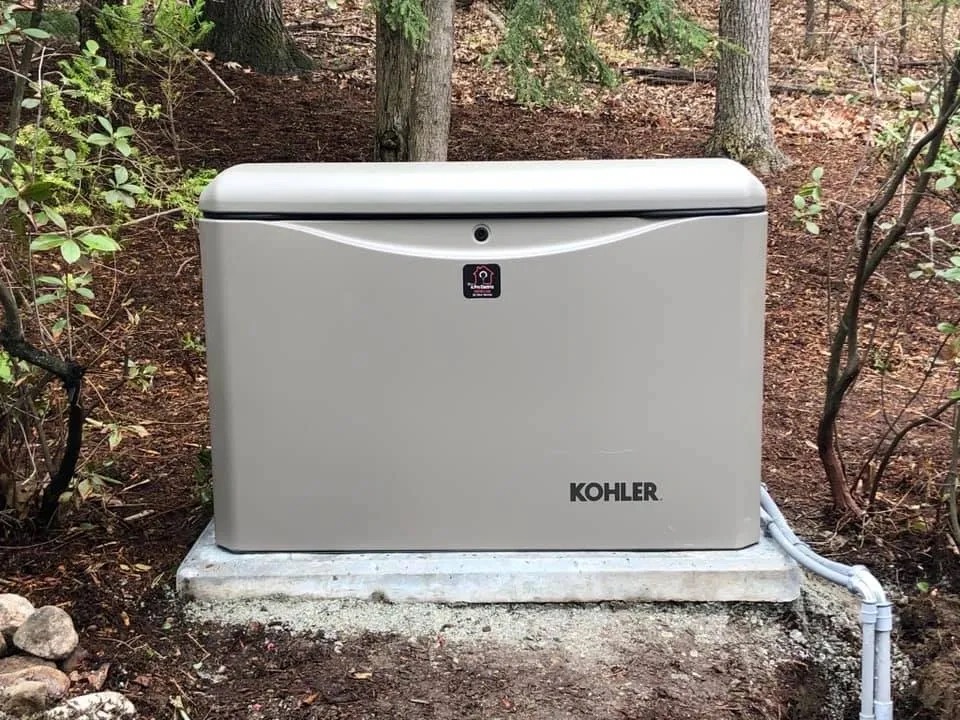
What Size Generator for a 200 Amp Service in NH, Sized From Your Circuits
What size generator for a 200 amp service in NH is answered from the circuits you want running in an outage and not from the amp rating of the panel, which is why two identical 200 amp houses can need generators many kilowatts apart.
How to Work Out the Generator Size for a 200 Amp Service in New Hampshire
What Size Generator a 200 Amp Service Actually Needs
The short answer is that a 200 amp service does not need a generator of any particular size, because the amp rating describes what the utility connection can deliver and a generator is sized from what you want to keep running. A house that keeps its heat, its well pump, its refrigerator and its lights on needs a generator in the neighborhood of ten kilowatts by the method below. A house that keeps an electric range, a dryer, a water heater and central air on as well needs one two or three times that size. Both houses can have the same 200 amp service.
That is why the number a dealer quotes and the number a homeowner expects so often disagree. A dealer who sizes to the whole house is answering one question, and a homeowner who wants the furnace and the freezer to survive a storm is asking another. Both are reasonable, and the difference is a choice about which circuits ride on the generator. We settle that choice first, with a list of circuits, and only then talk about kilowatts.
Everything here uses the same method as our generator sizing calculator, with the same typical figures for household equipment, so the worked examples can be checked against the tool and then replaced with the nameplate readings from your own furnace, pump and appliances. The general method is set out in standby generator sizing, and larger properties are covered in generator size for a 400 amp service.
The Arithmetic Behind a 200 Amp Service and Generator Size
A 200 amp service on a house supplied at 240 volts can deliver up to 48,000 volt-amperes, which is 200 multiplied by 240. That is the ceiling for the whole house, and the household almost never approaches it, because the range, the dryer, the water heater, the furnace and the air conditioner are not all running at their maximum in the same minute. The wiring rules recognize this through the load calculation in Article 220, which applies demand factors to the connected load to work out what the service has to carry. Our guide to what size electrical service a house needs walks through that calculation.
A generator calculation is a different calculation answering a different question. The service calculation asks what the building could ask of the utility on its worst day. The generator calculation asks what you choose to run when the utility is gone, and the answer is usually far smaller, because an outage is a time to run less. Sizing a generator to the 48,000 figure would mean buying capacity for loads you would never run at once, and the unit would cost far more to buy and to fuel.
The service rating still matters in one place, which is the equipment between the generator and the house. A whole-house transfer switch on a 200 amp service is rated at 200 amps because it sits in the path of everything the service carries, whatever the size of the generator behind it. We cover that in the transfer switch section below.
Generator Size for a 200 Amp House on Essential Circuits
Take a house with an oil boiler, a drilled well and a chest freezer in the basement, which describes a large share of New Hampshire houses. On the typical figures in the sizing tool, the boiler runs at 800 watts, the refrigerator at 700, the freezer at 500, the well pump at 1,000, the lights and outlets at 1,000, the internet and television at 300 and a microwave at 1,200. Added together that is 6,300 watts of running load.
Then comes the starting surge, the brief extra draw of anything with a motor. The well pump is the largest at 3,000 watts to start, ahead of the refrigerator at 2,200, and only one motor starts at a time, so the single largest start is added once. 6,300 plus 3,000 is 9,300 watts, or 9.3 kilowatts. A margin on top, so the generator is not running at its ceiling, and a round up to a unit that is actually sold, lands a little above that number.
Notice what this is next to the service. 9,300 watts is under a fifth of the 48,000 volt-amperes the service can deliver. That is the most common outcome on a 200 amp house, and it is why a critical loads panel, which feeds only these circuits, lets a smaller and cheaper generator do the job that matters in an outage.
Generator Size for a 200 Amp House With an Electric Range, Dryer and Water Heater
Now suppose the same house also wants to cook, dry clothes and heat water on the generator. On the same typical figures, the electric water heater adds 4,500 watts, the range 5,000, the dryer 5,000 and the dishwasher 1,200. The running load rises from 6,300 to 22,000 watts, and with the 3,000 watt well pump start on top the required size is 25,000 watts, or 25 kilowatts.
That jump is where the choice about circuits becomes a choice about money. A generator that can carry 25 kilowatts is a much larger machine than one that carries 9.3, with a bigger engine, a larger fuel supply and a higher purchase price. Most households find that they do not actually need the range, the dryer and the water heater running together during an outage, and a standby installation can be set up around that.
The tool for that is load management. Instead of sizing the generator to carry every large appliance at once, a load management arrangement lets the large appliances take turns, so the dryer waits while the range is in use. A smaller generator then covers the whole house in practice, on the rule that two of the biggest loads do not run in the same minute. We cover how that is set up in Generac installation, where load management changes what size you actually need.
Generator Size for a 200 Amp House With a Heat Pump
A heat pump changes the picture in a state where most houses burn something for heat. According to the U.S. Census Bureau American Community Survey estimates for 2020 to 2024, about 39.5 percent of occupied homes in New Hampshire heat with fuel oil, 21.4 percent with utility gas, 19.2 percent with propane and 11.1 percent with electricity. A house in the first three groups has a small electric load for its heating, a burner and a pump. A house with a whole-house heat pump has a large one.
On the typical figures, a whole-house heat pump runs at 4,500 watts and starts at 9,000. Add it, with an electric water heater at 4,500 watts, to the 6,300 watts of essentials and the running load is 15,300 watts. The largest single start is now the heat pump at 9,000, and the required size is 24,300 watts. The heat pump has taken the generator from about nine kilowatts to about twenty-four, which is the real cost of electric heat in an outage.
A mini-split is a gentler case, at 1,200 watts running and 2,900 to start, and a few of them are well within a generator sized for essentials. The planning question is whether the heat pump is the heat of last resort, in which case it belongs on the generator, or a supplement to a boiler that keeps the house warm anyway, in which case it can be left off.
Starting Surge and the One Motor That Sets the Generator Size
A motor draws far more current in the first second than it does once it is turning, and that brief surge is the part of generator sizing people get wrong most often. A well pump that runs at 1,000 watts may pull 3,000 to start, and a generator that carries the running load comfortably can still stall when the pump kicks in, tripping the very circuit that matters in an outage.
The method that works is to add the running load of everything you want on, then add the single largest start once. Two motors almost never start in the same instant, so adding every surge together would oversize the generator by thousands of watts. That is why a number built by adding every surge will be larger than ours, and why we are comfortable defending the smaller one.
The surge matters differently by equipment. Central air conditioning starts at 8,000 watts on the typical figures and a whole-house heat pump at 9,000, so either one tends to be the largest start and to set the size. A house with neither is usually set by the well pump. Knowing which motor sets the number is also how you see where a larger generator would buy you something, and where it would not.
Whole-House Transfer Switch or Critical Loads Panel on a 200 Amp Service
There are two ways to connect a generator to a 200 amp house, and they pull the generator size in opposite directions. A whole-house arrangement puts an automatic transfer switch rated for the service in front of the panel, so every circuit is available on the generator and the generator is sized to what you will run at once. A critical loads arrangement moves a chosen set of circuits into a separate backup panel, so only those circuits are ever on the generator and the unit can be much smaller.
The critical loads panel is the cheaper route and the one that suits the first example, with essentials at about nine kilowatts. The whole-house switch suits a household that wants no decisions during an outage, and it is the right choice for the second and third examples when paired with load management. Both are permitted and inspected, and both are tested under load before we leave.
The service rating decides the size of the switch, not the generator. A whole-house switch on a 200 amp service is a 200 amp device, because everything the service can carry passes through it, however small the generator behind it. A critical loads panel can be much smaller since it only carries the chosen circuits.
Fuel, Siting and Cold Weather for a 200 Amp Generator Installation
A generator rated for a given output does not always deliver it on every fuel. Manufacturers publish separate ratings for natural gas and propane, and the natural gas figure is lower, so the size on the nameplate has to be read against the fuel you will actually burn. A unit sized with no margin on propane can come up short on natural gas, and the difference is a reason to size with headroom and to check the rating sheet for the fuel in use.
The fuel supply has to keep up as well. A natural gas generator needs a gas line and a meter that can supply it alongside the furnace and the range, and a larger generator can call for a larger line. A propane generator needs a tank big enough to run through the outage you are planning for, and a refill that does not depend on the roads being clear. Gas fitting is licensed work that we coordinate with and do not do ourselves.
Cold and snow shape the installation as much as the size. The unit needs clear space around it for air and for service, a position that drifting snow will not bury and a run to the panel short enough to keep voltage drop low. We choose the position with the electrical run and the fuel in mind together, because the best place for one is rarely the best place for the others.
What We Measure Before Quoting Generator Size for a 200 Amp Service
A quote for a generator on a 200 amp house starts with a visit and a list. We note the nameplates on the furnace or boiler, the well pump, the sump pump and the main appliances, we open the panel to see its brand, its condition and how many spaces are free, and we confirm the service size and what kind of meter and mast the house has. Those readings replace the typical figures in the examples above with the real ones, and the real ones can move the answer by several kilowatts.
We also ask the questions a spreadsheet cannot. Who is home during an outage, whether the house is empty for weeks in winter, whether anyone works from home, and how much inconvenience is acceptable, such as a house that stays warm but cannot run the dryer. The answers decide the circuit list, and the circuit list decides everything after it.
The result is a written scope with the generator size, the transfer arrangement, the fuel and the position, set out so that the size can be checked against the load list. It forms part of a full standby generator installation in NH, permitted and inspected, with the generator tested under load before we hand it over.
Generator size for a 200 amp service in NH comes down to the circuits you want running, and A. Pro Electric is a licensed master electrician in Henniker who sizes it from your own nameplates and pulls the permit.
What a Generator Size for a 200 Amp Service Includes in Our Quote
- A circuit list worked out with you and checked against the nameplates
- A written generator size from running watts plus the largest motor start
- A transfer arrangement matched to the 200 amp service
- Fuel supply and position settled together with the electrical run
- Permit pulled and inspection attended
- A load test with the generator running before we leave
Signs You Need Generator Sizing for a 200 Amp Service in NH
- You have been given different generator sizes by different dealers
- You have a 200 amp service and are unsure what that means for a generator
- The house has a well pump, a boiler or a sump pump that must keep running
- You are adding a heat pump, an electric range or an EV charger
- You want a smaller generator and a clear list of what it runs
Generator Size for a 200 Amp Service Questions, Answered
Is a 200 Amp Service the Same Thing as a 200 Amp Generator?
No. The 200 amps describes what the utility connection can deliver, 48,000 volt-amperes at 240 volts, while a generator is rated in watts or kilowatts for what it can produce. A household generator is a small fraction of that service rating, and nobody needs a machine that matches it.
What Size Generator Runs a Whole House on a 200 Amp Service?
It depends on what the house runs together. By the sizing method, essentials such as heat, well, refrigeration and lights come to about 9.3 kilowatts, and adding an electric range, dryer, water heater and dishwasher brings it to about 25. Load management lets a smaller unit cover the larger list in practice.
Can One Generator Run Everything on a 200 Amp Service at the Same Time?
It can, if it is large enough, but that is rarely the sensible choice. A unit big enough to run every large appliance at once costs much more to buy, fuel and install, for loads that seldom run together. Most households are better served by a smaller generator and a plan for which loads wait.
Do I Need a 200 Amp Transfer Switch With a 200 Amp Service?
For a whole-house arrangement, yes, because the switch sits in front of the panel and has to be rated for the service. For a critical loads arrangement, no, since only a chosen set of circuits moves to the backup panel and the switch can be far smaller.
How Much Headroom Should the Generator Have Above the Calculated Load?
Enough that it is not running at its ceiling, which shortens its life. The calculated total gets a margin and is rounded up to a unit that is actually sold, then read against the rating for the fuel you will burn, since natural gas ratings are lower than propane.
Is It Better to Buy a Larger Generator Than the Calculation Says?
Only for a reason. A larger unit costs more to buy and to run and does nothing for loads you will not use. The good reasons are known additions, such as a heat pump or an EV charger planned within a year or two, which are better counted in the calculation from the start.
What If I Add a Heat Pump or an EV Charger After the Generator Is Installed?
Either can change the size a great deal. A 48 amp EV charger at 240 volts draws 11,520 watts, more than all the essentials in the first example together. Most households leave it off the generator or let load management make it wait, which is easier to plan before the generator is chosen.
Can You Size the Generator From the Calculator Without a Visit?
The calculator gives a sound indication from typical figures, and it is a good way to see the range. A quote needs the real nameplates, the panel and the fuel and position, so we visit before we give a size, and the result is written down so it can be checked.
Guides on Generators & Backup Power
Standby Generators: What They Cover and What They Do Not
Whole-house against essential circuits, automatic against manual, and what a transfer switch is for.
Getting a Home Ready for a New Hampshire Winter
Outage backup, heat cables for ice dams and frozen pipes, winter heating load, and outdoor power before the snow.
More Generators & Backup Power
Portable Generator Hookup
Inlet, interlock and permit, so a generator you own can run the house safely.
Automatic Transfer Switch Installation
The switch that moves the house onto the generator, sized to the service.
Critical Loads Panel
The subpanel that decides which circuits stay live in an outage.
Generator Servicing & Load Testing
The annual visit, tested under real load, with a written record.
Generac Generator Installation
The brand we fit most often, sized to the house and commissioned under load.
Generator Replacement & Upgrades
Replacing a set that is past parts, past repair or too small for the house.
Standby Generator Sizing
How to size a standby generator from the circuits you keep on, for 100 to 300 amp service.
Generator Size for a 400 Amp Service
Sizing a generator for a large house, a second panel or a property with outbuildings.
All generators & backup power work, including what a full installation involves and what it costs.