

What Size Electrical Service Does a House Need?
The Article 220 calculation in plain English, what pushes a New Hampshire house past 100 amps, and when a 200 amp service upgrade is genuinely needed.
Published
What Size Electrical Service a New Hampshire House Actually Needs
What Size Electrical Service Does a New Hampshire House Need?
What size electrical service a New Hampshire house needs is decided by arithmetic rather than by opinion, which is the first useful thing to know, because the answer you get informally tends to depend on who you asked. The calculation is set out in Article 220 of the National Electrical Code and every electrician runs the same one.
It works from the heated floor area, the fixed appliances, the heating or cooling, and anything continuous such as EV charging. General lighting is counted at three volt-amps per square foot. Two small appliance circuits and a laundry circuit are added at 1,500 volt-amps each. A demand factor is then applied to that subtotal, because no house ever runs everything at once, so the first 3,000 volt-amps count in full and the remainder counts at 35 percent.
Fixed appliances go in at their nameplate rating, with a 75 percent factor where there are four or more. Heating and cooling are counted once, at whichever is larger, since they do not run together. An EV charger is counted at 125 percent of its rating because it is a continuous load. Divide the total by 240 and you have the amps.
For most New Hampshire houses that lands at 100, 150 or 200 amps, and the pattern is regional as much as anything. Post-war and 1960s stock through Nashua, Derry, Salem and Hudson was overwhelmingly given 100 amps. Newer building in Bedford, Amherst and Hollis went to 200 as standard. Older stock in Manchester, Concord and Keene varies enormously depending on when it was last touched. What decides it is almost never the size of the house on its own.
It is the question behind most of the service upgrades we do across New Hampshire, in Manchester, Concord, Nashua, Derry, Salem, Bedford, Henniker, Laconia and Keene, and it is answered the same way everywhere.
Is 100 Amp Service Enough for a New Hampshire House?
It can be, and a great many New Hampshire houses run on it perfectly well. A 100 amp service was the standard for decades and it is entirely adequate for a house with gas or oil heat, a gas range, a gas water heater and ordinary lighting and outlets. There is nothing wrong with 100 amps in itself.
What makes it tight is electrification. Every load that moves from fuel to electricity lands on the same service. A heat pump, an electric water heater, an induction range, a hot tub and an EV charger are each substantial on their own, and any two of them together will put pressure on 100 amps in a way that oil heat and a gas range never did.
The symptom is rarely dramatic. It is not that the main breaker trips, although that does happen. It is that the house starts to feel like it is running close to something, with lights dimming when the well pump starts and breakers giving up in cold snaps when the heat is working hardest. On rural properties around Weare, Deering, Henniker and the Monadnock towns, where a private well and a septic pump are already on the service, there is less headroom to begin with than a house on municipal water in Concord or Nashua.
The point worth being clear about is that a bigger service does not cost more to run. The service size is the capacity available to you, not the amount you use. A 200 amp service does not draw more than a 100 amp service. It simply does not run out.
When Does a House Need a 200 Amp Service Upgrade?
When the calculation says so, and in practice that is usually when two or more significant electric loads arrive at once, or when one arrives at a house that was already close to its limit.
The common triggers we see are consistent. A heat pump replacing oil or propane heat, which is the biggest single change most New Hampshire houses make. An EV charger, particularly a 48 amp unit, which is counted at 125 percent and is therefore larger on paper than it looks. An electric water heater replacing a fuel-fired one. A hot tub, which is a genuinely heavy load that runs at all hours. A finished basement, an addition or an ADU, each of which brings its own circuits.
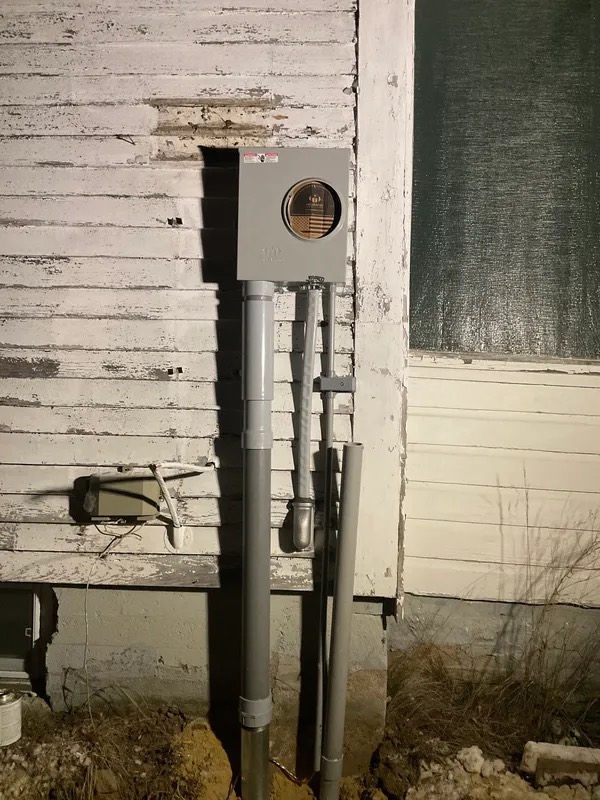
A 200 amp service upgrade runs $3,000 to $3,500 for a straightforward job, which is the real range rather than a national figure. What moves it is the service entrance rather than the panel: whether the mast and meter socket need replacing, whether the panel is moving, and what the grounding needs.
It is worth doing the arithmetic before committing to the equipment rather than after. Finding out that a house needs a 200 amp service upgrade is a manageable conversation in advance and an expensive surprise once the heat pump is on order. Where the trigger is a finished basement or an addition rather than a single appliance, the remodel and the service question are best priced together.
How Do You Work Out the Electrical Load of a House?
You add up what is actually there, apply the demand factors, and divide. The arithmetic is not difficult; the accuracy comes from the inputs. Nameplate ratings on the real equipment beat typical figures, which is the main difference between an indicative number and the one that goes on a permit.
The parts that catch people out are worth naming. Heating and cooling are counted once at the larger of the two rather than added together, which surprises people who assume the worst case is everything at once. Four or more fixed appliances attract a 75 percent factor, so the fifth appliance adds less than the first. Continuous loads such as EV charging are counted at 125 percent, so a 40 amp charger is treated as 50. And the demand factor on general lighting means a bigger house does not scale the way people expect.
Our load calculator runs exactly this calculation and shows the working, including what it counted and what it could not see. It uses typical nameplate figures rather than the ones on your equipment, so it will tell you whether you are comfortable, borderline or short, which is enough to plan with.
What it deliberately will not do is tell you that you are fine when you are close to the limit. Anything above roughly 80 percent of the service is reported as borderline, because the things a form cannot see start to matter in that range.
Does Adding an EV Charger Need a Bigger Electrical Service?
Sometimes, and less often than people assume. A Level 2 charger is a significant load and it is counted at 125 percent because it runs for hours rather than minutes, but plenty of houses have room for one without any change to the service at all.
What decides it is what else is on the service and how big the charger is. A 40 amp charger on a 200 amp service in a house with gas heat is usually straightforward. The same charger on a 100 amp service in a house with a heat pump and an electric water heater usually is not. The difference is not the charger; it is everything around it.
Where the calculation comes out short there are three real options and only one of them is a service upgrade. You can fit load management, which throttles the car when the rest of the house is busy and is common enough now to be unremarkable. You can install a smaller charger, since a 32 amp unit still adds far more range overnight than most people drive in a day. Or you can upgrade the service, which is worth doing anyway if the panel is also full or obsolete.
Which one is right depends on what else is likely to arrive in the next few years, and that is a genuine planning question rather than a technical one. EV charger installation and the load question behind it are the same conversation, and our guide to getting a home ready for an EV goes through the rest of it.
What Size Service Does a Heat Pump Need?
A whole-house heat pump is typically the largest single load a New Hampshire house will ever add, and it is the change most likely to push a 100 amp service past what it can carry. A ducted system commonly draws in the region of 40 amps, and there is usually supplementary electric heat behind it for the coldest days, which is an additional load again.
Mini-splits are a different proposition. A single head is modest, and even several are considerably less than a ducted whole-house system. Houses that add mini-splits room by room often find the service copes without any change, while the same house going to a ducted system would not.
The detail that catches people is the one the calculation handles automatically: heating and cooling count once, at the larger. So replacing central air conditioning with a heat pump is a smaller change than the raw numbers suggest, because the air conditioning was already being counted. Adding a heat pump to a house with no cooling at all is a bigger one.
The other consideration is what the heat pump replaced. A house that ran on oil has a service sized for a house that ran on oil, including a burner motor and not much else. Moving the entire heating load onto the panel is exactly the scenario the calculation exists for, and it is worth running before the equipment is ordered rather than after.
Can You Add Circuits Without Upgrading the Electrical Service?
Often, yes, and this is where the distinction between a full panel and an undersized service matters. Those are two different problems and they get confused constantly.
A panel with no spare spaces is a physical constraint. It does not mean the service is too small. A sub-panel can add spaces, particularly where the new load is concentrated in one place such as a garage, a workshop or a finished basement, and a feeder to that sub-panel is frequently a tidier answer than running six circuits individually. Tandem breakers are sometimes permitted depending on the panel and its label.
A service that is genuinely undersized is a capacity constraint, and no amount of finding space changes it. That is what the load calculation tells you and it is the only thing that does.
There is also a middle case worth knowing about. Some houses have adequate service capacity and a panel that is old, obsolete or defective, in which case the work is replacing the panel rather than upsizing the service. Panel replacement, sub-panels and feeders to outbuildings all sit in the same conversation, and which one you need is answered by looking rather than guessing.
How Do You Decide What Size Electrical Service to Install?
Run the calculation on what is there, then add what you are realistically going to add. That second part is where most of the judgement sits, and it is worth being honest with yourself about it, because the cost of upsizing during the work is small and the cost of doing it again in four years is not.
The questions that matter are practical ones. Is the heat likely to move to a heat pump. Is there an EV coming, or a second one. Is the basement going to be finished, or a garage heated, or an ADU built. Is the water heater near the end of its life, and will it be replaced with electric. Each of those is a load, and a service sized only for today will meet each of them with another conversation.
For most New Hampshire houses that are electrifying anything, 200 amps is the sensible answer and has been for some time. For a house staying on fuel heat with a gas range, 100 may well be fine and there is no reason to spend money proving otherwise. Houses on private wells have an additional reason to keep headroom, since a well pump is both a heavy starting load and the thing you least want to lose, which is also why it drives standby generator sizing on rural properties.
Working out what size electrical service a house needs is a half-hour job with the right inputs, and it is the single most useful thing to establish before buying equipment, finishing a basement or committing to a heat pump. We run the calculation properly, with eyes on the panel and the service entrance, across Manchester, Concord, Nashua, Derry, Salem, Bedford, Henniker, Laconia and Keene, and the towns around each of them.
Last updated
Electrical Service Size Questions
Does a Bigger Electrical Service Cost More to Run?
No. The service size is the capacity available to you, not the amount you use. A 200 amp service does not draw more than a 100 amp service. It simply does not run out, and your bill reflects what the house actually consumes either way.
How Do I Find Out What Size Service My House Has?
It is printed on the main breaker at the top of the panel, usually 100, 150 or 200. If there is no main breaker, or the panel is a fuse box, it is less obvious and worth having confirmed rather than guessed, since the service entrance conductors also have to match.
Can You Upgrade From 100 Amp to 200 Amp Service?
Yes, and it is one of the more common jobs we do. It usually involves the panel, the service entrance conductors, the meter socket and the grounding, and it brings the utility into the schedule. A straightforward 200 amp service upgrade runs $3,000 to $3,500.
Is 400 Amp Service Ever Needed in a House?
Rarely, and it is usually a sign that something else should be looked at first. Very large houses, properties with substantial outbuildings, or houses with multiple heat pumps and several EVs can justify it. For most houses a 200 amp service with sensible load management covers everything.
Does a Heat Pump Need Its Own Electrical Service?
No, it needs its own circuit, which is a different thing. What it may need is a larger service overall, because a whole-house heat pump is typically the biggest single load a New Hampshire house adds. Mini-splits are considerably smaller and often fit within an existing service.
How Accurate Is an Online Load Calculator?
It runs the same Article 220 arithmetic an electrician runs, so the method is right. What it cannot do is read the nameplate on your actual equipment or see the panel, so treat the result as a good indication of comfortable, borderline or short rather than as the number that goes on a permit.
What Happens If the Service Is Too Small for What I Want to Add?
There are three real options. Upgrade the service, which is worth doing anyway if the panel is also full or obsolete. Fit load management, which sheds heavy circuits when demand peaks and is common for EV charging. Or size the new equipment down. Which is right depends on what else is coming.
The Work Behind This Guide
More Guides for Homeowners
How to Tell If Your Electrical Panel Needs Replacing
The signs worth acting on, the panel brands insurers flag, and how to tell a full panel from an unsafe one.
Knob and Tube Wiring in New Hampshire
How to recognize it, why insurers ask about it, and what removing it actually involves.
Getting a Home Ready for an EV
What to check before you order the car, and why the charger is rarely the expensive part.