

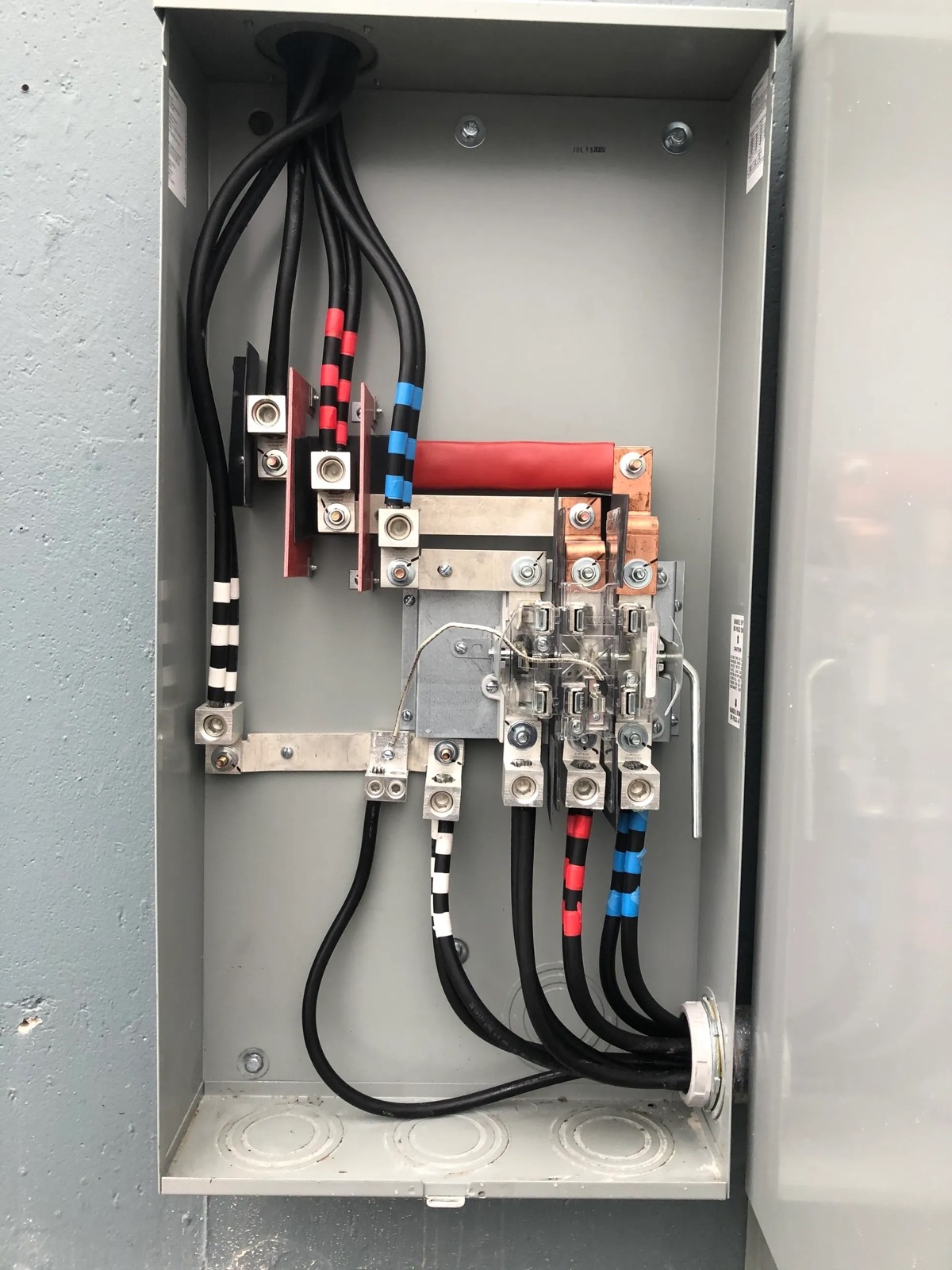
House Rewiring and Electrical Wiring in New Hampshire
Whole-house rewiring, knob and tube removal, aluminum wiring remediation, added circuits and fault finding, across Manchester, Concord, Nashua, Keene and the older towns between them. Staged where a full rewire is not needed all at once.
What Rewiring a New Hampshire House Actually Involves
When a New Hampshire House Needs Rewiring
A house needs rewiring when the wiring itself has run out of margin, which is a different question from whether the panel needs replacing and is confused with it constantly.
The clearest cases are the old systems. Knob and tube, which has no grounding conductor and insulation that has had seventy years or more to go brittle. Cloth-covered and early rubber cable, which fails the same way. Aluminum branch wiring from the 1965 to 1973 window, which is not dangerous in itself but whose connections are. Any of those means the wiring rather than the panel is the limit.
Then the less obvious ones. Two-prong outlets throughout, meaning no ground anywhere. Not enough circuits for how the house is used, which is most pre-war stock. Junctions made outside boxes. Circuits that have been extended by whoever was handy over four decades.
It turns up right across New Hampshire, in the older wards of Manchester and Concord, in Victorian Keene, and in the farmhouses around Henniker, Hopkinton, Warner, Bradford and Deering, and our guide to knob and tube wiring covers how to identify it before anybody is called.
How Much of a House Has to Be Opened
Less than people fear, and it depends far more on how the house was built than on how much wiring is being replaced.
Rewiring is fishing cable through existing cavities wherever that can be done, and opening only where it cannot. A house with an accessible attic and an unfinished basement gives access to the top and bottom of most wall cavities, and a great deal can be run without opening a finished wall at all.
New Hampshire housing stock is often helpful here. Balloon framing, which much of the pre-1930 stock uses, has continuous cavities from basement to attic and makes fishing considerably easier than later platform framing.
What forces opening is predictable. Plaster and lath that will not take a fish tape, fire blocking in a cavity, interior walls with no route from above or below, and anywhere a new box has to land. Where walls do come open it is usually a series of small patchable holes rather than sheets of drywall.
What a Whole-House Rewire Costs in New Hampshire
A whole-house rewire on a 2,000 square foot house runs $18,000 to $20,000. That is the real working figure rather than a national average, and it covers replacing the branch circuits throughout, landing everything in boxes, proper grounding, and the panel work that goes with it.
What moves it is access more than anything else. A house with a usable attic and an open basement sits at the lower end. A house with finished space above and below, plaster walls and awkward framing sits higher, because the labor is in the fishing rather than in the cable. Size matters too, though not linearly, since a larger house has more circuits but the same fixed setup.
A rewire almost always arrives with panel and service work attached, because a house with original wiring usually has an original panel, and doing one without the other leaves half a job.
The counterweight is that this is a once-per-lifetime job on most houses. It is expensive and it is also the last time anybody has to think about it.
Rewiring in Stages, Room by Room or Floor by Floor
Yes, and staging is normal rather than a compromise. It is frequently the difference between a job that happens and one that gets postponed indefinitely.
The usual approaches are by priority, by floor, or alongside other work. By priority means the circuits carrying the most load first, which is normally kitchens and bathrooms because they combine the heaviest loads with the highest requirement for grounding and GFCI protection. By floor keeps the disruption contained. Alongside other work is the cheapest of all.
That last one is worth taking seriously. If a kitchen or a bathroom is being redone, the walls are already open, the cabinets are off and somebody is already making good. The marginal cost of rewiring the rest of that floor while the room is stripped is a fraction of the same work as a standalone job. Remodel and addition work is by a distance the cheapest moment to deal with old wiring.
What staging needs is a plan, so each phase leaves the house safe and the next phase does not undo the last.
Aluminum Branch Wiring Remediation
Aluminum branch circuit wiring was used widely in houses built roughly between 1965 and 1973, when copper prices made it attractive, and a fair amount of New Hampshire post-war suburban stock falls in that window.
The issue is not the aluminum. It is the connections. Aluminum expands and contracts more than copper, oxidizes differently, and creeps under a terminal screw over time. Connections that were tight on the day loosen over decades, and a loose connection under load makes heat. The failure point is almost always at a device rather than in the middle of a run.
It is remediable rather than requiring a full rewire, which is the part people often do not realize. The recognized fixes treat every connection properly, whether by approved connectors at each device or by pigtailing to copper using listed methods. It is methodical work because it means every device in the house.
What is not acceptable is leaving it because nothing has gone wrong yet, or having it fixed with ordinary wire nuts, which is common and is worse than useless.
GFCI and AFCI Protection in Older Circuits
They watch for two different things and neither is what a normal breaker watches for, which is why an older house can have working breakers and still be missing most of its protection.
A GFCI compares current going out against current coming back and trips on a difference of a few thousandths of an amp. That level of leakage is what electrocutes people, which is why GFCI protection is required at kitchens, bathrooms, garages, basements, outdoors and anywhere near water.
An AFCI listens for the electrical signature of arcing, which is what a damaged cable or a loose connection does before it sets fire to something. It is required on most living-space circuits in new work.
Most houses built before the 1990s have far less of both than current requirements call for, and adding them is one of the higher-value pieces of a partial rewire. If a circuit is already tripping, our guide to why breakers trip explains what each type is telling you.
Added Circuits and Outlets Without a Full Rewire
Very often, and it is one of the most common jobs we do. An added circuit solves an overload without touching anything else, and an overload is the most frequent cause of a tripping breaker by a distance.
The usual candidates are predictable. A kitchen that was given two circuits and now runs eight appliances. A home office in a spare bedroom, which happened to a great many houses across Derry, Salem, Londonderry and the commuter towns. A workshop or garage with equipment on an extension lead. A basement that has become a living space.
What decides whether it is simple is the route and the panel. A circuit to a room above an accessible attic or below an open basement is straightforward. A circuit to the middle of a finished second floor is more work. And the panel needs a space, which is where the full-panel question sometimes arrives.
Heavy appliances are a separate case and get their own dedicated circuits rather than sharing.
Troubleshooting and Fault Finding
Methodically, by isolating and splitting the circuit until the fault is cornered, and it is the part of the work that takes the time rather than the part that looks dramatic.
A fault that is present all the time is comparatively straightforward. The circuit is isolated, divided at a convenient point, and each half tested, which halves the search each time until the section containing the fault is small enough to inspect.
An intermittent fault is the hard one, because it may not be present when anybody is looking. Those get found by pattern rather than by measurement: what is running when it happens, what the weather is doing, whether it follows a time of day. Rodent damage in attics and crawlspaces, and water reaching an outdoor box after rain, are both common in New Hampshire houses and both intermittent.
Fault finding is charged on the time it takes rather than as a fixed item, because the work is genuinely open-ended until the cause is located, and we would rather say that up front than surprise anybody with it.
What Wiring and Rewiring Covers
- Whole-house rewiring, staged where that suits the house
- Knob and tube identification and removal
- Aluminum branch wiring remediation using listed methods
- Added circuits and outlets for kitchens, offices and workshops
- Switch and outlet replacement throughout
- GFCI and AFCI protection added where it is missing
- Troubleshooting and fault finding, including intermittent faults
- Circuits opened up and made safe at a unit turnover or a sale
- Rewiring coordinated with a remodel while walls are already open
Signs a House Needs Rewiring
- Two-prong outlets, meaning no grounding conductor
- Ceramic knobs and tubes visible in the attic or basement
- Cloth-covered or rubber-insulated cable
- The house was built between 1965 and 1973 and has aluminum branch wiring
- Breakers tripping in the same room repeatedly
- Outlets or switch plates that are warm, discolored or loose
- Lights that flicker or dim when something else starts
- Extension leads doing a permanent job
- An insurer or a home inspector has raised the wiring
Wiring & Rewiring Questions, Answered
Can We Live in the House During a Rewire?
Usually yes, particularly where the work is staged. Individual circuits go off rather than the whole house, and the panel work is the only part needing a longer outage. An empty house is cheaper and quicker to rewire, which is why it is worth doing before moving in where that is an option.
Does Rewiring Mean Replastering the Whole House?
No. Most cable is fished through existing cavities from the attic and the basement, and where walls have to be opened it is usually small patchable holes rather than sheets of drywall. Plaster and lath is the awkward case and it is worth surveying before the work is priced.
How Long Does a Whole-House Rewire Take?
It depends on size and access more than anything else, and on whether the house is occupied. Staged work spreads over a longer elapsed time by design. The useful question at survey is how many days of disruption rather than how many days of work.
Do I Have to Remove Abandoned Knob and Tube?
Not necessarily. What matters is that it stops being live. Conductors that are genuinely inaccessible can be left in place once they are dead and disconnected at both ends, since pulling every original wire out of a plastered wall would do more damage to the house than leaving it.
Will Rewiring Fix My Breakers Tripping?
Only if the wiring is the cause, and frequently it is not. The most common cause is an overloaded circuit, which is a usage problem solved by an added circuit. Working out which one you have comes before deciding on any of this.
Is Aluminum Wiring a Reason Not to Buy a House?
No. It is a known, remediable item to price rather than a reason to walk away, and a fair amount of New Hampshire post-war stock has it. What matters is that it is remediated properly with listed methods rather than left alone or bodged with ordinary wire nuts.
Can You Rewire Around a Finished Basement?
Yes, though it removes one of the two easy routes. A finished basement means less access to the underside of the first floor, so more of the work goes through the attic or through opened walls. It is worth establishing at survey because it affects both the price and the disruption.
Guides on Wiring & Rewiring
Knob and Tube Wiring in New Hampshire
How to recognize it, why insurers ask about it, and what removing it actually involves.
Buying an Older New Hampshire House: What to Check Electrically
What a general home inspection misses, and the findings worth putting into a negotiation.
Why Breakers Trip, and What It Means
The difference between an overload, a short and a ground fault, and which of them is urgent.
Other Residential Electrical Work
Electrical Panels & Service
Panel replacements, service upgrades, meter and mast work.
Lighting
Recessed lighting, fixtures, exterior and landscape lighting.
EV Charger Installation
Level 2 chargers, 240 volt outlets, service capacity for an EV.
Generators & Backup Power
Transfer switches, standby generator wiring, portable inlets.
Remodels & Additions
Kitchens, bathrooms, basements, additions and new builds.
Appliance & Specialty Circuits
Hot tubs, well pumps, ranges, dryers and heat pump circuits.
Safety, Inspections & Repairs
Safety inspections, code corrections, surge and detector work.
24 Hour Emergency
Power loss, scorched panels, storm damage, repeat tripping.