

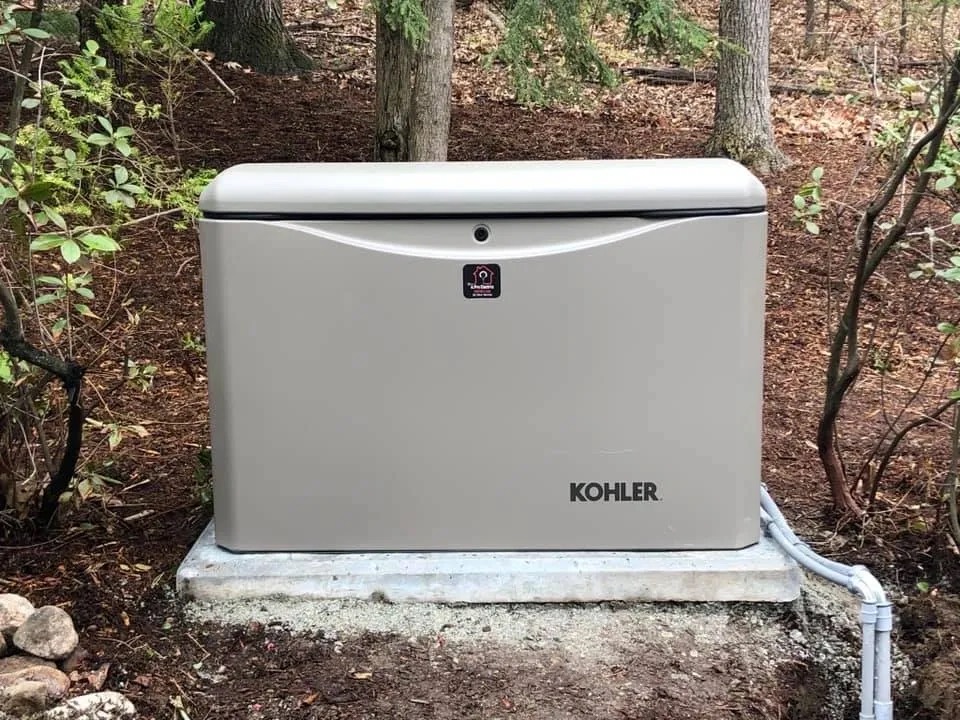
Commercial Generators and Emergency Power in NH and Massachusetts
Keeping a business running when the power goes. Standby generators, automatic transfer switches and emergency power systems for commercial and industrial buildings across Manchester, Nashua, Concord, Portsmouth, Dover, Keene and the Merrimack Valley.
Standby Generators and Emergency Power for New Hampshire Businesses
What Commercial Standby Power Protects
For a business the question is not comfort, it is what an outage costs and what it destroys. Stock in a walk-in, a production batch, a server room, a data record, a day of trading, or a legal obligation to have emergency lighting and life safety systems running.
New England outages are a weather problem and they are not rare. Ice, nor'easters and the remains of tropical systems take out overhead distribution across this region every year, and rural and wooded areas lose supply for longer because they are restored later.
We install and maintain standby systems across southern New Hampshire and northern Massachusetts: the commercial and industrial areas of Manchester, Nashua, Concord and Bedford, the Seacoast at Portsmouth, Newington, Dover and Rochester, the I-93 corridor at Salem, Derry and Londonderry, Keene to the west, and over the state line in Lowell, Lawrence, Haverhill, Methuen and Andover.
Both states are licensed under the same master electrician, so multi-site businesses on the border deal with one contractor.
Sizing a Generator From Connected Load
Commercial generator sizing is done from what the building actually has to run, not from floor area, and this is where specifications most often go wrong in both directions.
The exercise is listing what genuinely has to stay live, then the load characteristics of each item. Motor loads matter far more than their running figures suggest, because starting current is a multiple of running current and a generator has to absorb that surge without the voltage collapsing. A unit sized correctly on paper for the total running load can be unable to start the largest motor on it.
Sequencing is how that gets managed. Staggering motor starts rather than letting everything come on together means a smaller unit can carry the same building, which is a real saving on both the equipment and the fuel.
Oversizing is not a safe default either. A generator running lightly loaded for long periods, particularly a diesel, suffers for it. Our guide to what a standby generator protects in a business covers how the sizing exercise runs, and the generator sizing tool gives a starting figure.
Transfer Switches and How the Changeover Works
The transfer switch is the installation. The generator is equipment; the switch is what makes it a system, and it is where the engineering decisions actually sit.
An automatic transfer switch senses the loss of utility supply, signals the generator to start, waits for it to stabilize, and transfers the load. On restoration it waits to confirm the utility is genuinely back, transfers across and shuts the generator down after a cooldown. The whole sequence happens without anyone present, which is the point.
The critical function is that it physically prevents the generator and the utility supply being connected at the same time. That is not a preference: back-feeding the utility endangers line crews working to restore the supply, and it is why a proper transfer arrangement is not optional.
Whether the switch serves the whole building or an emergency panel is a cost decision as much as an engineering one. Many commercial installations back a selected panel carrying the loads that genuinely matter, which allows a much smaller generator than backing everything.
Standby Power for Restaurants and Food Service
Food service has the clearest case for standby power in the commercial sector, because an outage does not only stop trading, it destroys inventory.
Walk-in coolers and freezers, prep refrigeration, and in some operations the cooking line itself are the loads that matter. A busy kitchen can lose a substantial amount of stock in a summer outage, and beyond a certain point the health requirements make the decision rather than the owner.
The point of sale system and the network matter more than people expect too. A restaurant with power and no way to take payment is barely trading, so the small electronic loads earn their place on the emergency panel out of proportion to their size.
This is frequently designed in during a restaurant fit-up, which is the right time: the emergency panel and the transfer arrangement are far cheaper to build in than to retrofit once the kitchen is running.
Generators for Manufacturing, Warehousing and Industrial Sites
On an industrial site the calculation is about process rather than stock, and the losses can be larger and less obvious.
A production process interrupted mid-run may lose the batch and the material, and restarting a line is not instantaneous. Equipment that needs controlled shutdown can be damaged by an abrupt loss of supply. Refrigerated or climate-controlled storage has the same problem a restaurant walk-in does, on a larger scale.
Heavy motor loads make the sizing exercise more involved, and load shedding is frequently part of the design: running the essential process on the generator while non-essential loads stay off until the utility returns.
Some facilities also need the generator for life safety regardless of process: emergency lighting, egress illumination, fire pumps and alarm systems, which are code obligations rather than business decisions.
Fuel, Placement and the Practical Installation
The generator itself is one line item in a project that also includes fuel, a location, a pad, the transfer gear and the wiring between them.
Fuel choice is the first decision. Natural gas removes the storage and refill problem entirely but only works where there is a gas main, which rules it out across much of rural New Hampshire. Propane is the common answer where there is no gas, with a tank sized for a realistic run time. Diesel is standard on larger industrial units and brings tank, containment and fuel maintenance obligations with it.
Placement has to satisfy clearances from the building and from openings, exhaust routing, noise considerations relative to neighbors, and access for service. On urban commercial sites the location is frequently the hardest part of the project rather than the electrical work.
Winter matters here. A unit that has to start in a New Hampshire January needs the cold weather provisions to do it, and that is specification rather than hope.
Testing, Exercise and Maintenance
A standby generator that has not been run is an assumption, not a system, and the failures are almost always found at the moment it was needed.
Automatic weekly or monthly exercise runs the unit under controlled conditions and reveals the things that quietly fail: a dead starting battery, stale fuel, a coolant loss, a controller fault. The battery is the single most common reason a standby unit does not start, and it fails silently.
Commercial installations should also be load tested rather than just exercised, because running at no load proves the engine starts and almost nothing else. Some occupancies have testing and record-keeping requirements of their own.
Servicing follows the manufacturer schedule on oil, filters, coolant and the battery, and it is one of the things most sensibly folded into a scheduled maintenance arrangement rather than remembered occasionally.
Adding Standby Power to an Existing Building
Retrofitting a generator into a working commercial building is a different exercise from designing one in, and it starts at the distribution rather than at the generator.
The loads that need backing are rarely all on one panel. Getting them there means rearranging distribution so that an emergency panel exists and carries the right circuits, which is frequently the larger part of the project. That is distribution work as much as generator work.
The transfer switch has to go somewhere sensible relative to the service, the route from the generator location has to exist, and the cutover to bring it all into service needs a planned outage.
That outage is usually short and it is scheduled around the business, out of hours or at a weekend. Keeping a business open during electrical work covers how those windows are found.
What a Commercial Standby Power System Covers
- Load assessment from connected load and motor starting characteristics
- Generator specification, supply and installation
- Automatic and manual transfer switches
- Emergency panels carrying only the loads that matter
- Load shedding and start sequencing to allow a smaller unit
- Natural gas, propane and diesel installations
- Pad, clearances, exhaust routing and cold weather provision
- Life safety loads: emergency lighting, alarms and fire systems
- Commissioning under load, not just an exercise run
- Scheduled exercise, servicing and load testing
When a Business Needs Standby Generator Power
- An outage would spoil stock or lose a production batch
- The site has lost supply more than once in recent winters
- Refrigeration, climate control or a process cannot be interrupted
- Emergency lighting or life safety systems are a code obligation
- A server room or network has no backup beyond a short UPS
- An existing generator has never been load tested
- A standby unit failed to start when it was last needed
- A fit-up or new building is being designed and backup has not been considered
Commercial Generators & Emergency Power Questions, Answered
How Is a Commercial Generator Sized?
From the connected load that genuinely has to run, with motor starting characteristics counted separately. Floor area is not a basis for commercial sizing. Start sequencing and load shedding frequently allow a smaller unit to carry the same building, which is worth exploring before specifying.
Does the Generator Have to Back the Whole Building?
Usually not, and backing everything is the expensive option. Most commercial installations feed an emergency panel carrying the loads that matter, which allows a much smaller unit. Deciding what goes on that panel is the main design conversation.
How Often Should a Standby Generator Be Tested?
Automatic exercise weekly or monthly, and a load test periodically. Running at no load proves very little beyond that the engine starts. Some occupancies also have their own testing and record requirements for emergency systems.
Why Do Standby Generators Fail to Start?
Most often the starting battery, which fails silently and is the single most common cause. After that, stale or contaminated fuel, coolant loss, and controller faults. All of them are found by regular exercise and none are found by leaving the unit alone.
Natural Gas, Propane or Diesel?
Natural gas where there is a main, because it removes storage and refilling entirely. Propane where there is not, sized for a realistic run time. Diesel on larger industrial units, which brings tank, containment and fuel maintenance obligations with it.
Can a Generator Be Added to a Building That Was Not Designed for One?
Yes, and the work is mostly in the distribution rather than the generator. The circuits that need backing have to be brought onto an emergency panel, which is frequently the larger part of the project. The cutover itself is a short planned outage.
Can a Portable Generator Be Used for a Commercial Building?
Only through a proper transfer arrangement, and for most commercial loads it is not a practical answer. Connecting one without a transfer switch can back-feed the utility and endanger line crews, which is why the switch is not optional.
Guides on Commercial Generators & Emergency Power
Other Commercial Electrical Work
Tenant Fit-Ups & Build-Outs
Restaurants, retail, offices and warehouses, rough-in to trim.
Service, Distribution & Switchgear
Three-phase service, panelboards, transformers and feeders.
Commercial Wiring & Circuits
New build wiring, retrofits, added circuits, conduit and raceway.
Commercial Lighting
LED retrofits, parking lot and site lighting, controls, high-bay.
Low Voltage & Systems
Data cabling, intercom, surveillance and access control.
Maintenance & Service Contracts
Scheduled maintenance, thermal scanning, planned replacement.
24 Hour Commercial Emergency
Downtime response, storm and outage work, temporary power.
Property Management & Multi-Family
Common areas, apartment buildings, turnovers, house panels.
Equipment & Machine Connections
Kitchen equipment, motors, rooftop units and process circuits.
Commercial EV & Fleet Charging
Workplace charging, fleet charging, multi-port installations.
New Construction & GC Work
Ground-up commercial, design-build, subcontracting to GCs.