

Commercial Electrician in Southern New Hampshire and Northern Massachusetts
Fit-ups, service and distribution, lighting, generators, low voltage and scheduled maintenance, for businesses from Manchester and Nashua to the Seacoast and over the border into the Merrimack Valley. New Hampshire master electrician, license 14569M, and separately licensed in Massachusetts, and used to working around a business that has to stay open.
Commercial Electrical Work across New Hampshire and Northern Massachusetts
Twelve areas of work, from a single tenant fit-up to the switchgear behind it. Each has its own page covering scope, how the job runs, and what a building owner or manager usually needs to know.
Tenant Fit-Ups & Build-Outs
Restaurants, retail, offices and warehouses, rough-in to trim.
Service, Distribution & Switchgear
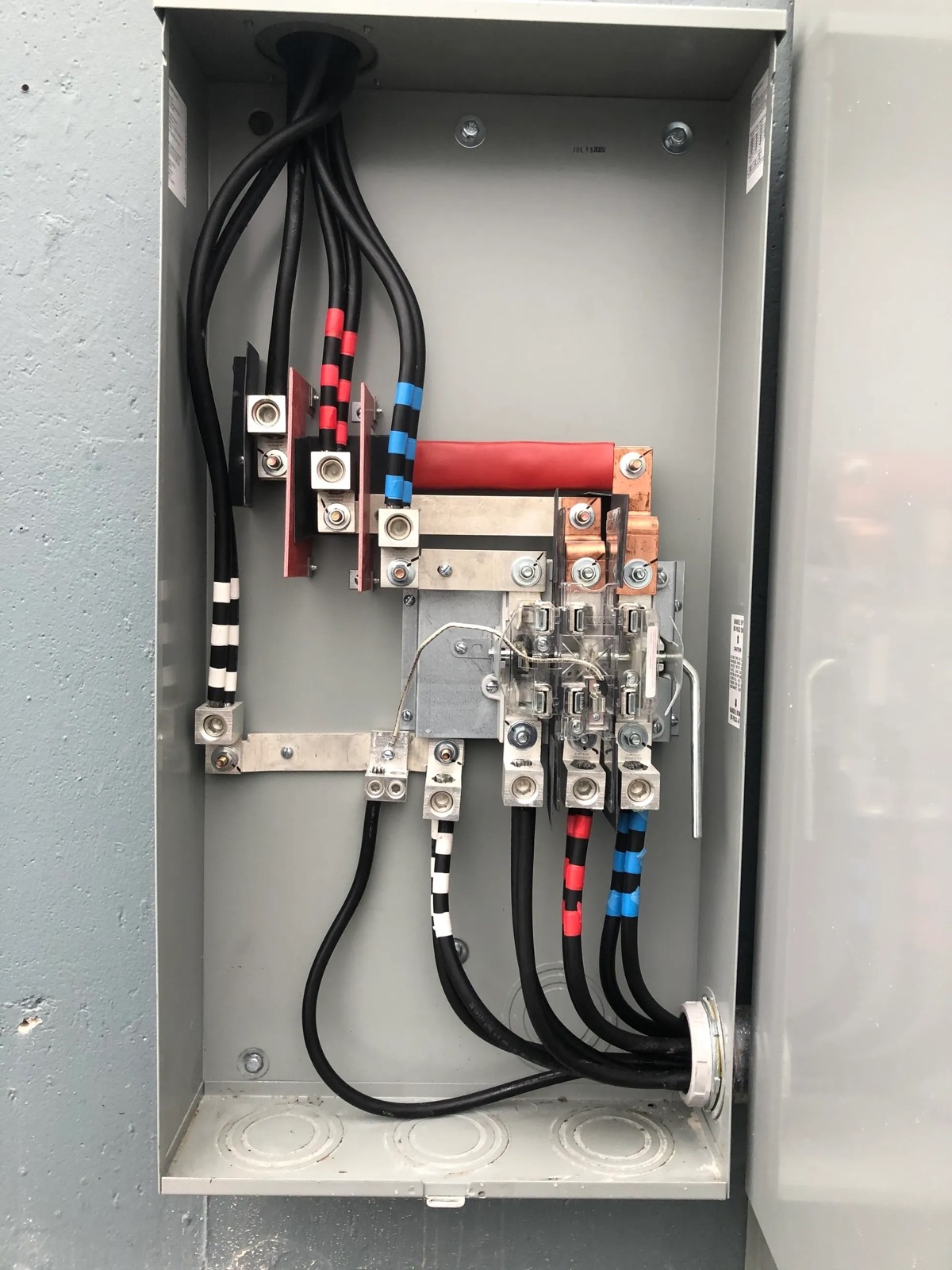
Three-phase service, panelboards, transformers and feeders.
Commercial Wiring & Circuits
New build wiring, retrofits, added circuits, conduit and raceway.
Commercial Lighting
LED retrofits, parking lot and site lighting, controls, high-bay.
Low Voltage & Systems
Data cabling, intercom, surveillance and access control.
Maintenance & Service Contracts
Scheduled maintenance, thermal scanning, planned replacement.
24 Hour Commercial Emergency
Downtime response, storm and outage work, temporary power.
Property Management & Multi-Family
Common areas, apartment buildings, turnovers, house panels.
Equipment & Machine Connections
Kitchen equipment, motors, rooftop units and process circuits.
Commercial Generators & Emergency Power
Standby systems, automatic transfer switches, life safety power.
Commercial EV & Fleet Charging
Workplace charging, fleet charging, multi-port installations.
New Construction & GC Work
Ground-up commercial, design-build, subcontracting to GCs.
Commercial Electrical Contracting in New Hampshire and Massachusetts
Where We Work: Southern New Hampshire, the Seacoast and Northern Massachusetts
Henniker is home, and Concord and Manchester are regular territory. Beyond that the commercial reach is deliberately wider than the residential one, because a job of real size justifies a drive that a service call does not.
In practice that means the industrial and commercial corridors of the region: the Manchester millyard and the Route 293 belt, downtown Nashua and the Everett Turnpike corridor through Merrimack, Concord and the Loudon Road commercial district, Bedford and Hooksett, the I-93 towns of Salem, Derry and Londonderry, Pease International Tradeport and the Newington industrial area, Portsmouth, Dover, Rochester and Somersworth on the Seacoast, and Keene to the west.
Over the state line the work runs through the Merrimack Valley: Lowell, Lawrence, Haverhill, Methuen, Andover, Tewksbury and Dracut, which is where the mill stock and the industrial base sit on the Massachusetts side.
The service area page sets out the whole geography, market by market, including the towns around each city.
Licensed in Both States, and Why That Matters on the Border
Austin Provencher holds New Hampshire master electrician license 14569M and is separately licensed in Massachusetts. Both, not one.
An electrical license does not cross a state line. A contractor licensed only in New Hampshire cannot legally pull a permit in Lawrence, and one licensed only in Massachusetts cannot pull one in Nashua. Businesses twenty minutes either side of the border run into this constantly, usually at the point where a project is already underway.
A master license is also the tier the state holds responsible for a job. It is what a permit is pulled under, what an inspection signs off against, and what an insurance certificate references. For a facilities manager or a general contractor it is frequently the first thing asked for, and the number is checkable on the state lookup.
For a business with sites in both states, or a landlord with a portfolio that straddles the line, that means one contractor, one standard and one number to call rather than a separate arrangement in each state.
Tenant Fit-Ups, Build-Outs and Restaurant Work
Taking a shell or a previous tenant's space and making it work for the business moving in is the commercial job we do most.
Tenant fit-ups and build-outs cover the panel and the sub-feed, the branch circuits, the lighting and controls, the receptacles and data, and the connections for whatever equipment the tenant is bringing. The first task on any of them is establishing exactly where the landlord's work stops, because that line decides the scope and it is frequently not where the lease says it is.
Restaurants and food service are a particular strength and the fit-up most contractors are least comfortable with, because the loads are heavy, the equipment schedule is long, and the health and fire sign-offs sit alongside the electrical inspection. A commercial kitchen is a genuinely large electrical load and a good proportion of it is three phase.
Retail, office and medical build-outs are lighter loads where the difficulty moves to the lighting design, the data infrastructure and the finish. Our guide to planning the electrical for a restaurant fit-up sets out how the heaviest version of it runs.
Service, Distribution and the Power Behind the Building
Everything on this page eventually comes back to what the building's supply can carry, which is why service, distribution and switchgear is frequently the first question rather than the last.
The trigger is almost always something new that will not fit: a tenant with equipment the building was never sized for, a kitchen going into a unit that was offices, EV charging added to the lot, or gear old enough that replacement breakers are no longer made. Sometimes the answer is that the service is fine and the problem is distribution, which is a much smaller job and worth establishing before anyone quotes a new service.
Whether a building has three phase is the other early question, because most commercial equipment of any size expects it and a lot of it is not made any other way. What is available depends on the street, and bringing it in where it is absent is a utility project measured in weeks or months. Our guide to three-phase power and when a business needs it covers how to find out what a building already has.
Downstream of the gear, commercial wiring and circuits is the conduit, the cable and the branch circuits that get power to where the work actually happens.
Commercial Lighting and LED Retrofits
Commercial lighting is the clearest return available in most commercial buildings, and it is the one electrical decision a business owner notices every day.
Retrofitting older fluorescent, metal halide or high pressure sodium to LED saves in three places, and only one of them is the lamp. The wattage drop is the obvious part, and on older fluorescent the ballast draw counts too. The second is maintenance, because a high bay at twenty feet costs more to relamp than to run. The third is that many older systems are no longer producing the light they used to, so the space is under-lit as well as expensive.
Running hours decide the payback rather than building size, and commercial electricity rates in New England are among the higher ones in the country, which shortens every payback here compared with the national figures manufacturers quote.
Our LED payback calculator runs the numbers on a real fixture count, and the guide to working out an LED retrofit payback explains what belongs in that calculation and what does not.
Keeping the Building Running: Generators, Maintenance and Emergency Cover
For a business the electrical question is rarely what the work costs. It is what an outage costs, and these three are the answer to that in different timeframes.
Commercial generators and emergency power handle the outage you cannot prevent, and in New England that is a weather problem rather than a rare one. Sizing is done from the connected load that genuinely has to run, with motor starting characteristics counted separately, and the transfer switch is the installation rather than the generator.
Scheduled maintenance handles the failure you can prevent. Thermal imaging under load finds the loose or corroded connection that is running hot months before it fails, which is the failure mode behind most unplanned outages and most electrical fires. Austin wants recurring work of exactly this kind, so it is an arrangement rather than an upsell, and it is built around what would actually hurt if it failed rather than from a standard package.
24 hour commercial emergency response handles the rest. Most emergency call-outs are the visible end of a process that was findable in advance, which is the argument for the other two. Our guide to what preventive maintenance actually prevents covers what a survey typically turns up.
Equipment Connections, Low Voltage and EV Charging
Three areas that sit behind the obvious ones and decide whether a building actually works for the business in it.
Equipment and machine connections is the circuit, the disconnect and the controls for production machinery, commercial kitchen equipment, HVAC and motors. Every one of them is designed from the nameplate rather than from a catalog description, and rotation is checked on every three-phase motor, because a pump or a compressor running backward can be damaged immediately.
Low voltage and structured cabling is data, wireless access points, access control and cameras, plus the pathways that let the next system go in without opening the ceiling again. Austin does a lot of this work, in part because low voltage technicians tend not to want to be on a ladder, and it is far cheaper done in the same rough-in window as the power.
Commercial and fleet EV charging is an array rather than a charger, and the useful engineering is in load management: sharing capacity between connected vehicles so a site can support far more units than its spare capacity would suggest. A service upgrade should be the conclusion after that is considered, not the opening assumption.
Property Managers, Multi-Family and Multi-Site Work
A. Pro Electric is already affiliated with several large property management companies, and the work behaves differently from project work.
Property management and multi-family electrical splits into three streams: reactive tenant repairs that arrive without warning and are usually described inaccurately, planned common area and infrastructure work, and turnovers between tenancies, which have a fixed deadline and no flexibility in it.
What a manager actually needs is predictability: somebody who knows the buildings, attends a tenant issue without it becoming a project, and reports clearly what was found. A tenant saying the power went off is not information. A note saying the kitchen circuit trips because the unit has two receptacle circuits where a modern kitchen needs more is something that can be planned around.
Much of the older rental stock in Manchester, Nashua, Dover and across the river in Lowell and Lawrence was wired for a fraction of modern demand and then subdivided, so circuits crossing between units and obsolete panels are common findings rather than exceptions. Our guide to electrical in multi-tenant and mixed-use buildings covers how those get untangled.
New Construction and Working With General Contractors
A. Pro Electric subs to general contractors five or six times a year and is actively looking for more of it.
On new construction and GC work the general contractor runs the program and the electrical fits into it, which makes reliability worth more than anything else on the quote. What a GC needs is a sub who turns up when the schedule says, flags an electrical dependency before it becomes their problem, and handles their own permits and inspections without being managed.
The dependencies worth flagging early are consistent and they are the ones that slip commercial programs: how long the utility will take, when the switchgear will actually arrive, what has to be in before the slab is poured or the walls close, and which inspections happen in what order. Both the utility application and the gear order can start from a known load long before the finishes are decided.
We also work directly for owners on smaller commercial projects where there is no general contractor, and on larger jobs the crew scales with temporary help and trusted subcontractors rather than the job being turned down.
Working Around a Business That Cannot Close
For most commercial customers the cost of being shut is larger than the cost of the electrical work, which changes how a job is planned rather than how it is done.
It is worth saying plainly which parts genuinely cannot be done live. Cutovers, service work and anything inside the gear need the power off, and the useful question is when rather than whether: early mornings before a restaurant opens, overnight in a retail unit, between shifts in a plant, or in phases so only part of a floor is down at once.
Most other work, including new circuits and most lighting retrofits, can be done area by area with only the circuit being worked on isolated. Where a building genuinely cannot lose supply at all, a temporary feed or a phased cutover is the answer rather than a longer outage.
That gets planned before the job starts rather than discovered on the day. Our guide to keeping a business open during electrical work covers how those windows are found.
Commercial Electrical Questions, Answered
Do You Work Directly for Building Owners, or as a Subcontractor?
Both. On a fit-up or a new build that usually means working alongside a general contractor and the other trades, and we sub to GCs regularly. On service, maintenance and repair work it is normally direct with the owner or the property manager.
Are You Licensed and Insured for Commercial Work?
Yes. New Hampshire master electrician license 14569M goes on the permit, we are separately licensed in Massachusetts for work over the border, and there is a $2 million umbrella policy behind the work. Certificates go to whoever needs them before we start.
Are You Licensed in Massachusetts?
Yes, and it is a separate license from the New Hampshire one. Electrical licenses do not cross state lines, so a contractor holding only the New Hampshire license cannot legally pull a permit in Lawrence or Lowell. We hold both, which for a business with sites either side of the border means one contractor rather than two.
Can You Work Around a Business That Cannot Close?
Usually, and it is worth establishing up front which parts genuinely need the power off. Cutovers, service work and anything inside the gear do; most circuit and lighting work does not. Those items get scheduled into a window before the job starts rather than discovered on the day.
How Far Do You Travel for Commercial Work?
Further than for a service call, because a job of real size justifies the drive. Henniker is home, Concord and Manchester are regular, and Nashua, the I-93 towns, the Seacoast, Keene and the northern Massachusetts border towns are all well within range.
Do You Take on Multi-Site Work?
Yes, and several locations under one arrangement is usually easier for everyone than treating each site as a separate job. With licenses in both states a portfolio that straddles the border runs as one arrangement.
Who Handles the Permit and the Inspection?
We do, under the master electrician license, in whichever state the building sits in. On a fit-up that also means lining the inspection sequence up with the other trades, and on anything involving the utility the disconnect and reconnect are scheduled with them rather than assumed.
Do You Do Maintenance Contracts?
Yes, and it is work we actively want. A typical arrangement covers a thermal survey under load, termination and panel checks, emergency lighting testing and generator servicing, on an interval built around what would actually hurt if it failed rather than a standard package.