

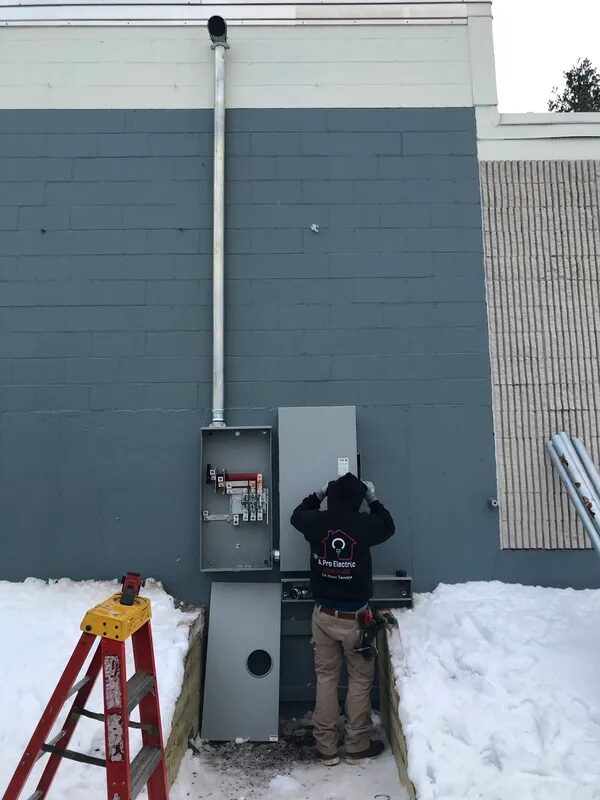
24 Hour Commercial Emergency Electrician, NH and Massachusetts
When a business cannot trade until the power is back. Emergency response for commercial and industrial buildings across Manchester, Nashua, Concord, Henniker, Portsmouth, Dover and over the border into Lowell, Lawrence, Haverhill and Methuen.
Emergency Electrical Response for Commercial Buildings in NH
What Counts as a Commercial Electrical Emergency
Anything that stops a business trading, threatens stock or equipment, or creates a hazard to staff or the public. In commercial work the threshold is lower than in a house, because the cost of waiting is measured in lost trading hours.
Total or partial loss of power to a unit. A burning smell or visible heat damage at a panel. Water into electrical equipment. Refrigeration down in a food business. A tripped main that will not reset. Storm damage to the service entrance. Loss of emergency lighting or life safety systems in an occupied building.
We respond across southern New Hampshire and into northern Massachusetts. Henniker is home, Concord and Manchester are regular territory, and Nashua, Bedford, Hooksett, Salem, Derry, Londonderry, Portsmouth, Dover, Rochester and the Merrimack Valley towns of Lowell, Lawrence, Haverhill and Methuen are all within range for commercial work.
Both states are licensed. An electrician without a Massachusetts license cannot legally work on a Lawrence building, which matters when the call comes in at two in the morning.
Power Loss and Whether It Is the Building or the Utility
The first question on any loss of supply is whether the problem is inside the building or upstream of it, and it changes who fixes it.
A whole-building outage with the neighbors also dark is a utility problem, and the useful action is reporting it and then dealing with the consequences: what is at risk while it is down, and whether there is a way to keep the critical parts running.
A building dark while the street is lit is inside the property, and that is ours. It could be the service entrance, the main breaker, a failed main lug connection or a utility fault at the individual service. A partial outage, where some circuits are live and some are not, frequently points to one phase lost on a three-phase service, which is important to identify quickly because three-phase equipment running on two phases can be damaged within minutes.
That single-phasing scenario is one of the genuine reasons not to wait until morning. Motors in that condition draw heavily and overheat, and an afternoon of it can cost more than the call-out several times over.
Burning Smells, Heat and Signs of Arcing
These are the calls to treat as urgent regardless of what is still working, because the equipment is telling you it is failing before it fails.
A hot or acrid smell near a panel, discoloration or scorching at a breaker or lug, a buzzing or crackling that was not there before, or warmth on a panel cover. A loose or deteriorating connection generates heat at the fault, and heat accelerates the deterioration, so the condition worsens on its own once it starts.
The correct response is isolating the affected equipment if it can be done safely and getting somebody in. It is not opening the panel to have a look: commercial gear carries fault energy a domestic panel does not, and an arc flash in a commercial switchboard is a serious injury.
This is also the failure mode that scheduled maintenance with thermal imaging is specifically designed to catch, because a hot connection shows on a thermal survey long before it produces a smell.
Refrigeration, Stock and Time-Critical Losses
For food businesses and anywhere with temperature-controlled stock, the electrical fault is the smaller problem and the clock is the real one.
A restaurant, grocery, convenience store or food producer with walk-in refrigeration down is losing inventory continuously, and past a certain point the stock is not recoverable regardless of whether the power returns. The same applies to laboratory, pharmacy and some manufacturing storage.
On arrival the first move on that kind of call is frequently restoring the refrigeration circuits, by whatever means is safe, before dealing with the rest of the building. Getting the critical load running and then fixing the underlying fault properly is a better sequence than a single tidy repair that takes three hours.
Businesses that keep having this exposure are the clearest candidates for standby power, because an emergency call-out cannot beat an outage that is the utility's to fix.
Storm Damage and Winter Call-Outs
New England weather produces a predictable pattern of commercial emergency work, and most of it is the same handful of faults.
Ice and wind bring branches onto overhead services, which can pull a service mast or weatherhead off the building. That is a repair the property owner is responsible for even though the utility owns the wire to it, and the utility will not reconnect until it is made good.
Water is the other winter problem: ice dams and roof leaks finding their way into light fixtures, panels and equipment, sometimes days after the weather event that caused them. Water in a panel is an isolate-first situation.
After a widespread storm everybody calls at once, so the honest answer is that response is sequenced by severity. A commercial building with a damaged service and no power is ahead of a single failed circuit, and we say which one a call is rather than promising an hour that cannot be met.
Getting a Business Trading Again
On a commercial emergency the objective is trading, and that is not always the same as a completed repair.
Frequently the right answer is a safe temporary arrangement that gets the business open today and a proper repair scheduled for a window that costs nothing. A temporary feed to critical circuits, isolating a faulted section so the rest of the building can run, or a replacement part fitted now with the underlying cause addressed properly later.
What is not acceptable is leaving something unsafe running because it is inconvenient to stop. Where a circuit or a piece of gear genuinely cannot be used, that gets said plainly, along with what it would take to change the answer.
The follow-up matters as much as the call-out. An emergency repair that was a temporary measure should be booked in as permanent work, not quietly become the permanent solution by default.
What to Do Before the Electrician Arrives
A few minutes of the right action makes a difference, and one wrong action makes things considerably worse.
If there is a smell of burning, heat or visible damage, isolate the affected part if the main disconnect can be operated safely and stay away from the equipment. If there is water involved, isolate and keep people away from it. If the building is dark, check whether neighboring buildings are too, because that answers the first diagnostic question before anybody arrives.
Do not reset a main breaker repeatedly. A breaker that trips again immediately is protecting against a fault that is still there, and each reset puts the fault energy through the gear again. Once is diagnostic; three times is damage.
Have the panel location, the meter location and, if you know it, what changed recently ready to hand. On a commercial site, knowing which panel feeds which unit saves a great deal of time at two in the morning, and it is the reason keeping panel schedules current earns its keep.
Reducing How Often the Emergency Call Is Needed
Most commercial emergency call-outs are not sudden. They are the end of a process that has been visible for a while.
Loose connections that were warm for months, breakers that had been tripping occasionally, equipment that had been showing faults, and gear that is old enough that failures are expected rather than surprising. Almost all of it is findable in advance.
A scheduled maintenance arrangement with thermal imaging catches the heat before the failure, and our guide to what preventive maintenance actually prevents sets out what a survey typically finds.
Where the risk is the utility supply rather than the building, the answer is standby power. Where it is aging distribution, it is usually replacing gear before it fails rather than after. Both are cheaper planned than at midnight.
What an Emergency Commercial Call-Out Covers
- Loss of power to all or part of a commercial building
- Diagnosis of whether the fault is the building or the utility supply
- Lost phase on a three-phase service, before equipment is damaged
- Burning smells, heat, scorching or arcing at panels and gear
- Water into panels, fixtures and equipment
- Refrigeration and time-critical load restoration first
- Storm damage to service masts, weatherheads and entrances
- Failed emergency lighting and life safety systems
- Safe temporary arrangements to get a business trading
- Follow-up permanent repair scheduled into a planned window
Call Straight Away If
- There is a burning or acrid smell near a panel or equipment
- A panel, breaker or disconnect is hot, buzzing or scorched
- Part of a three-phase building has lost power but not all of it
- Water is getting into a panel, fixture or piece of equipment
- A main breaker trips again immediately when reset
- Refrigeration or a critical process is down
- A service mast or overhead service has been damaged
- Emergency lighting or alarms are out in an occupied building
- Anyone has had a shock from equipment or a fitting
24 Hour Commercial Emergency Questions, Answered
Do You Cover Commercial Emergencies Out of Hours?
Yes. Commercial work frequently has to happen outside trading hours anyway, and an emergency does not wait for a weekday. Response is sequenced by severity, and after a widespread storm that sequencing is real rather than notional.
How Do I Know If the Outage Is My Building or the Utility?
Look at the neighbors. If the street is dark it is the utility and it needs reporting to them. If your building is dark while others are lit, the problem is at or inside your service and that is work for an electrician.
Part of the Building Has Power and Part Does Not. Is That Urgent?
On a three-phase service, yes. It frequently means a phase has been lost, and three-phase motors running on two phases overheat and can be damaged in a short period. It is worth treating as urgent rather than waiting for the morning.
Should I Keep Resetting the Main Breaker?
No. A breaker that trips again immediately is protecting against a fault that is still present, and every reset puts fault energy through the gear again. Once tells you something; repeatedly doing it causes damage.
How Far Do You Travel for a Commercial Emergency?
Henniker is home, with Concord and Manchester as regular territory. Nashua, Bedford, the I-93 towns, the Seacoast and the Massachusetts border towns are all covered for commercial work. Distance affects arrival time, and we say what that realistically is rather than quoting a standard figure.
Can You Get Us Trading Again Before the Full Repair?
Frequently yes, with a safe temporary arrangement and the permanent repair scheduled for a window that costs the business nothing. What we will not do is leave something unsafe running because stopping it is inconvenient.
Can These Call-Outs Be Avoided?
Most of them, yes. The majority of commercial emergency work is the end of a visible process: warm connections, occasional trips, aging gear. Scheduled maintenance with thermal imaging finds those before they become a call at midnight.
Guides on 24 Hour Commercial Emergency
Keeping a Business Open During Electrical Work
What genuinely cannot be done live, how work gets phased, and why the schedule is the real cost.
What a Standby Generator Protects in a Business
Working out what an hour of downtime costs, and sizing backup against that rather than against the building.
Preventive Maintenance: What It Actually Prevents
Thermal scanning, torque checks and what a loose connection looks like before it becomes an outage.
Other Commercial Electrical Work
Tenant Fit-Ups & Build-Outs
Restaurants, retail, offices and warehouses, rough-in to trim.
Service, Distribution & Switchgear
Three-phase service, panelboards, transformers and feeders.
Commercial Wiring & Circuits
New build wiring, retrofits, added circuits, conduit and raceway.
Commercial Lighting
LED retrofits, parking lot and site lighting, controls, high-bay.
Low Voltage & Systems
Data cabling, intercom, surveillance and access control.
Maintenance & Service Contracts
Scheduled maintenance, thermal scanning, planned replacement.
Property Management & Multi-Family
Common areas, apartment buildings, turnovers, house panels.
Equipment & Machine Connections
Kitchen equipment, motors, rooftop units and process circuits.
Commercial Generators & Emergency Power
Standby systems, automatic transfer switches, life safety power.
Commercial EV & Fleet Charging
Workplace charging, fleet charging, multi-port installations.
New Construction & GC Work
Ground-up commercial, design-build, subcontracting to GCs.