

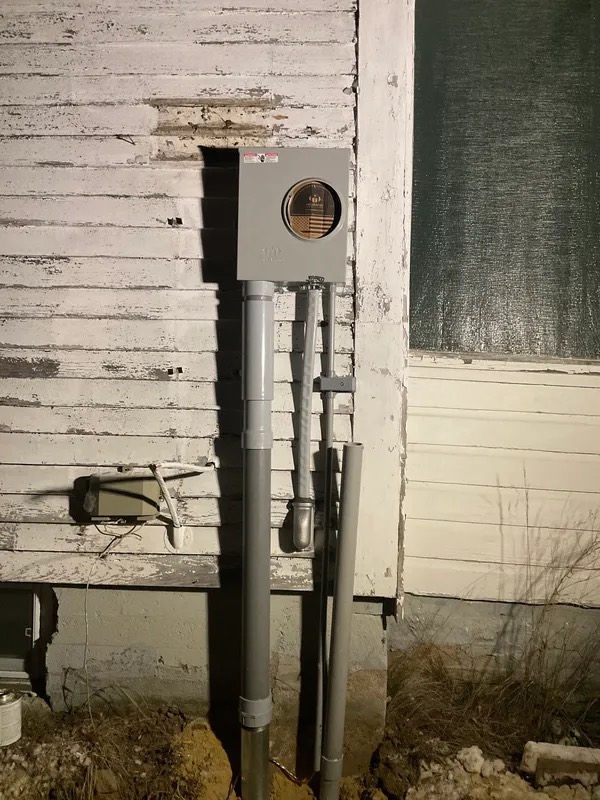
Critical Loads Panel Installation in New Hampshire
The subpanel that decides what stays on when the generator is carrying the house. Heat, water, refrigeration, and the circuits you would actually miss.
How a Critical Loads Panel Works in a New Hampshire Home
What a Critical Loads Panel Is For
A critical loads panel is a second, smaller panel holding only the circuits you want running during an outage. The generator feeds that panel rather than the whole house, so the set only ever has to carry what is inside it.
The reason it exists is cost. A generator sized to carry an entire modern house, with electric range, dryer, water heater and air conditioning all available at once, is a large and expensive machine. A generator sized to carry heat, water, refrigeration and lighting is a fraction of it, and for most households the second one delivers nearly all of the benefit.
It also removes a failure mode. When the generator feeds the whole panel, nothing stops somebody switching on a dryer during an outage and stalling the set. When it feeds a critical loads panel, the choice was made at installation and cannot be got wrong at two in the morning.
The alternative approach is a whole-house switch with automatic load management, which sheds large loads when the generator is running. That suits a larger house and a larger budget. For most New Hampshire homes the subpanel is the simpler and cheaper answer, and it is easier to understand later.
Choosing Which Circuits Make the List
This is the conversation that decides the whole installation, and it is worth having properly rather than accepting a standard list.
Four things are on almost every list in this state. Heating, because a New Hampshire house without heat for two days is a house with burst pipes, and that means the furnace or boiler and its controls rather than the fuel itself. Water, which on a private well means the pump. Refrigeration, because a freezer full of food is a real cost. And enough lighting to move around the house safely.
After that it becomes specific to the household. A home office that has to keep working. A sump pump in a basement that floods. Medical equipment, which changes the specification rather than just the list. A single kitchen outlet for a kettle and a microwave is worth more than people expect during a long outage.
What comes off the list is usually electric heat of any kind, the range, the dryer and air conditioning. Those are the loads that drive generator size, and dropping them is most of the saving.
Well Pumps, Septic and the Loads People Forget
On a rural property the pumps are the whole argument, and they are the loads most often underestimated.
A well pump draws several times its running current at the instant it starts, and that starting surge is what a generator has to swallow. A pump that runs comfortably on paper can stall a set that is already carrying a furnace, which is why the starting figure rather than the running figure is what belongs in the sizing.
Septic systems with a pump chamber need the pump and the alarm, and the alarm circuit is the one that gets left off. An alarm nobody can hear during a multi-day outage defeats the point of having it. The same applies to a sump pump in a house where the basement takes water, which in parts of Weare, New Boston and Deering is most of them.
Those circuits are usually on dedicated appliance and pump circuits already, which makes moving them into a backup panel straightforward. Where a pump shares a circuit with something else, separating it is worth doing at the same time.
Heating controls are the other commonly missed item, and they are easy to miss because they draw almost nothing. A boiler or furnace needs its thermostat, its zone valves and its circulators as well as the burner itself, and a backup panel that carries the burner circuit while leaving a zone controller behind produces heat that cannot be distributed. On a house with multiple zones that is worth confirming circuit by circuit rather than assuming one breaker covers it.
Sizing the Panel and the Generator Together
The panel and the generator are one decision, not two. The circuits on the list add up to a load, that load sets the generator size, and the generator size limits what can go on the list. It is a loop rather than a sequence.
The number that matters is the worst honest case: everything on the list that could plausibly run at once, with the largest motor starting at that moment. Sizing to average demand produces a system that works until the night it is genuinely needed.
It is worth leaving headroom, and worth being explicit about how much. A panel filled exactly to the generator’s capacity leaves no room for the circuit somebody wants to add in three years, and adding it later means revisiting the generator rather than the panel.
Two spare spaces and a little generator capacity is the usual recommendation, and it costs very little at installation compared with revisiting the whole arrangement later.
The generator sizing calculator works through the arithmetic, and the whole-house against essential-circuits decision is set out in full separately. Both are worth doing before the quote rather than after.
Moving Circuits Into the Backup Panel
The physical work is re-terminating the chosen circuits from the main panel into the new subpanel, and it is more involved than it sounds on a house where the wiring was never planned for it.
Circuits have to physically reach. A furnace circuit originating at the far side of a main panel may not have the slack to land in a subpanel mounted beside it, and the answer is either extending it properly in an accessible junction or re-running it. Neither is difficult; both take time that belongs in the quote.
Shared neutrals are the complication that catches people out. Where two circuits share a neutral conductor, separating one into a backup panel and leaving the other behind creates a genuine hazard rather than an inconvenience, and finding those is part of the survey rather than a surprise on the day.
On older houses the condition of what we find matters. Cloth-covered cable, aluminum branch wiring from the late sixties and early seventies, and brittle insulation all turn a simple re-termination into rewiring that circuit properly, and it is better to know before the work starts.
The subpanel also needs feeding, and that feeder is sized for the panel rather than for the sum of the circuits inside it. Its overcurrent protection sits in the main panel, which means at least one space there, and on a main panel that is already full that becomes part of the job rather than a detail. It is one of the more common reasons a straightforward-looking installation turns out to need the main panel addressed first.
Where the Panel Mounts and How It Is Labeled
The subpanel goes next to the main panel in almost every case, because that is where the circuits are and it keeps the work contained to one wall.
Where that is genuinely impossible, a remote subpanel is workable but it means a feeder run and a second location somebody has to find during an outage, which is worth avoiding where there is any alternative.
Clearances are the constraint rather than preference. Working space in front of the equipment is required and is frequently what decides the position on a crowded basement wall. Where the main panel is already boxed in by storage or a later partition, resolving that is part of the job.
Labeling is not a finishing touch on this panel, it is a function. This is equipment somebody uses in the dark during a storm, possibly somebody who did not commission it and does not know what is on it. Every circuit gets labeled with what it actually feeds, in plain words rather than trade shorthand.
The main panel gets relabeled at the same time, because half of it has just changed. Circuits that moved to the backup panel leave gaps behind, and a main panel whose labels no longer describe what is inside it is a hazard for whoever works on the house next, including us in five years. It is ten minutes of work at the end of a job and it is skipped more often than anything else on this list.
A card at the panel covering the start-up sequence belongs there too, for the same reason. The day it is needed is not a day for remembering how it works.
Where a household changes hands, that card and those labels are the only thing the next owner has. A backup system nobody understands is a backup system nobody uses correctly, and the ten minutes spent on labeling outlasts everybody who was present at the installation.
Permits, Inspection and What the Record Is Worth
A subpanel is permitted and inspected work. It adds distribution to the house and it is fed from a generator, so both halves of that matter to an inspector.
The permit is pulled in the town the house sits in and carries a licensed electrician’s name. Austin Provencher is a New Hampshire master electrician, which is the tier that can pull permits and take responsibility for the work, and the number is checkable against the state license lookup.
What an inspector looks at here is the separation of neutrals and grounds in the subpanel, the feeder and its protection, and the arrangement that prevents the generator and the utility ever meeting. The first of those is the most commonly got wrong on amateur work and the least visible once the cover is on.
The record follows the house. A buyer’s inspector who finds a backup panel and a generator connection with no permit history behind it will flag it, and it is not a question that can be answered afterwards.
When a Whole-House Switch Is the Better Answer
A critical loads panel is not always right, and saying so is more useful than selling one anyway.
Where a household genuinely wants everything available during an outage, and is prepared to buy a generator large enough to carry it, a whole-house transfer switch with load management is the cleaner arrangement. Nothing is excluded, nothing has to be decided in advance, and large loads are shed automatically when the set is near capacity.
It also suits a house where the circuits that would go on the list are scattered across a large panel in a way that makes moving them expensive. At some point the cost of re-terminating twelve circuits approaches the cost of the larger switch that made the exercise unnecessary.
The honest version of the comparison is that the subpanel is cheaper to install and cheaper to run, and the whole-house arrangement is more comfortable and less to think about. Both are legitimate. Automatic transfer switch installation covers the whole-house route, and the backup power page sets out where each one lands.
What a Critical Loads Panel Installation Covers
- Walk-through to agree which circuits are genuinely critical
- Load calculation including motor starting current
- Subpanel supplied and mounted beside the existing panel
- Chosen circuits re-terminated, with shared neutrals resolved properly
- Feeder and overcurrent protection sized to the panel
- Plain-English labeling on every circuit
- Permit pulled and inspection attended
When a Critical Loads Panel Makes Sense
- A whole-house generator costs more than the outages justify
- You want heat, water and refrigeration guaranteed, not everything
- The property is on a private well or has a septic pump
- You want the decision made once rather than during an outage
- An existing generator keeps stalling because too much is on it
Generators & Backup Power Questions, Answered
How Many Circuits Can a Critical Loads Panel Hold?
Physically as many as the panel has spaces for, but the real limit is the generator. Most households end up with somewhere between six and twelve circuits, and the number matters far less than which ones they are.
Can I Add Circuits to It Later?
Yes, provided the generator has the headroom and the panel has the spaces. That is the argument for leaving both with a little room at installation rather than filling them exactly.
Does a Critical Loads Panel Work With a Portable Generator?
It can, and it is a sensible pairing with a manual transfer switch. The panel decides what is available and the switch connects it, which removes the guesswork about what to turn on during an outage.
What Usually Gets Left Off the List?
Electric range, dryer, air conditioning and electric water heating, because those are the loads that drive generator size. Dropping them is most of the saving, and most households find they do not miss them for a day or two.
Will the Rest of the House Still Work Normally?
Yes. When utility power is on, everything runs exactly as it did. The subpanel only changes what happens during an outage, and the circuits inside it are fed normally the rest of the time.
Can Medical Equipment Go on the Panel?
Yes, and it should be raised explicitly because it changes the specification rather than just the circuit list. Equipment that cannot tolerate the seconds of transfer time needs a small battery backup of its own alongside the generator.
Guides on Generators & Backup Power
Standby Generators: What They Cover and What They Do Not
Whole-house against essential circuits, automatic against manual, and what a transfer switch is for.
Getting a Home Ready for a New Hampshire Winter
Outage backup, heat cables for ice dams and frozen pipes, winter heating load, and outdoor power before the snow.
More Generators & Backup Power
Portable Generator Hookup
Inlet, interlock and permit, so a generator you own can run the house safely.
Automatic Transfer Switch Installation
The switch that moves the house onto the generator, sized to the service.
Generator Servicing & Load Testing
The annual visit, tested under real load, with a written record.
Generator Replacement & Upgrades
Replacing a set that is past parts, past repair or too small for the house.
Home Battery Backup
Grid-charged battery backup, silent and instant, sized in hours.
All generators & backup power work, including what a full installation involves and what it costs.