

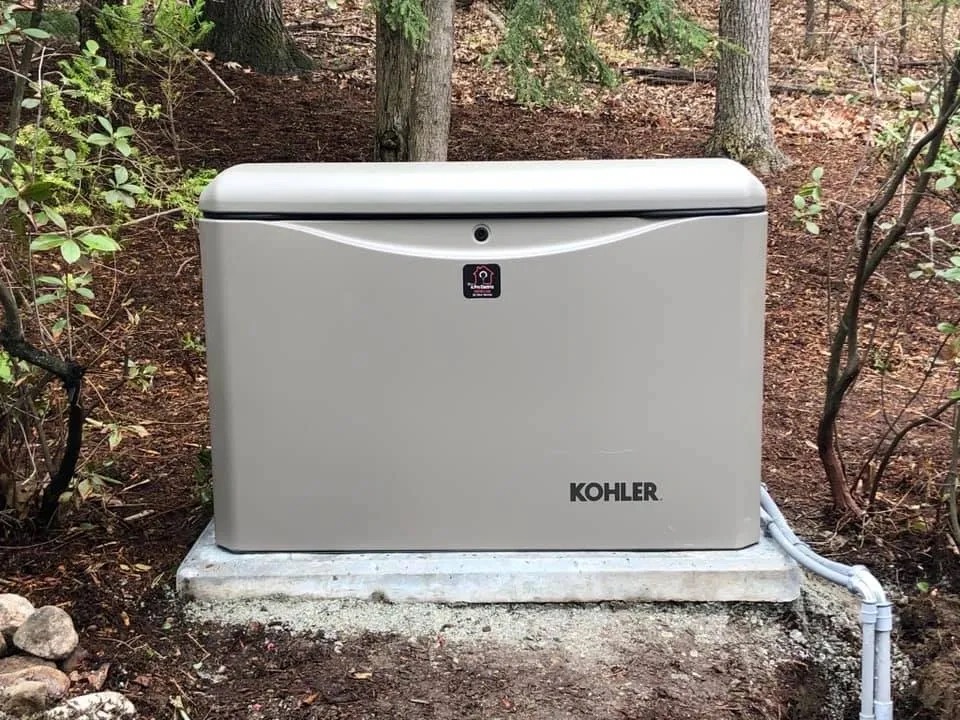
What Size Generator for a 100 or 125 Amp Service in NH, Small Service Homes
What size generator for a 100 amp service in NH is usually a smaller answer than people expect, because a house or camp on a 100 or 125 amp service tends to run a short list of things in an outage, and the generator is sized from that list rather than from the service.
Working Out the Generator Size for a 100 or 125 Amp Service in New Hampshire
What Size Generator a 100 Amp Service Needs, in Short
A 100 amp service at 240 volts can deliver up to 24,000 volt-amperes, and a 125 amp service up to 30,000. Neither number tells you the generator size. A generator is sized from what you choose to run during an outage, and on a small-service house that list is usually short, so the answer often lands somewhere between six and fourteen kilowatts by the method in our generator sizing calculator, before the margin and the round up to a unit that is actually sold.
The reason is the kind of house that has a 100 or 125 amp service. In New Hampshire that is often an older house that was never upgraded, a cottage or camp, a small ranch or a house heated by oil, gas or propane with no large electric loads. Those houses keep their heat, their water, their food and their lights going on a few thousand watts, and a generator that carries that list is a modest machine.
The small service does matter in other ways, and most of the advice for these houses is about the panel and the transfer equipment rather than the generator. The general method for every size is set out in standby generator sizing, and what follows applies it to the small-service house.
Generator Size for a 100 Amp Camp or Cottage That Stands Empty
About 10.1 percent of New Hampshire's housing units are held for seasonal, recreational or occasional use, according to the U.S. Census Bureau American Community Survey estimates for 2020 to 2024, and many of them are camps and cottages on a 100 amp service. For a house like that the generator question is different, because nobody is there to notice an outage, and the risk is a frozen pipe, a flooded basement or a freezer full of spoiled food found weeks later.
Take a camp with lights and outlets at 1,000 watts on the typical figures, a refrigerator at 700, a well pump at 1,000, the internet at 300 so the owner can watch the cameras, and a mini-split at 1,200 to keep the chill off. The running load is 4,200 watts. The well pump has the largest start, at 3,000 watts, and adding it once gives 7,200 watts. With a margin and a round up, the camp needs a small standby unit.
What matters most for an empty house is that the generator starts by itself and is exercised on a schedule, which is the case for a standby unit with an automatic transfer switch. A portable generator is no use to a camp in January if nobody is there to start it, and the size of the unit matters far less than the fact that it runs without anyone present.
An empty camp also benefits from a generator that reports in. Many standby units can send a message when they start, when they exercise and when something goes wrong, which lets an owner a long way away know that the house kept its heat through the storm. The internet connection that carries those messages is on the circuit list for that reason, and it costs only a few hundred watts.
Generator Size for a 100 Amp Town House on Gas With a Sump Pump
A different small-service house is the older home in town on utility gas, with no well and a sump pump in the basement. About 21.4 percent of occupied homes in the state heat with utility gas on the same Census estimates, and in those houses the heating system needs only a few hundred watts for its burner, igniter and blower, which keeps the essential load small.
On the typical figures, the furnace runs at 800 watts, the refrigerator at 700, a chest freezer at 500, the lights and outlets at 1,000, the internet at 300 and the sump pump at 800. That is 4,100 watts of running load. The largest start is now the sump pump at 2,400 watts, just ahead of the refrigerator at 2,200, and adding it gives 6,500 watts.
A house like this is often a good candidate for a portable generator rather than a standby one, if someone is usually home. A portable generator hookup with an inlet and an interlock typically costs about $650 and lets a portable of the right size run these circuits safely. The sizing is the same, and the difference is who starts the generator and who keeps it fueled.
What Size Generator for a 125 Amp Service With an Electric Water Heater
A 125 amp service sits between the old 100 amp standard and the modern 200 amp one, and it turns up in houses that were upgraded once and not again. The houses tend to be a little larger and to carry a little more, and the commonest extra on the generator list is an electric water heater, which is a large load with no starting surge.
Take an oil-heated house on a well with the boiler at 800 watts, the refrigerator at 700, the freezer at 500, the well pump at 1,000, the lights and outlets at 1,000, the internet at 300 and a microwave at 1,200, which together come to 5,500 watts. Add the electric water heater at 4,500 and the running load is 10,000 watts. The well pump start of 3,000 watts takes the required size to 13,000.
The water heater has more than doubled the running load, and it is worth asking whether it needs to be on the generator. Hot water can wait a day in most outages, and a tank holds its heat for a good while. Leaving it off brings the 125 amp house back to an essentials figure of about 8,500 watts, and the decision is worth thousands in the size of the unit.
Panel Space and Transfer Switches on a 100 or 125 Amp Service
The real constraint on a small-service house is usually the panel. An older 100 amp panel is often full, sometimes a fuse box, and sometimes one of the brands we would rather replace than add to. A generator needs either a transfer switch in front of the panel or a breaker space for an interlock, and a full or obsolete panel may have room for neither.
On a 100 amp service a whole-house automatic transfer switch is rated at 100 amps, because it has to carry everything the service can, however small the generator behind it. A critical loads arrangement moves the chosen circuits into a small backup panel, which suits these houses well because the list is short and the panel move tidies up a crowded main panel at the same time.
We open the panel before we talk about generators, because the panel decides which arrangement fits and what it costs. Where the panel is a fuse box or a brand with a known history, the honest advice is to deal with it first, and a generator connected to a panel that should be replaced is money spent in the wrong order.
When a 100 Amp House Should Upgrade the Service Before Buying a Generator
Some small-service houses are about to stop being small-service houses. A heat pump in place of an oil boiler, an electric range in place of a gas one, an EV charger or a hot tub can each push a 100 amp service to its limit, and a household planning any of them may be better served by a service upgrade first and the generator second.
The order matters because the transfer equipment follows the service. A transfer switch bought for a 100 amp service has to be replaced when the service becomes 200 amps, and a generator sized for today's short list may be too small for the house after the heat pump arrives. A 200 amp service upgrade typically runs $3,000 to $3,500 for the service itself, and doing it before the generator avoids buying the transfer equipment twice.
If no large additions are planned, the 100 or 125 amp service is perfectly adequate and the generator can be sized for the house as it is. Our guide to what size electrical service a house needs explains how to tell which case you are in, and panel and service upgrades covers the work if the answer is to upgrade.
Standby or Portable Generator for a 100 or 125 Amp House
On a small-service house the choice between a standby and a portable generator usually matters more than the exact size. A standby unit sits on a pad, runs on natural gas or propane and starts by itself when the power fails. A portable is wheeled out, started by hand and fueled with gasoline, and it is connected through an inlet and an interlock or a small transfer switch.
A standby system is typically $10,000 to $20,000 installed, with the unit included, and for a camp that stands empty or a household that is often away it is the only choice that protects the house when nobody is there. A portable with a proper hookup costs a fraction of that and is a sensible answer for an occupied house with a short essential list, as long as someone is willing to run it through a long outage.
Both are sized the same way, from the circuits on the list. A portable that is too small stalls when the well pump starts, and one that is too large burns fuel for nothing, so the arithmetic is worth doing either way. Our guide to standby generators explained sets out what each choice covers and what it does not.
What We Check Before Quoting a Generator for a 100 or 125 Amp Service
A quote starts at the panel. We confirm the service size, the panel brand and condition and how many spaces are free, because those decide whether a transfer switch, an interlock or a critical loads panel will fit. Then we read the nameplates on the heating system, the well pump, the sump pump and the main appliances, which replace the typical figures in the examples with the real ones.
We ask how the house is used. Whether it is lived in all year or closed for the winter, whether anyone is home to start a portable, what large additions are coming and how much inconvenience is acceptable in an outage. Those answers decide the circuit list, and on a small-service house they usually decide between a standby and a portable as well.
The result is a written scope with the generator size, the transfer arrangement, the fuel and the position, so the size can be checked against the list. Larger houses are covered in what size generator for a 200 amp service, and every installation is permitted, inspected and tested under load before we leave.
What size generator for a 100 amp service in NH is usually a short list and a small unit, and the panel matters more than the generator. A. Pro Electric, a licensed master electrician in Henniker, opens the panel first and sizes the generator from your own nameplates.
What Generator Sizing for a 100 or 125 Amp Service Includes
- A look at the panel, its brand, its condition and its free spaces
- A circuit list worked out with you and checked against the nameplates
- A written generator size from running watts plus the largest motor start
- A transfer switch, interlock or critical loads panel matched to the service
- Advice on whether a service upgrade should come first
- Permit, inspection and a load test before we leave
Signs a 100 or 125 Amp House Needs Generator Sizing Before a Purchase
- A camp or cottage that stands empty through the winter
- A fuse box or a full panel on a 100 amp service
- A well pump or sump pump that has to keep running
- A heat pump, electric range or EV charger planned soon
- Two dealers have quoted two very different sizes
Generator Size for a 100 or 125 Amp Service Questions, Answered
What Size Generator Do I Need for a 100 Amp Service?
Usually a small one. On the typical figures, a camp with lights, a refrigerator, a well pump, internet and a mini-split needs about 7,200 watts before the margin, and a town house on gas with a sump pump about 6,500. Your own nameplates give the real answer.
What Size Generator Do I Need for a 125 Amp Service?
It depends on the list. An oil-heated house on a well comes to about 8,500 watts for essentials, and about 13,000 if an electric water heater is added. Leaving the water heater off is the single biggest saving.
Can a 100 Amp Service Support a Whole-House Generator?
Yes. A whole-house transfer switch on a 100 amp service is rated at 100 amps, and the generator behind it is sized to what you run at once. The service limits the switch, not the generator.
Should I Upgrade My 100 Amp Service Before Buying a Generator?
If a heat pump, electric range, EV charger or hot tub is planned, often yes, because the transfer equipment follows the service and would otherwise be bought twice. If nothing large is coming, the 100 amp service is fine.
Is a Portable Generator Enough for a 100 Amp House?
For an occupied house with a short essential list, often yes, with a proper inlet and interlock, which typically costs about $650. For a camp that stands empty, no, because nobody is there to start it.
My 100 Amp Panel Is a Fuse Box. Can a Generator Be Connected?
It can be done in some cases, but the honest advice is usually to replace the fuse box first. A generator connected to a panel that should be replaced is money spent in the wrong order.
Is the Generator Setup Different for 125 Amps Than for 100 Amps?
Only in the transfer equipment, which is rated for the service, so a whole-house switch on a 125 amp service is a 125 amp device. The generator is sized the same way from the circuit list, and a 125 amp house often carries one more large load, such as an electric water heater, which is worth deciding about first.
Do I Need a Permit for a Generator on a 100 Amp Service?
Yes. A generator connection changes how the house connects to the supply, so it is permitted and inspected work in New Hampshire. We pull the permit and test the generator under load before we leave.
Guides on Generators & Backup Power
Standby Generators: What They Cover and What They Do Not
Whole-house against essential circuits, automatic against manual, and what a transfer switch is for.
Getting a Home Ready for a New Hampshire Winter
Outage backup, heat cables for ice dams and frozen pipes, winter heating load, and outdoor power before the snow.
More Generators & Backup Power
Portable Generator Hookup
Inlet, interlock and permit, so a generator you own can run the house safely.
Automatic Transfer Switch Installation
The switch that moves the house onto the generator, sized to the service.
Critical Loads Panel
The subpanel that decides which circuits stay live in an outage.
Generator Servicing & Load Testing
The annual visit, tested under real load, with a written record.
Generac Generator Installation
The brand we fit most often, sized to the house and commissioned under load.
Generator Replacement & Upgrades
Replacing a set that is past parts, past repair or too small for the house.
Standby Generator Sizing
How to size a standby generator from the circuits you keep on, for 100 to 300 amp service.
Generator Size for a 150 Amp Service
Wells, septic, central air and home offices, worked into a generator size.
Generator Size for a 200 Amp Service
What size generator a 200 amp house needs, worked from the circuits and not the service.
Generator Size for a 300 Amp Service
All-electric and heat pump homes, split services and workshops, sized with load management.
Generator Size for a 400 Amp Service
Sizing a generator for a large house, a second panel or a property with outbuildings.
All generators & backup power work, including what a full installation involves and what it costs.