

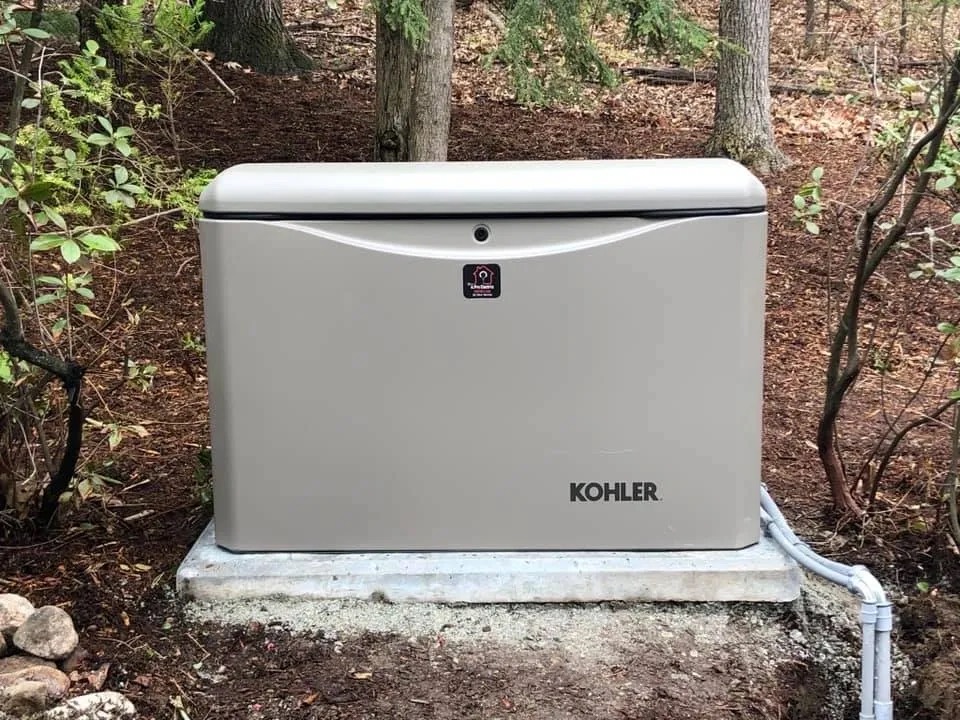
Automatic Transfer Switch Installation in New Hampshire
The device that decides, in seconds and without anyone present, whether your house is on the utility or on the generator. Sized to the service, wired to the panel, tested under load.
What an Automatic Transfer Switch Installation Involves in New Hampshire
What an Automatic Transfer Switch Actually Does
An automatic transfer switch watches the utility supply and moves the house onto the generator when that supply fails. It starts the generator, waits for it to stabilise, transfers the load, and then reverses the whole sequence when utility power returns and holds steady. Nobody has to be home, awake or willing to go outside.
It is also the safety device that makes a standby generator legal. The switch physically prevents the generator and the utility from being connected at the same moment, which is what stops power flowing backwards onto lines a utility crew is working on. Everything else about a standby installation is convenience; this part is the requirement.
The distinction from a manual switch is only who does the work. A manual transfer switch does the same job with a person operating it, which is fine alongside a portable generator hookup where somebody is home anyway. The automatic version exists because the outages that cause real damage in New Hampshire happen at three in the morning, or while the house is empty for a February week.
It sits between the utility supply and the panel, so it is a change to the service itself rather than an addition alongside it. That is why it is permitted, inspected work and why it is not a device that gets retrofitted casually.
Service-Entrance Rated Switches Against Downstream Switches
There are two places a transfer switch can sit, and the choice changes the cost and the disruption more than anything else on the job.
A service-entrance rated switch takes the incoming supply directly and contains the main disconnect, so it replaces part of the existing service equipment. It is the tidier installation and it often suits a house that is due an electrical panel replacement anyway, because the two jobs share most of their work. The trade is that it is a bigger intervention in the service and a longer day with the power off.
It also tends to be the better answer where space is tight, since it removes one enclosure from the wall rather than adding another beside it.
A downstream switch sits after the existing main, between it and the panel. The existing service equipment stays exactly as it is, which makes it the less invasive option and usually the cheaper one. It suits a house with a recent service that has no other reason to be touched.
Which one is right is decided at the survey rather than in advance, and it depends on the age and condition of what is already there. A house with a sound 200 amp service installed five years ago and a house still on an original 100 amp service with a crowded panel are different jobs, and pricing them the same would be guessing.
Sizing a Transfer Switch to the Service, Not the Generator
This is the sizing rule that surprises people. A transfer switch is rated for the service it carries, not for the generator that feeds it. A 200 amp service takes a 200 amp switch even if the generator behind it is far smaller, because the switch also carries the full utility load whenever the house is running normally, which is almost all of the time.
Undersizing it is not a saving, it is a fault. A switch rated below the service becomes the weakest point in the supply, and it is carrying the entire house every ordinary day of the year rather than only during outages.
The reverse case comes up on houses that have had a service upgrade since the generator went in. A switch sized for a 100 amp service does not become adequate because it has been working fine; it becomes the part that was never revisited when everything around it grew. Any work on the service is the moment to check what the switch is rated for, and it is a question worth asking of an installation somebody else did.
Where the generator is smaller than the service, which is the usual case, the way to reconcile the two is not a smaller switch. It is either load management built into the system, which sheds large loads automatically when the generator is running, or a critical loads panel that limits what can draw from the generator in the first place.
The generator sizing calculator works through the generator side of that. The switch side follows from the service rating, which is a fact about the house rather than a choice.
Transfer Timing and the Equipment That Cares About It
There is a gap between the utility failing and the generator carrying the house. On a standard residential installation it runs to a handful of seconds: the switch senses the loss, signals the generator to start, waits for the engine to reach stable output, and only then transfers. The wait is deliberate, because transferring onto an engine that has not settled is worse than waiting.
For most of a house that gap is invisible. Heating, pumps, refrigeration and lighting all restart without complaint. What notices are devices that cannot tolerate an interruption at all, and in an ordinary house that is a short list: a desktop computer mid-task, some network equipment, and occasionally medical equipment that has to be raised specifically because it changes the specification.
The answer for those is not a faster switch. It is a small uninterruptible supply on that one piece of equipment, which bridges the seconds until the generator has the house. Trying to close the gap at the switch is the expensive way to solve a cheap problem.
Coming back is the half nobody thinks about. The switch waits for the utility to prove itself stable before returning the house, and then lets the generator run on to cool before shutting it down. A switch that returns the moment voltage reappears will hand the house back into a supply that is still failing.
Where the Switch Mounts and Why That Matters Later
The switch goes near the service equipment, because that is where the conductors it needs already are. Within that constraint there are choices, and they are worth making deliberately.
Getting that decision right at the survey costs nothing; revisiting it afterwards means opening the service a second time.
Outdoors alongside the meter is common and perfectly sound, provided the enclosure is rated for it, and it keeps the cable runs short. Indoors next to the panel is tidier and easier to service in February, which on a New Hampshire property is worth something. The deciding factor is usually where the generator will sit, since the conductors between the set and the switch have to get there somehow and the route is easier to establish before anything is mounted than after.
Indoors also keeps the controller out of the temperature swings that shorten the life of electronics, which is a quieter argument for it than accessibility but a real one.
Access is the part that gets overlooked. This is equipment that will be tested annually and worked on eventually, so a switch boxed behind storage in a finished basement, or one that ends up behind a snow drift every winter, creates a small recurring cost for the life of the installation.
Where the generator itself ends up is part of the same decision. The conductors between the set and the switch have to run somewhere, and a route established before anything is mounted is straightforward where one retrofitted afterwards is frequently not.
Clearances in front of the equipment are not negotiable, and on a crowded wall they are frequently what decides the position rather than preference.
Wiring the Switch Into an Existing Panel
Most of this work is on houses that already have a panel and a service, so the job is an interruption to a working system rather than a fresh install. That shapes how it runs.
The service conductors are re-routed through the switch, which means the power is off for a meaningful part of the day and the utility is usually involved in disconnecting and reconnecting at the meter. That is scheduled rather than improvised, and on a winter job it is worth planning around anything in the house that genuinely cannot lose power for a few hours.
What we find inside the existing panel sometimes changes the scope. Crowded neutrals, double-tapped breakers, aluminum branch conductors and panels with no listed parts still available are all common on houses of a certain age around Henniker, Hopkinton and Warner. None of it is a reason not to proceed, but it is better established at the survey than discovered with the service open.
On a house where the panel is already at capacity, fitting the switch and leaving the panel untouched is often a false economy, because the next piece of work opens the same wall again.
Permits, Inspection and the Utility
A transfer switch changes the service, so it is permitted and inspected work and the utility has to be involved wherever the meter is disconnected. Neither is optional and both take scheduling rather than a phone call on the day.
The permit is pulled in the town the house sits in and carries a licensed electrician’s name. Austin Provencher is a New Hampshire master electrician, the tier that can pull permits and take responsibility for the work.
Inspection happens once the installation is complete, and the transfer switch is the part an inspector will look at hardest, because it is the interlock between two supplies. An installation that works but cannot be inspected is not finished.
The record matters beyond the day for the same reasons it does on any service work. An insurer after a fire, or a buyer’s inspector at sale, will ask whether the generator connection was permitted, and it is not a question that can be answered retrospectively.
Exercising, Testing and What Fails Over Time
A transfer switch is a mechanical device that spends years in one position. Left entirely alone, contacts oxidise, linkages stiffen and the controller’s own battery or settings drift, and none of that announces itself.
Most systems exercise weekly on a schedule, which starts the generator and runs it briefly. That is worth having, and it is the easiest test there is. It usually runs the engine without transferring the house, so it proves the generator starts and proves almost nothing about the switch.
The test that means something transfers the actual load and then returns it, which is a different exercise and the reason annual generator servicing covers the switch rather than only the engine. A set that starts perfectly into a switch that will not transfer is a building with no power and a running generator outside it.
Where a switch is old enough that parts are no longer available, that is worth knowing before it fails rather than during the outage it was bought for, and it frequently arrives alongside replacing the generator itself.
What a Transfer Switch Installation Covers
- Survey of the existing service, panel and generator position
- Automatic or manual transfer switch, sized to the service rating
- Service-entrance or downstream configuration, whichever suits the house
- Conductors between the generator, the switch and the panel
- Utility coordination where the meter has to be disconnected
- Permit pulled and inspection attended
- Live transfer test in both directions before handover
When a Transfer Switch Is the Right Call
- You are installing a standby generator and need the switch that makes it legal
- The house is empty for stretches in winter
- Nobody wants to go outside at 3am to start a generator
- An existing switch is old enough that parts are getting scarce
- A manual hookup has stopped being practical
Generators & Backup Power Questions, Answered
Can I Use an Automatic Transfer Switch With a Portable Generator?
Usually not in the automatic sense, because a portable has to be started and connected by hand, which removes the point of the automation. A manual transfer switch or an interlock is the correct match for a portable, and it does the same safety job.
How Long Does a Transfer Switch Installation Take?
Typically a day, with the power off for several hours of it while the service conductors are re-routed. Where the utility has to disconnect at the meter that is scheduled in advance rather than arranged on the day.
Does the Switch Have to Match the Generator Brand?
Not necessarily, though a matched set from one manufacturer is often simpler because the controls are designed to talk to each other. Where a switch and a set come from different makers, the control wiring between them has to be established before anything is ordered.
What Happens If the Transfer Switch Fails?
The house stays on the utility, which is the safe direction to fail in, but the generator cannot carry it. That is precisely why the annual test transfers the load rather than only starting the engine.
Can a Transfer Switch Be Added to an Existing Generator?
Often yes, and it is a common upgrade on a house that started with a manual arrangement. Whether the existing set supports automatic starting is the first thing to check, because not every unit does.
Do I Need a Permit for a Transfer Switch?
Yes. It changes how the house connects to the utility supply, so it is permitted and inspected work, and the permit carries a licensed electrician’s name.
Will My Lights Flicker When It Transfers?
There is a short interruption rather than a flicker, usually a handful of seconds while the generator starts and stabilises. Almost everything in a house restarts without noticing; anything that genuinely cannot is better handled with a small battery backup on that one device.
Guides on Generators & Backup Power
Standby Generators: What They Cover and What They Do Not
Whole-house against essential circuits, automatic against manual, and what a transfer switch is for.
Getting a Home Ready for a New Hampshire Winter
Outage backup, heat cables for ice dams and frozen pipes, winter heating load, and outdoor power before the snow.
More Generators & Backup Power
Portable Generator Hookup
Inlet, interlock and permit, so a generator you own can run the house safely.
Critical Loads Panel
The subpanel that decides which circuits stay live in an outage.
Generator Servicing & Load Testing
The annual visit, tested under real load, with a written record.
Generator Replacement & Upgrades
Replacing a set that is past parts, past repair or too small for the house.
Home Battery Backup
Grid-charged battery backup, silent and instant, sized in hours.
All generators & backup power work, including what a full installation involves and what it costs.