

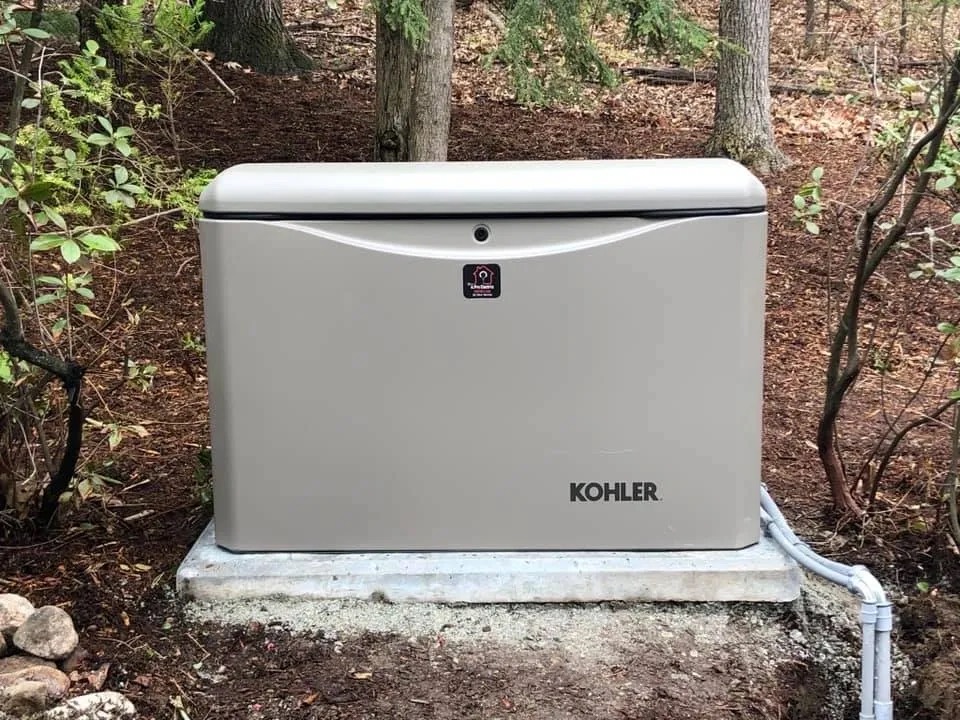
Standby Generator Servicing in New Hampshire
The annual visit that finds the battery, the block heater or the transfer switch before an ice storm does. Tested under real load, with a record of what was found.
What Annual Standby Generator Servicing Covers in New Hampshire
What an Annual Generator Service Covers
A standby generator service is an inspection, a set of replacements on a schedule, and a test that proves the system carries the house. The engine work is the part people picture, and it is the smaller half.
On the engine side it is oil and filter, air filter, spark plugs on a gas set, coolant where there is a radiator, and the drive belts. Those follow the manufacturer’s hours and calendar rather than a guess, because a set that runs a weekly exercise accumulates hours quietly and a set that has carried two long outages accumulates them quickly.
On the electrical side it is the battery, the charger, the block heater, the control board settings and the connections at the set, all of which are where the failures actually cluster. A generator that will not start has far more often lost a battery or a heater than an engine.
Then the test, which is what separates a service from a look. The system is run under real load and transferred, because that is the only way to know it does the job it exists for.
What the visit is not is an engine service in isolation. A generator that starts perfectly into a transfer switch that will not move the load leaves a house in the dark with a machine running outside it, which is why the switch is part of the same appointment rather than a separate one.
Load Testing Against Weekly Self-Exercise
Almost every standby set exercises itself weekly. It starts, runs for ten or fifteen minutes and shuts down, usually without transferring the house. It is worth having and it is the easiest test that exists.
What it proves is that the engine starts on a mild day with no load on it. What it does not prove is that the set will carry the house, that the transfer switch will move the load, or that it will start at minus ten in February. Those are the three things that matter in an outage and none of them is covered.
A load test transfers the house onto the generator and leaves it there long enough to reach operating temperature and stabilise. Problems that only appear under load surface here: an engine that runs rough once it is asked for real output, a voltage regulator drifting, a set that is simply undersized for what the house has become since it was installed.
Reaching temperature is the part that cannot be shortcut. A set run for five minutes has proved it starts; a set run until it is hot has proved it can keep going, and the faults that matter almost all appear in the gap between those two.
It is also the only honest test of the automatic transfer switch, because a switch that has sat in one position for a year is a mechanical device that has not moved. Testing the generator without testing the switch covers half the system.
Batteries, and Why Most Non-Starts Are Not Engine Faults
The single most common reason a standby generator fails to start is its battery, and it is also the most predictable.
A generator battery lives a hard life. It sits in an unheated enclosure through a New Hampshire winter, gets asked for a large cranking current occasionally, and spends the rest of its time on a trickle charger. Capacity falls with age on a known curve and falls further in cold, so a battery that is marginal in October is a non-start in January, which is exactly when it is wanted.
Most manufacturers put the service life somewhere around three years in this climate, and replacing on that schedule rather than on failure is one of the few genuinely predictable maintenance decisions available. A battery costs very little against an outage the set sleeps through.
The charger matters as much as the battery. A failed charger produces a battery that discharges slowly over months, and the set gives no indication until it is asked to start. Checking charging voltage is a two minute test that catches it.
Terminals matter as much as the battery itself. Corrosion at a post adds resistance exactly where the largest current in the whole system passes, and a set that cranks slowly is frequently telling you about its terminals rather than its battery. Cleaning and protecting them is trivial work that prevents a replacement nobody needed.
Block Heaters and Cold-Weather Readiness
A block heater keeps the engine warm enough to start reliably when it is genuinely cold, and on a New Hampshire installation it is not optional equipment.
It is also invisible when it fails. The heater draws power continuously through the winter to be ready for a day there is none, and nothing on the set announces that it has stopped. The generator will still run its weekly exercise perfectly well in mild weather, so the failure hides until the first hard cold snap.
Checking it is straightforward: confirm the heater is drawing current and that its circuit is live. That single check is one of the highest-value things on a pre-winter visit, which is why the sensible time for the annual service is early fall rather than whenever the anniversary falls.
Fuel behaves differently in the cold too. Propane loses vaporization pressure as temperature drops, so a tank that ran the set fine in October can struggle to supply it in January, and tank size and fill level are part of the cold-weather check rather than the fuel supplier’s problem alone.
Fuel, Storage and the Problems That Come From Sitting
Standby sets run on natural gas, propane or diesel, and each fails differently when left alone.
Natural gas is the least trouble, since the supply is continuous and there is nothing to store. What matters is that the supply line is sized for the set’s demand, which is occasionally found to be marginal on an installation where the generator was added to an existing service.
That shows up as a set that runs well until something else in the house calls for gas at the same time, which is exactly the condition a long winter outage creates.
Propane is the common answer across rural New Hampshire because there is no gas main, and the issues are pressure and quantity. A set carrying a house for several days gets through a surprising volume, and a tank sized for a range and a water heater will not sustain it. Regulator capacity is the other half, and it is sized for the whole demand rather than the generator alone.
Diesel is the one that punishes storage. Fuel degrades, absorbs water and grows microbial contamination in a tank that sits for years, and it gels in cold without the right winter blend. On a diesel set, fuel condition is part of the service rather than an assumption.
The Transfer Switch Gets Tested on the Same Visit
A generator and its transfer switch are one system, and servicing one without the other leaves the more likely failure untouched.
The switch is a mechanical device that has usually spent a year in a single position. Contacts oxidise, linkages stiffen and, on an outdoor or unheated installation, condensation and corrosion do their work quietly. None of it shows until it is asked to move.
The test that matters transfers the house onto the generator and then returns it, in both directions, with the timing checked on each. A switch that transfers but will not return leaves a house running on a set that was never meant to run for days.
Timing is recorded rather than merely observed. How long the set takes to reach stable output, how long the switch waits before transferring, and how long it holds before handing the house back are all adjustable and all drift over time. A system transferring noticeably slower than it did a year ago is saying something about the engine or the controller well before either fails outright, and that is only visible if last year’s figures were written down.
Where the switch is old enough that parts are getting scarce, that is worth knowing in advance rather than discovering it during the outage it was bought for. It frequently arrives alongside replacing the generator itself, since the two tend to reach the end of their lives together.
The enclosure gets the same attention on an outdoor installation. Seals, gaskets and the points where conduit enters are where water gets in, and water inside a transfer switch is a fault waiting for a cold night. On a house where a critical loads panel sits alongside it, the same check covers both.
What Gets Recorded, and Why the Record Has Value
A service that leaves no record behind is difficult to build on. Everything found, replaced and tested is written down, along with the readings that will matter next time.
Hours run, battery voltage and its condition, what was replaced and when, whether the load test passed and at what load, and anything that is working now but will not be in two years. That last category is the useful one, because it turns maintenance into something that can be planned rather than reacted to.
Warranty terms frequently depend on it as well. Most manufacturers require documented servicing at stated intervals, and a claim on a set with no record is a difficult conversation regardless of how well the machine was actually treated.
For a household the record answers the question that comes up at sale, when a buyer’s inspector asks whether the backup system has been maintained. A set with a service history is an asset; one with none is an unknown.
It also means the next visit starts from evidence rather than from scratch, which is the practical argument for the same electrician doing it each year.
A Scheduled Visit Against Calling When It Fails
The alternative to a service schedule is not saving money. It is discovering the fault during the outage, alongside everybody else in the region discovering theirs.
A generator that fails during an ice storm is competing for attention with every other emergency in the state, in the weather that caused it, with parts availability that depends on suppliers who are also affected. A generator that fails during a scheduled test in October is a parts order and a return visit.
The economics are not subtle. The annual service is a small fraction of what the generator cost, and the generator exists specifically to prevent an expense that is much larger than either. A set that sleeps through the outage it was bought for has delivered nothing at all.
Austin wants recurring work of exactly this kind, so it is arranged as a standing schedule rather than something remembered each year. The backup power page covers the systems themselves, and emergency call-outs run around the clock for the times the plan does not hold.
What an Annual Generator Service Covers
- Oil, filters, plugs and belts on the manufacturer’s schedule
- Battery test and replacement on a three-year cycle
- Charger output and block heater current confirmed
- Fuel supply, pressure and condition checked
- Load test with the house transferred onto the generator
- Transfer switch operated in both directions and timed
- Written record of readings, replacements and what to expect next
When a Generator Needs Servicing
- It has never been load tested, only self-exercised
- A year or more since anyone looked at it
- It cranks slowly or hesitates on its weekly exercise
- Winter is coming and nobody has checked the block heater
- It is due to carry the house and nobody is confident it will
Generators & Backup Power Questions, Answered
How Often Should a Standby Generator Be Serviced?
Annually for most residential sets, and early fall is the right time in this climate because it puts the visit before the season the generator exists for. Sets that have carried long outages may need it sooner, since hours accumulate faster than the calendar suggests.
My Generator Exercises Itself Weekly. Is That Enough?
It proves the engine starts, which is worth having, but it runs unloaded and usually does not transfer the house. It says nothing about whether the set will carry the building, whether the switch will move, or whether it will start at minus ten.
How Long Does a Service Visit Take?
Usually two to three hours including the load test. The house transfers onto the generator for part of it, which is a brief interruption rather than a day without power.
Do You Service Generators You Did Not Install?
Yes. The first visit takes a little longer because it starts with establishing what is there and what condition it is in, and that becomes the baseline everything afterwards is measured against.
What If You Find Something Wrong?
You get told what it is, what it will cost and how urgent it actually is, before anything is done. Some findings are replace-now and some are plan-for-next-year, and the difference is worth stating plainly rather than bundling.
Is Servicing Worth It on an Older Generator?
Usually, up to the point where parts availability becomes the problem. That is the honest moment to talk about replacement instead, and it is better raised during a service than during an outage.
Guides on Generators & Backup Power
Standby Generators: What They Cover and What They Do Not
Whole-house against essential circuits, automatic against manual, and what a transfer switch is for.
Getting a Home Ready for a New Hampshire Winter
Outage backup, heat cables for ice dams and frozen pipes, winter heating load, and outdoor power before the snow.
More Generators & Backup Power
Portable Generator Hookup
Inlet, interlock and permit, so a generator you own can run the house safely.
Automatic Transfer Switch Installation
The switch that moves the house onto the generator, sized to the service.
Critical Loads Panel
The subpanel that decides which circuits stay live in an outage.
Generator Replacement & Upgrades
Replacing a set that is past parts, past repair or too small for the house.
Home Battery Backup
Grid-charged battery backup, silent and instant, sized in hours.
All generators & backup power work, including what a full installation involves and what it costs.