

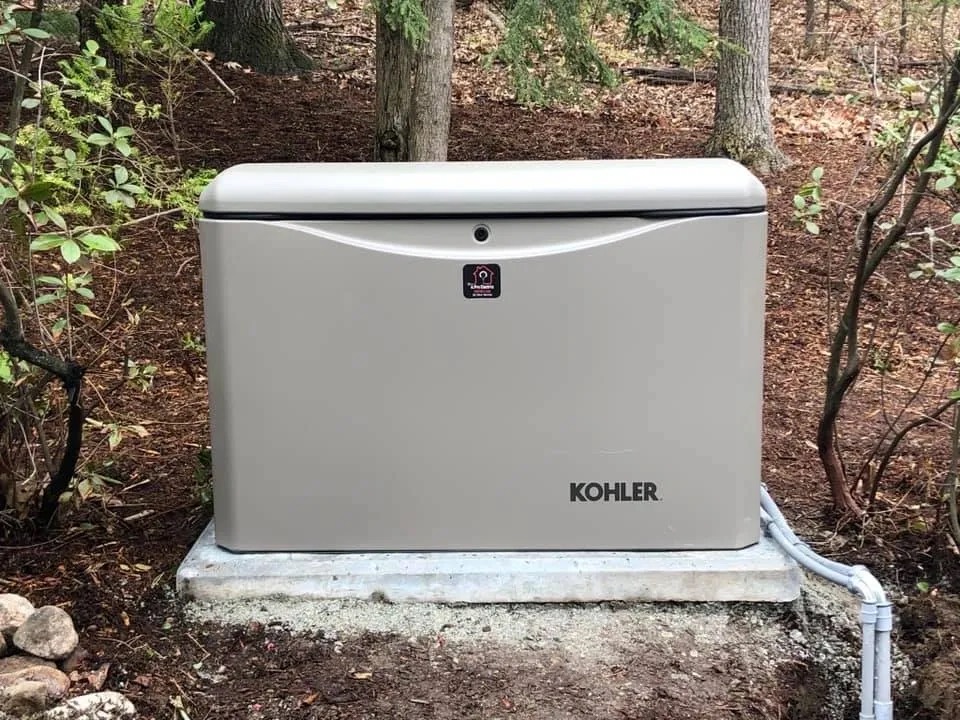
Residential Electrician in New Boston, NH: Generator Installation and Backup Power
A licensed master electrician for standby and portable generator installation in New Boston. Sized from the circuits, sited on a large lot, wired through a transfer switch, permitted and commissioned under load.
Generator Installation for New Boston Homes, Wells and Large Lots
Why New Boston Is a Generator Town
Most places that need a generator need one for a reason that has little to do with the town. New Boston has a reason that is the town.
Almost nobody here lives in the village. With 326 of 6,108 residents in the village center, nearly every house is on its own lot at the end of its own driveway, served by its own overhead run, with its own well and its own septic. Nothing about that is unusual in the New Hampshire hills, and all of it makes an outage matter more than it does in a town.
When the power goes in a dense town it is a nuisance on a street full of neighbors. When it goes here it is a house on its own, often with children or someone elderly in it, with no water, no heat that needs a fan or a pump, and no reason to think anyone else is looking. That is the case a generator is for.
When the Power Goes, so Does the Water
This is the part of a rural outage people feel first and plan for last.
A drilled well is supplied by an electric pump. No power means no pump, which means no water at the tap, no flushing, and no way to run a washing machine or dishwasher. The pressure tank holds a little, and then it does not. In winter the same outage takes the pump that keeps a frozen pipe from becoming a burst one.
So the well pump is the first circuit on almost every New Boston generator, and it shapes the sizing. A pump has a starting surge well above its running load, and a generator that is sized for the running figure can stall on the start.
The next circuits are usually the furnace or boiler controls, since most heating systems need electricity even when they burn something else, then the refrigerator and freezer, then lighting and a few outlets. The point is to decide what the house actually needs to keep running and size from that.
Gas in the Street, or a Tank in the Yard
The fuel question decides the whole installation, and it should be settled before a unit is chosen.
A standby generator runs on natural gas or on propane. Which one is available depends on the road. Where there is piped natural gas at the street, it is the simplest supply: a connection and a meter with enough capacity. Where there is not, the generator runs from a propane tank, which has to be sited, sized and connected to its own rules.
A house running a generator through a three-day outage uses more fuel than anyone expects, and a tank sized for convenience can run low in the middle of one. The right tank size comes from the load and the length of outage you want to cover, and it should be decided before the pad goes in.
We establish what is on your road at the start. It is the first question we ask and not a discovery during the job, because the answer changes the cost and the equipment.
Where It Goes on a Large Lot
A New Boston lot gives you room, which turns the siting question into a real decision and not a squeeze.
The unit has to sit on a level pad, clear of the house, of openings and of anything combustible, by the manufacturer's distances. Exhaust direction matters relative to windows and doors. That much is true anywhere. What is particular to a large rural lot is the run between the generator, the fuel supply and the house: a longer run means more conductor, more trenching and a bigger voltage drop to allow for.
Snow is the variable people forget. A unit sited in the place where the plow banks, or under a roofline that sheds, is buried in February, which is when it is needed. Siting is decided by walking the property and thinking about where the snow goes, and not from a drawing.
The Transfer Switch, and What You Actually Back Up
A generator is not connected to a house by an extension cord through a window. It goes through a transfer switch, which disconnects the house from the line before the generator is connected, so power cannot flow back out onto the wires and endanger anyone working on them.
A portable generator is the lighter option, and a proper portable hookup with an inlet and a transfer arrangement is about $650. It is for a household that can tolerate starting a machine in the cold and feeding it by hand.
A standby unit starts itself and runs the house automatically, which is the case for a household that is away, elderly, or simply does not want to be doing it at three in the morning. Installed, that is typically $10,000 to $20,000, depending on size and location, with the unit included.
Between the two, a critical loads panel is the way to back up the circuits that matter without sizing for the whole house, which is usually the most cost-effective route on a property with a well pump and electric heating controls.
Sizing From the Circuits, Not the Catalog
The most common mistake is sizing a generator from a number somebody gave you. The right way is to add up what you actually want running.
We list the circuits, assign each a running load and a starting load, and decide which are on the list. The well pump, the heating controls, the refrigeration, some lighting, and perhaps a few outlets. Then the machine is chosen to carry that, with some margin, and no more.
Oversizing costs money twice: in the unit and in the fuel. Undersizing is worse, because the day it stalls on the pump starting is the day you needed it. A calculation from the real circuits is cheaper than either mistake.
The generator sizing tool gives a first answer, and the calculation at the house gives the real one.
Servicing, and Who Repairs It
A generator needs looking after, and this is the question to ask before you buy and not five years later.
Scheduled servicing and everything electrical is ours: the oil and filters on the manufacturer's schedule, the battery, the load test and the transfer switch checked in both directions. When a fault is genuinely inside the engine, it goes to a generator specialist we work with, who sells and services these machines as their trade and administers the warranty.
That is deliberate and it is a benefit: one call, the electrical side handled here, the engine covered by somebody who does nothing else. Generator servicing explains what a visit covers.
What a New Boston Generator Installation Covers
- A circuit-by-circuit load list, with the well pump's starting load counted
- The fuel question settled first: what is on your road, and tank sizing where it is propane
- A level pad sited for clearance and for where the snow goes
- Transfer switch or critical loads panel at the service
- Feeder and control wiring over the length of a rural lot
- Grounding and bonding, and any gas or propane connection by the right trade
- Commissioning under real load, with the transfer timed in both directions
- Permit, inspection and a scheduled service arrangement afterwards
When a New Boston House Should Think About a Generator
- A drilled well and no way to get water when the power is out
- An outage that has lasted more than a day, more than once
- Someone in the house who depends on equipment or on heat
- A house that is empty for part of the year and cannot be checked
- A long driveway that takes a day to get plowed after a storm
- A portable generator on an extension cord, which is the thing to replace
Generators & Backup Power in New Boston Questions, Answered
Do I Need a Standby Generator or Is a Portable Enough?
It depends on who is home and how long you want to be without. A portable with a proper hookup, about $650, suits a household happy to start a machine and feed it by hand. A standby, typically $10,000 to $20,000 installed, starts itself, which matters if you are away or elderly, or simply do not want to be doing it at three in the morning.
Will a Generator Run My Well Pump?
Yes, if it is sized for it. A pump draws far more to start than to run, and a generator sized only for the running figure can stall on the start. We count the starting load when we size, which is why the calculation is from the circuits.
Do I Need Natural Gas, or Will Propane Do?
Either works. What matters is which is available on your road, which we establish first. Where there is no piped gas, a propane tank is sited, sized and connected to its own rules. A house running through a long outage uses more than people expect, so the size matters.
Where Should It Go on My Lot?
On a level pad, clear of the house, openings and anything combustible, by the manufacturer's distances, with exhaust pointing away from windows. On a large lot the real decisions are the length of the run to the fuel and the house, and where the snow goes. We decide it by walking the property.
How Long Does the Installation Take?
The electrical work is usually a day or two. The longer parts are the pad, the fuel connection and any permit timing. On a large lot the trenching adds to it. We would rather give you a realistic schedule than a fast one.
Do You Service the Generator Once It Is In?
Yes. Scheduled servicing and everything electrical is ours: oil and filters on the manufacturer's schedule, the battery, the load test and the transfer switch. Engine repair and warranty work go to a generator specialist we work with.
Can I Run the Whole House on It?
You can, but most households do not need to, and it is the expensive way. A critical loads panel backs up the circuits that matter, which is usually the well pump, heating controls, refrigeration and some lighting, and the cost comes down accordingly.
Do I Need a Permit?
Yes. The work is permitted under the master license and inspected by the town, and a gas or propane connection is its own trade and its own sign-off. The permit is also part of what makes a manufacturer warranty worth anything.
Guides on Generators & Backup Power
Standby Generators: What They Cover and What They Do Not
Whole-house against essential circuits, automatic against manual, and what a transfer switch is for.
Getting a Home Ready for a New Hampshire Winter
Outage backup, heat cables for ice dams and frozen pipes, winter heating load, and outdoor power before the snow.
More Electrical Work in New Boston
Electrical Panels & Service in New Boston
A licensed master electrician for panel replacements and service upgrades in New Boston, from the farmhouses on the hills above the Piscataquog to the newer houses along Routes 13 and 77.
Wiring & Rewiring in New Boston
A licensed master electrician for rewiring and older wiring in New Boston, from knob and tube in the oldest farmhouses to the cable damage that comes with a house in the country.
Appliance & Specialty Circuits in New Boston
A licensed master electrician for the circuits a country property needs and a house in town does not: the barn, the workshop, the well pump, the hot tub, the welder.
All generators & backup power work covers the service without the local detail, and the service area page sets out the towns around New Boston we work in regularly.