

Residential Electrician in New Boston, NH: Panel and Service Upgrades
A licensed master electrician for panel replacements and service upgrades in New Boston, from the farmhouses on the hills above the Piscataquog to the newer houses along Routes 13 and 77. Permitted, inspected, and coordinated with the electric supplier where the service itself changes.
Panel and Service Upgrades for New Boston Farmhouses and Rural Homes
A New Boston Service Is Usually a Long Way From the Road
New Boston is a town where almost nobody lives in the town. Of its 6,108 residents, only 326 are in the village, which means nearly every house here stands on its own lot, often well back from the road, and the electrical service reaches it the long way round.
That changes the job in ways a house in a dense town never meets. The service often arrives overhead across a long run, sometimes through trees, down to a mast on a house that was built a century before anybody thought about where a meter ought to go. Distance matters because voltage drop does, and because part of what it costs to bring a service to a house is the length it has to travel.
It also means the panel is rarely the whole story. A house with a long driveway usually has a garage, a barn or a workshop further out, and each of those is fed from the main panel by a run that was added whenever it was needed and sized for whatever it carried at the time.
So the honest first step is to look at the whole property rather than the box in the basement: where the service comes in, how far it travels, and what is hanging off the end of it.
Farmhouses That Were Added to Over Generations
New Boston was incorporated in 1763, and the older farmhouses here have usually been added to more than once. An ell for the kitchen, a barn chamber turned into a bedroom, a mudroom pushed out the back. Each addition was wired from whatever was nearest, by whoever was doing the work in that decade.
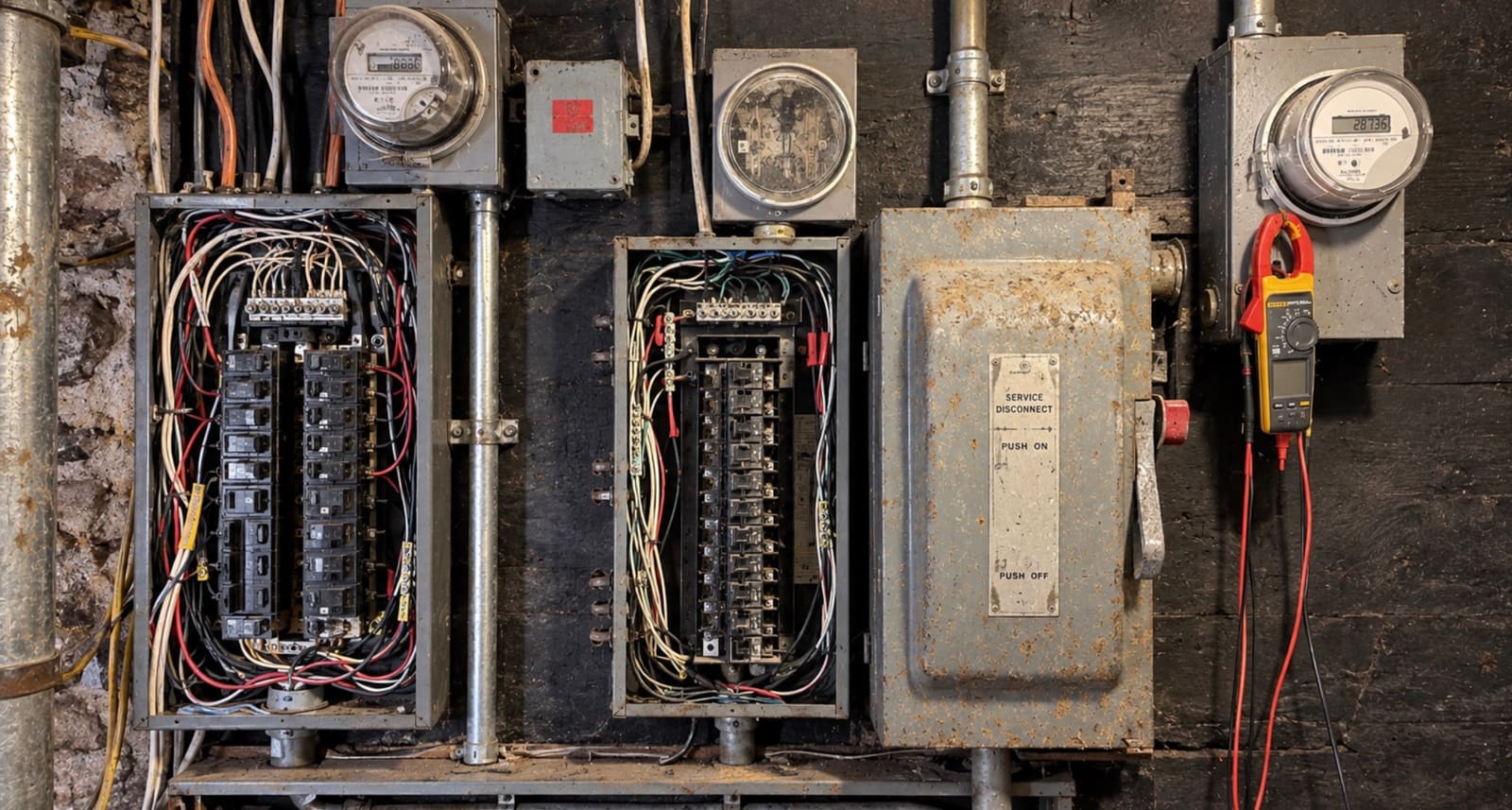
The result is a panel that has outlived its job. The original service might be 60 amps on fuses. A second panel was added when the first filled up. A third subpanel feeds the addition, and nobody drew a diagram of any of it. The house works, mostly, until the day somebody adds a heat pump or a range and discovers there is nowhere left to put it.
What we look for first is how many panels there really are and what each one is fed from, because a farmhouse that has grown by accretion often has more than the owner knows about. The capacity question comes second. The tidying question, which is making one coherent installation out of three, comes with it, and it is usually the part that pays back.
The Well Pump and the Loads That Never Appear on a Floor Plan
A house in a dense town is its own whole electrical story. A house in New Boston is usually that plus a small utility company's worth of equipment behind it, and most of that equipment is invisible on a floor plan.
The well pump is the first. When the water comes from a drilled well it is supplied by a pump on its own circuit, and that circuit has a motor starting load that matters when the service is tight. The septic system may have a pump or an alarm. There is often a sump, a chest freezer in the garage that holds the winter's meat or the garden, and a shop with a compressor or a table saw.
None of these is large on its own. Together, on a house with an old 100 amp service and a new heat pump, they are the reason a breaker trips when two things start at once. A load calculation that counts the whole property rather than the living space is the only honest way to say whether the service is enough, which is why it is where we start.
The Village After the Fire
The village is a different housing stock from the rest of town. In 1887 the Great Village Fire destroyed nearly forty buildings, and the older buildings in the village center tend to date from what went up afterward.
That gives the village houses a recognizable vintage: late Victorian frame houses and the early twentieth-century houses built beside them, most of them on small lots by New Boston standards, close to the street and to each other. Some are still single-family. Some have been divided into apartments over the years, which brings the metering question that comes with any subdivided building.
The panels in them are the usual spread: an original service that was upgraded once, often in the 1970s or 1980s, and has not been looked at since. Federal Pacific and Zinsco panels turn up in houses updated through those decades, and it is worth checking for them specifically, because neither failure announces itself.
Subpanels for the Barn, the Garage and the Workshop
In town the question is usually whether the panel is big enough. Here it is just as often how to get power to a building that is not the house.
A barn, a detached garage or a workshop needs its own feeder from the house, and how it is done decides whether it works properly. The run is usually buried, which means a trench, the right cable or conduit for the ground it goes through, and enough cover that a frost heave or a snowplow does not find it. At the far end there is a disconnect and a subpanel, with its own grounding, because an outbuilding is grounded locally and not through the house.
The mistake we see most is a long run in undersized wire. It works for a light and a radio and then fails when a welder or a compressor is added, because the wire was sized for the load it carried on the day and not for the load somebody will want. Sizing the feeder for what the building might become costs very little on the day and a great deal afterwards. The whole subject has its own page at barn, workshop and specialty circuits in New Boston.
The Permit, the Inspection and the Town of New Boston
A panel or service change is permitted work and it is inspected. That is not paperwork to be got around, and on a house that will eventually be sold it is the thing that makes the work worth having.
The permit is pulled under the master license and the inspection is the town's. Where the service itself changes, meaning a new mast, a new meter socket or a change in capacity, the electric supplier is involved as well, because the connection at the top of the mast is theirs and the disconnection and reconnection are scheduled with them and not decided by us.
Which supplier that is depends on the address, so it is one of the first things we establish on the call, not something to assume. What you keep afterwards is the permit, the sign-off and a panel with a written schedule, which is also what an insurer asks for and what saves the next electrician a day of working out what is on which breaker.
What Changes When the Service Itself Changes
There is a real distinction between replacing a panel and upgrading a service, and both the price and the disruption hinge on it.
A panel swap keeps the existing service. The same conductors come in, the meter stays, and a modern panel with modern breakers replaces the old one. It is the right job where the capacity is adequate and the equipment is not.
A service upgrade changes what the house is fed. A new mast and weatherhead, a new meter socket, new service conductors, grounding and bonding to current requirements, and the supplier scheduling the disconnect and reconnect. It is the right job where capacity is the real limit.
On a long overhead run there is a third consideration neither term covers: the run itself. Where the existing drop is old, long or through trees, it is worth deciding at the same visit whether it is going to be upgraded as well, because that is the point at which doing it costs least. A mast replaced in October and a drop that comes down in a February storm are the same job done at very different prices.
What a New Boston Panel or Service Upgrade Covers
- A look at the whole property, not just the box in the basement
- Load calculation including the well pump, shop and outbuildings
- New panel, main breaker and full circuit transfer
- Service entrance, mast and meter socket where the service changes
- Coordination of the shutdown with the electric supplier
- Feeders and subpanels for the barn, garage or workshop
- Grounding and bonding brought up to current requirements
- Permit, inspection and a panel schedule that matches the circuits
When a New Boston House Needs the Panel Looked At
- A fuse box, or a panel with no spare spaces left
- More than one panel, and nobody sure what feeds which
- Breakers that trip when the well pump and something else start together
- A heat pump, range or EV charger going into a house with a 100 amp service
- Federal Pacific, Zinsco or Challenger on the label
- A long overhead service run through trees
Electrical Panels & Service in New Boston Questions, Answered
Do I Need a 200 Amp Service on My New Boston House?
Often, and a load calculation settles it rather than the number you have heard. A rural property counts the well pump, a workshop and any outbuildings, not just the living space. A 100 amp service that was right for a 1970s house is frequently not right once a heat pump and an EV charger are added.
What Does a Panel or Service Upgrade Cost in New Boston?
A 200 amp service runs $3,000 to $3,500, and that is the service rather than the whole job. On a New Boston property what moves it is the length and condition of the overhead run, whether the mast and meter socket need replacing, and what feeds the outbuildings. A panel swap on an existing service is less. We would rather establish the property before quoting than revise it afterwards.
My House Is a Long Way From the Road. Does That Cost More?
It can, and it is better to know before the quote. A longer service run means more conductor and sometimes a different approach to the overhead drop. Whether it is the supplier's side or yours depends on where the line stops being theirs, which we establish at the visit.
Can You Power My Barn or Workshop From the Main Panel?
Yes, with a proper feeder to a subpanel at the building, buried to the right cover and sized for what you may want to run there, not only what is there today. It is grounded locally at the outbuilding, with its own disconnect.
How Long Will the Power Be Off?
A panel swap is typically most of a day. A service upgrade is a day, and the supplier schedules the disconnect and reconnect, so the date is arranged with them. On a long overhead run it is worth asking whether the drop is being replaced at the same visit.
Do I Need a Permit for a Panel Change in New Boston?
Yes. It is permitted work, pulled under the master license and inspected by the town. Where the service changes the supplier is involved as well, because the connection at the mast is theirs. The permit and the sign-off are also what an insurer or a buyer's inspector will ask for.
My House Still Has a Fuse Box. How Urgent Is It?
It is a plan-it rather than a panic. A fuse box is not dangerous because it is old; it is limiting, and it is often a sign that other things in the house are original too. The common trigger is an insurer asking, or adding something the box cannot carry.
Do You Add a Heat Pump or EV Circuit at the Same Time?
Frequently, and it is cheaper done together. The load calculation is already being done and the panel is already open. It is also the point at which you find out whether the service can carry it, which is better known before you buy than after.
Guides on Electrical Panels & Service
How to Tell If Your Electrical Panel Needs Replacing
The signs worth acting on, the panel brands insurers flag, and how to tell a full panel from an unsafe one.
What Size Electrical Service Does a House Need?
100, 150 or 200 amps, what pushes a house from one to the next, and how to work out where yours sits.
Getting a Home Ready for an EV
What to check before you order the car, and why the charger is rarely the expensive part.
More Electrical Work in New Boston
Wiring & Rewiring in New Boston
A licensed master electrician for rewiring and older wiring in New Boston, from knob and tube in the oldest farmhouses to the cable damage that comes with a house in the country.
Generators & Backup Power in New Boston
A licensed master electrician for standby and portable generator installation in New Boston.
Appliance & Specialty Circuits in New Boston
A licensed master electrician for the circuits a country property needs and a house in town does not: the barn, the workshop, the well pump, the hot tub, the welder.
All electrical panels & service work covers the service without the local detail, and the service area page sets out the towns around New Boston we work in regularly.