

Residential Electrician in Manchester, NH: Panel and Service Upgrades
A licensed master electrician in Manchester for panel replacements and service upgrades, from the triple-deckers in the older wards to the post-war streets on the West Side. Permitted, inspected, and coordinated with Eversource where the service itself changes.
Panel and Service Upgrades for Manchester Houses and Three-Family Homes
The Triple-Decker Is the Manchester Panel Job
Manchester built housing for mill workers faster and denser than anywhere else in the state, and the shape it settled on was the three-family wooden house. There are thousands of them, and they are the reason a panel job here is a different conversation from one twenty miles away.
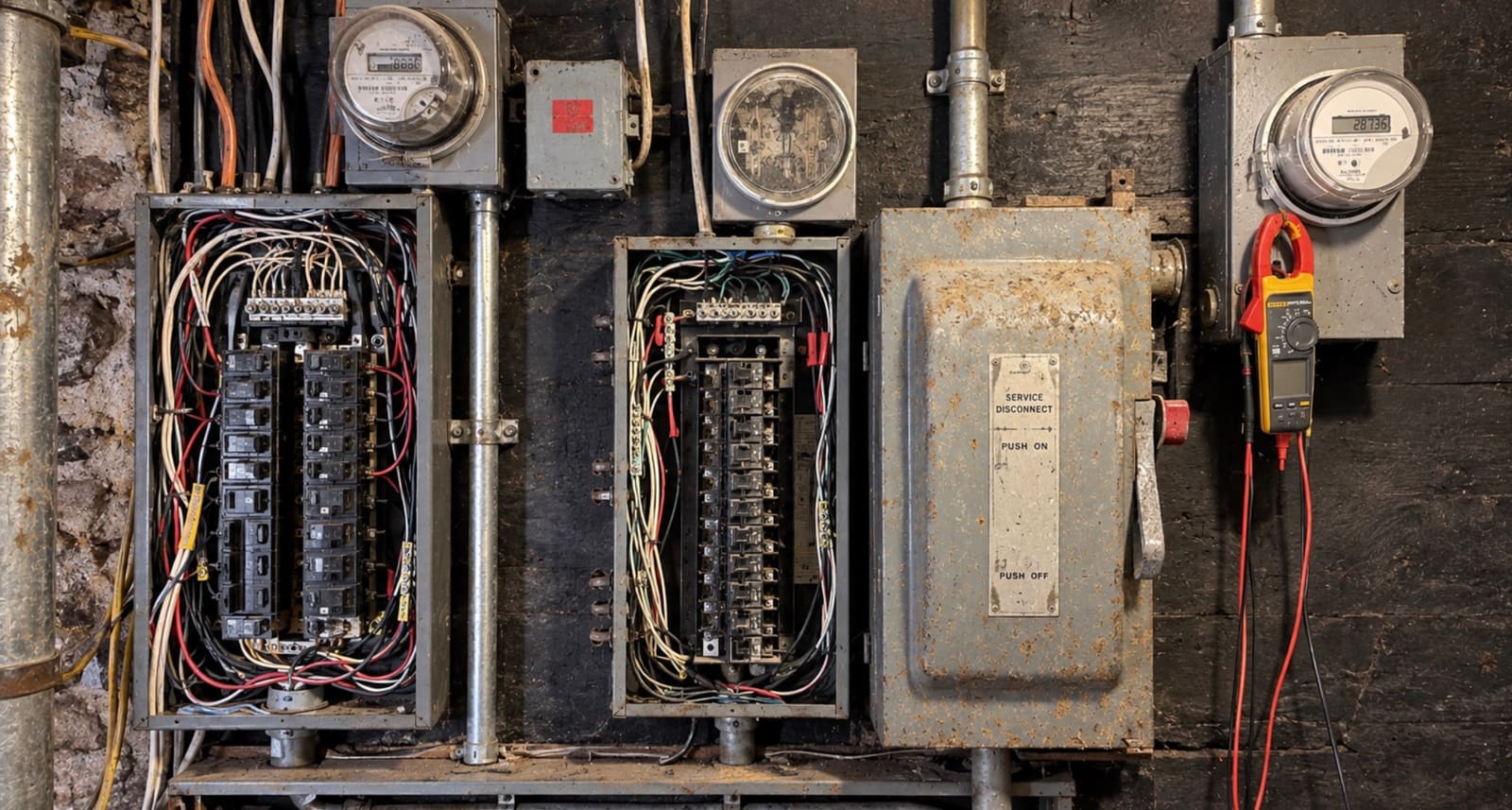
The electrical problem is stacked rather than spread. One service entrance, usually on the back or the side, feeds a meter bank, and from that bank three sets of conductors run vertically through the building to three separate panels. Everything shares one path. That means a service upgrade is not a job you do to one apartment, it is a job that touches the whole stack, and it means the condition of the riser matters as much as the condition of any individual panel.
The second thing is that many of them are no longer three units. A third floor gets divided, a basement gets finished and let, an attic becomes a studio. The meter bank still says three. We find services sized for a 1925 three-family carrying five modern households, and the owner is often genuinely unaware, because nothing has failed yet.
The third is age spread. A triple-decker rarely has one electrical vintage. The first-floor panel was replaced when that tenant complained, the second floor was done during a sale, and the third floor is original. Three panels, three decades, one service, and only one of them has been looked at.
What a Manchester Service Was Sized for, and What It Carries Now
The arithmetic is the honest part of this. A service installed for a 1920s tenement was sized for lighting, a radio and an icebox. Cooking was gas, heat was oil or coal, and hot water was a coil off the boiler.
What sits on it now is not comparable. Three electric ranges is a possibility rather than a certainty, but three refrigerators is a certainty, and so is three of everything else. Add a window air conditioner per unit through July and August, a heat pump where a landlord has modernized, and increasingly a car on a charger in the drive, and the number stops resembling what the service was built for.
Which is why a load calculation is the first thing we do rather than the last. A homeowner usually arrives asking for a 200 amp service because that is the number they have heard. Sometimes that is right. On a three-family it is frequently the wrong question, because the constraint is the meter bank and the riser rather than the main, and replacing the main without touching either leaves the actual bottleneck exactly where it was.
The other reason to calculate rather than assume is cost. A service upgrade on a triple-decker is a bigger job than on a single family, because there is more of everything: more conductors, more terminations, more coordination with Eversource, and often more than one shutdown if the units cannot all be off at once. Knowing whether you need it is worth doing properly.
Panels We Expect to Find Behind a Manchester Cover
Two brands change the conversation as soon as we see them, and both are common here because of when Manchester did its first round of electrical modernization.
Federal Pacific Stab-Lok panels turn up constantly in housing that was updated between the late 1950s and the early 1980s, which is most of the older wards. The concern is documented and specific: the breakers have a history of failing to trip on an overload, which means the panel can be energized, look correct, and not be protecting the circuit it is on. There is no repair for it. Replacement is the answer and insurers increasingly ask.
Zinsco panels are the second, less common here than Federal Pacific but present, with a related failure: the breaker connection to the bus degrades, and the result is heat at the connection rather than a trip.
Neither is an emergency in the sense of evacuate the building. Both are a reason to plan the work rather than wait for it, and on a three-family both are a reason to look at all three panels rather than the one that prompted the call, because a building that got Federal Pacific on the first floor in 1971 almost certainly got it on the other two.
Where the Landlord Stops and the Tenant Starts
This is the question that actually delays multi-family electrical work in Manchester, and it is worth settling before anyone quotes.
The service, the meter bank, the risers and the house panel are the building. They are the owner's, and work on them affects every unit. An individual unit panel and everything past it behaves more like the tenant's territory in practice, even where the owner still owns it, because the disruption lands on one household.
It matters because the two need different planning. Building-side work means notifying every unit, arranging access to a shared basement, and a shutdown that takes the whole stack dark for a period. Unit-side work is one apartment and one conversation.
We work this out at the survey, in writing, before the quote. Where a building has a manager rather than a resident owner, that is who receives the scope, and our property management work in Manchester exists for exactly that relationship. Turning up to find that nobody told the third floor is the most common reason a day gets lost.
The West Side and the Post-War Streets
Not all of Manchester is a triple-decker, and the West Side in particular is a different housing stock with a different problem.
Across the Merrimack the neighborhoods are largely post-war single family, built through a period when 100 amps was a generous service and three-prong outlets were new. The panels are typically a later replacement, so the equipment is often reasonable, and the constraint is capacity rather than condition.
That changes what the job looks like. On a triple-decker we are usually solving a shared-infrastructure problem. On the West Side we are usually solving a straightforward not-enough-service problem, and the answer is a clean 200 amp upgrade with a new mast and meter socket, which is a one-day job with one shutdown.
The other post-war inheritance worth naming is aluminum branch wiring, which turns up in houses built or rewired through the late sixties and early seventies. It is not a panel issue and it is not solved by a panel upgrade, but a panel upgrade is when it gets discovered, because that is when somebody finally looks at every termination. Rewiring and older wiring in Manchester covers what that involves.
The Permit, the Inspection and the City of Manchester
A panel or service change is permitted work and it is inspected. That is not a formality to be worked around, and on multi-family it is protection worth having.
The permit is pulled under the master license and the inspection is the city's. Where the service itself changes, meaning a new mast, a new meter socket, or a change in capacity, Eversource is involved as well, because the connection at the top of the mast is theirs and the disconnection and reconnection are scheduled with them rather than decided by us.
On a three-family that scheduling is the part that needs the most notice. A single family loses power for a few hours and one household plans around it. A triple-decker loses power for three, and if one of those is a tenant who works nights or a household with medical equipment, that is a conversation to have a week ahead rather than on the morning.
What you keep afterwards is a record: a permit, a sign-off and a panel that is labeled. On a rental building that record is worth more than it looks. It is the thing an insurer asks about, and it is the thing that stops the next electrician charging you to work out what an unlabeled panel does.
What Changes When the Service Itself Changes
There is a real distinction between swapping a panel and upgrading a service, and the price and the disruption both hinge on it.
A panel swap keeps the existing service: the same conductors come in, the same meter stays, and a modern panel with modern breakers replaces the old one. It is the right job where the capacity is adequate and the equipment is not, which describes most Federal Pacific replacements.
A service upgrade changes what the building is fed. New service conductors, usually a new mast and weatherhead, a new meter socket, new grounding and bonding to current requirements, and Eversource scheduling the disconnect and reconnect. It is the right job where the capacity is genuinely the limit.
On a Manchester three-family there is a third case that neither term covers well: the service and the main are fine, and the meter bank or the riser is the problem. That is its own job, it is more disruptive than a panel swap and less than a full service upgrade, and it is the one most likely to be missed by a quote given over the phone. It is why we would rather look at the building.
What a Manchester Panel or Service Upgrade Covers
- Load calculation from the real circuits, counting every unit rather than the meter bank
- The meter bank and the riser assessed, not just the panel that prompted the call
- New panel, main breaker and full circuit transfer
- Service entrance, mast and meter socket where the service changes
- Eversource application, and a shutdown scheduled around every tenancy at once
- Grounding and bonding brought up to current requirements
- A panel schedule per unit, written to match what is actually on the circuits
- City of Manchester permit and inspection
When a Manchester Building Needs the Panel Looked At
- A fuse box, or a panel with no spare spaces left
- One service and three panels from three different decades
- A triple-decker that is quietly four or five households now
- Federal Pacific, Zinsco or Challenger on the label
- Lights dimming across a unit when a large appliance starts
- An insurer asking about the panel, or a sale inspection flagging the service
Electrical Panels & Service in Manchester Questions, Answered
Do I Need to Upgrade the Service on My Manchester Triple-Decker, or Just the Panels?
Those are two different jobs and only a look at the building tells you which you need. If the units are tripping breakers and the panels are full or obsolete, the panels are the job. If the whole building is at its limit, or the meter bank and the riser are original, the service is the job. It is common on a three-family for the main to be adequate while the riser is the real bottleneck, which is why a phone quote on this is close to a guess.
What Does a Panel or Service Upgrade Cost in Manchester?
A 200 amp service runs $3,000 to $3,500, and that is the service rather than the whole job. On a single family on the West Side that is usually close to the finished number. On a three-family it is a starting point, because there is a meter bank, three sets of conductors and often more than one shutdown. A panel swap on an existing service is less. We would rather establish what is actually needed before quoting than revise afterwards.
I Have a Federal Pacific Panel. How Urgent Is It?
It is a plan-it rather than an evacuate-the-building. The documented concern is that the breakers have a history of not tripping on an overload, so the panel can look right and not be protecting the circuit. There is no repair, only replacement. If you own a three-family and found one, expect the other two floors to have the same, because they were almost certainly done at the same time.
How Long Will the Power Be Off?
A panel swap on one unit is typically most of a day for that unit. A service upgrade is a day, and on a three-family it takes all three units dark for a substantial part of it, because the supply is shared. Eversource schedule the disconnect and reconnect, so the date is set with them. On a rental building that notice matters more than the duration.
Can You Do One Apartment Without Disturbing the Others?
Usually yes, if the work is genuinely unit-side. An individual panel change affects that unit and needs the building briefly at the survey stage. Anything touching the service, the meter bank or the riser is shared by definition and cannot be done to one unit alone.
Who Arranges This, Me or My Property Manager?
Whoever holds the building. Where there is a manager we deal with them, scope in writing, and they handle tenant notice, which is the part that actually determines whether a scheduled day works. We do a lot of this kind of work and it is set out on our Manchester property management page.
Do I Need a Permit for a Panel Change in Manchester?
Yes. It is permitted work, pulled under the master license, and inspected by the city. Where the service changes, Eversource are involved as well, because the connection at the mast is theirs. The permit and the sign-off are also what an insurer will ask for later.
Is Manchester on Eversource?
Yes, Eversource for electricity. Natural gas in Manchester is Liberty Utilities, trading as EnergyNorth, which is a different company. That distinction matters when a job involves both, because the scheduling and the responsibilities are separate.
Do You Add EV Charging at the Same Time as a Panel Upgrade?
Frequently, and it is the cheaper way to do it. The load calculation is already being done, the panel is already open, and adding the circuit while everything is apart avoids paying twice for the same access. It is also the point at which you find out whether the service can carry it, which is better known before you buy the car than after.
Guides on Electrical Panels & Service
How to Tell If Your Electrical Panel Needs Replacing
The signs worth acting on, the panel brands insurers flag, and how to tell a full panel from an unsafe one.
What Size Electrical Service Does a House Need?
100, 150 or 200 amps, what pushes a house from one to the next, and how to work out where yours sits.
Getting a Home Ready for an EV
What to check before you order the car, and why the charger is rarely the expensive part.
More Electrical Work in Manchester
Wiring & Rewiring in Manchester
A licensed master electrician in Manchester for rewiring and older wiring, from knob and tube behind plaster in the older wards to aluminum branch circuits in post-war West Side homes.
Property Management & Multi-Family in Manchester
A licensed master electrician for Manchester property managers and multi-family owners: turnovers, common areas, service and metering questions, and the call that comes at six on a Friday.
Tenant Fit-Ups & Build-Outs in Manchester
A commercial electrician in Manchester for fit-up and build-out work: office and lab space in the converted millyard, restaurants and retail on and around Elm Street, and ground-floor units in buildings that were never designed for what is now going into them.
All electrical panels & service work covers the service without the local detail, and the service area page sets out the towns around Manchester we work in regularly.