

Commercial Electrician in Manchester, NH: Property Management and Multi-Family
A licensed master electrician for Manchester property managers and multi-family owners: turnovers, common areas, service and metering questions, and the call that comes at six on a Friday. Austin already works with several property management companies.
Electrical Work for Manchester Property Managers and Building Owners
Manchester Is the Biggest Rental Market in the State
That is not a boast on our part, it is the reason this page reads differently from the same page for a smaller town. Manchester has more multi-family housing than anywhere else in New Hampshire, and most of it is old.
The stock splits roughly three ways. Triple-deckers and other wood-frame multi-family in the older wards, much of it subdivided beyond its original unit count. Converted millyard space, where a nineteenth-century industrial building now holds offices, apartments or both. And post-war single family on the West Side that has been turned into rentals one house at a time.
Each has a different electrical personality, and a manager holding a mixed portfolio is holding three different problems. The triple-decker problem is shared infrastructure. The millyard problem is a building carrying loads its conversion never anticipated. The West Side problem is usually just capacity.
What they share is that the work is rarely convenient. It is a turnover with a letting date, a common area that has to stay lit, or a fault in an occupied unit. Almost none of it is a green-field job with an empty building and an open timetable.
Turnovers, and Why the Electrical Bit Runs Late
A turnover has a date, and the date was set before anyone looked behind a cover plate. That is the recurring shape of this work.
What actually causes the delay is almost never the work itself. It is discovery: the unit needs three receptacles replaced, and once we are in the boxes it turns out the circuit is shared with the floor below, or the grounding is not what the three-prong outlets imply, or a previous tenant’s installation was done by somebody’s brother.
So we would rather look at a unit before it is empty than on the morning it needs to be ready. A twenty minute walk-through while the outgoing tenant is still there tells us whether this is a two-hour turnover or a two-day one, and it is the difference between a letting date that holds and one that slips.
Where a portfolio turns over predictably, the better arrangement is a standing scope: an agreed list of what gets checked and replaced at every turnover, priced per unit, so it stops being a quote each time. That is what a maintenance contract is for, and it is the arrangement Austin has said he would rather have than one-off call-outs.
Common Areas Are Where the Liability Sits
Inside a unit, a problem has one tenant and one complaint. In a common area it has every tenant, and in an emergency it has the fire service and an insurer.
Egress and emergency lighting is the part that gets missed most, because it works until the day it is needed and nobody notices in between. Battery units fail quietly. A stairwell that is lit today may not be lit in a power cut, and the only way to know is to test it rather than look at it.
Then the ordinary common-area electrical that accumulates: hall and stair lighting, basement and laundry circuits, exterior and parking lighting, entry systems, and whatever has been added to the house panel over decades by people solving one problem each.
The house panel is worth a specific mention. On an older Manchester multi-family it is frequently the least documented thing in the building, feeding common lighting, a laundry, a boiler and a sump, with no schedule and no obvious logic. Labeling it is a small job that pays for itself the first time somebody needs to kill a circuit in a hurry.
Metering, and the Question That Stops Work
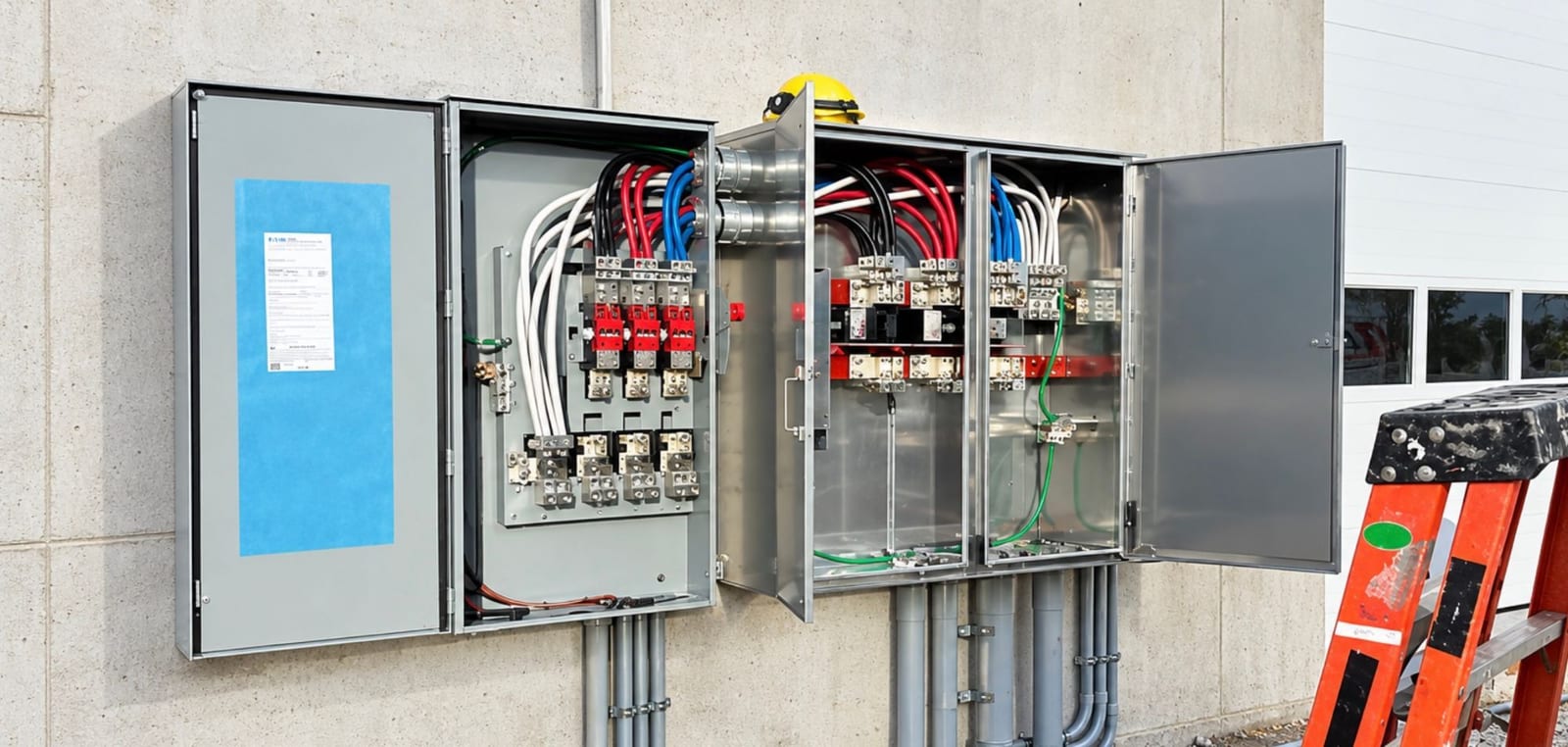
The most common reason a multi-family electrical job stalls in Manchester is that nobody can say with confidence which meter feeds what.
It happens because buildings changed shape. A three-family became four units. A basement was finished and let. A commercial unit on the ground floor was carved out of what used to be storage. The meter bank was not always updated to match, and the assumption that it was is the thing that turns out to be wrong.
It matters commercially before it matters technically. A tenant paying for a common-area load, or for a neighbor’s, is a billing dispute waiting to happen and a reason a tenant will not agree to anything. Establishing it is a morning’s work with the right approach, and it is worth doing before a quote rather than discovering it during the job.
Where it has genuinely drifted, the fix is a decision rather than a repair: re-establish the metering to match the units as they now exist, which is a service-side job, or accept the arrangement and document it clearly. Both are defensible. What is not defensible is a building where nobody knows.
The Call-Out, and What Actually Justifies One
A manager with a portfolio needs to know two things about an out-of-hours call: that it will be answered, and that it will not be answered at the same rate for something that could have waited.
What genuinely cannot wait is anything that is a fire risk or leaves a building unsafe: burning smells, a panel that is hot, arcing, water into electrical equipment, a common area or egress route in the dark, or a failure that takes out a whole building rather than a unit.
What can usually wait until the morning is a single circuit in one occupied unit where the rest of the apartment is fine, a failed appliance that happens to be electrical, and most lighting faults that are not egress.
We would rather agree that boundary with a manager in advance than have it negotiated at eleven at night by somebody who is not in a position to judge it. Emergency and after-hours work covers the response side.
Converted Millyard Buildings Are Their Own Category
A manager holding space in the Amoskeag millyard or a similar conversion is holding a different asset from a wood-frame triple-decker, and the electrical difference is larger than the architectural one.
These buildings were designed around line shafts and machinery, not around domestic or office distribution. Everything electrical in them was retrofitted, and the retrofit reflects whenever it happened. A conversion done in the eighties has eighties distribution, sized for eighties tenants.
What has changed is the tenant. Millyard space now holds offices, labs, clinical and light manufacturing tenants alongside residential, and those draw loads and want redundancy that an eighties office fit-out never contemplated. The recurring job is not a fault, it is capacity: a tenant wants something the floor cannot currently give them.
The practical consequence for a manager is that letting decisions and electrical capacity are the same conversation. Knowing what a floor can actually carry before agreeing a fit-out is the difference between a straightforward tenant fit-up and a service upgrade nobody budgeted for.
Working With Managers Rather Than Around Them
Austin already works with several property management companies, and the arrangement that holds is the same every time: scope in writing, one point of contact, and tenant notice handled by the people who hold the tenancies.
That last one is not administrative politeness, it is the single biggest determinant of whether a scheduled day works. An electrician who turns up to a unit nobody told has lost the day, and on a building with a shared service that can mean losing it for every unit at once.
What we provide back is the record: what was done, in which unit, under which permit, with a panel schedule that matches. On a managed portfolio that record is the thing that makes the next job cheaper, because nobody is paying to rediscover the building.
Where a portfolio is large enough, a standing arrangement beats call-outs on both sides. Predictable work for us, a known response and a known price for the manager, and a building that gets looked at rather than reacted to.
What We Do for Manchester Property Managers
- Turnover inspections and unit-level electrical work to a letting date
- Common areas: hall, stair, basement, laundry, exterior and parking lighting
- Emergency and egress lighting tested rather than assumed
- House panels labeled and documented, often for the first time
- Metering established where a building no longer matches its meter bank
- Service and capacity work on triple-deckers and converted millyard space
- After-hours response, to a boundary agreed in advance rather than at midnight
- Permits, inspections and a written record per unit
When a Manchester Portfolio Needs an Electrician Looking at It
- Nobody can say for certain which meter feeds which unit
- A house panel with no schedule, feeding things nobody has mapped
- Emergency or egress lighting that has never actually been tested
- Turnovers that keep running late for electrical reasons
- A unit count that has grown while the service has not
- Repeat call-outs to the same building for what turns out to be one cause
Property Management & Multi-Family in Manchester Questions, Answered
Do You Work With Property Management Companies in Manchester?
Yes, and it is work Austin has said he wants more of. He is already affiliated with several property management firms. The arrangement that works is scope in writing, one point of contact, and tenant notice handled by whoever holds the tenancies.
Can You Work to a Turnover Date?
Yes, and the way to protect the date is to look at the unit before it is empty rather than on the morning it has to be ready. Twenty minutes while the outgoing tenant is still there tells us whether it is a two-hour job or a two-day one. Discovery is what makes turnovers run late, not the work.
What Counts as an Emergency on a Rental Building?
Anything that is a fire risk or leaves the building unsafe: burning smells, a hot panel, arcing, water into electrical equipment, or a common area or egress route in the dark. A single circuit in one occupied unit, where the rest of the apartment is fine, can usually wait for the morning. We would rather agree that boundary with you in advance.
Nobody Knows Which Meter Feeds What. Can You Sort That Out?
Yes, and it is one of the more common jobs on older Manchester multi-family. Buildings changed shape over decades and the meter bank did not always follow. Establishing it is usually a morning’s work, and it is worth doing before a quote rather than discovering it mid-job, because it is a billing question as much as a technical one.
Do You Do Emergency and Egress Lighting Testing?
Yes. It is the part of common-area electrical most often missed, because it works right up until the moment it is needed. Battery units fail quietly. Looking at a fitting tells you nothing; it has to be tested.
We Have Space in a Converted Mill Building. Is That Different?
Quite different. Everything electrical in those buildings was retrofitted, and it reflects whenever the conversion happened. The recurring issue is capacity rather than fault: a prospective tenant wants more than the floor can currently give. Knowing what a floor can carry before agreeing a fit-out avoids a service upgrade nobody budgeted for.
Would a Maintenance Contract Make Sense for Our Portfolio?
Often, and it is Austin’s preference over one-off call-outs. An agreed scope at every turnover, priced per unit, plus a scheduled look at common areas and emergency lighting. It makes the cost predictable for you and the work predictable for us, and buildings that get looked at generate fewer emergencies than buildings that get reacted to.
Do You Handle Tenant Notice?
No, and that is deliberate. Notice belongs with whoever holds the tenancy, because they have the relationship and the legal obligation. What we do is give you enough lead time to give it properly, which on a shared service means more than a day.
Guides on Property Management & Multi-Family
Electrical in Multi-Tenant and Mixed-Use Buildings
House panels, sub-metering, who pays for what, and the questions to settle before a tenant moves in.
Workplace and Fleet EV Charging: What It Takes
Service capacity, load management across several ports, and what changes when it is a fleet rather than staff.
More Electrical Work in Manchester
Electrical Panels & Service in Manchester
A licensed master electrician in Manchester for panel replacements and service upgrades, from the triple-deckers in the older wards to the post-war streets on the West Side.
Wiring & Rewiring in Manchester
A licensed master electrician in Manchester for rewiring and older wiring, from knob and tube behind plaster in the older wards to aluminum branch circuits in post-war West Side homes.
Tenant Fit-Ups & Build-Outs in Manchester
A commercial electrician in Manchester for fit-up and build-out work: office and lab space in the converted millyard, restaurants and retail on and around Elm Street, and ground-floor units in buildings that were never designed for what is now going into them.
All property management & multi-family work covers the service without the local detail, and the service area page sets out the towns around Manchester we work in regularly.