

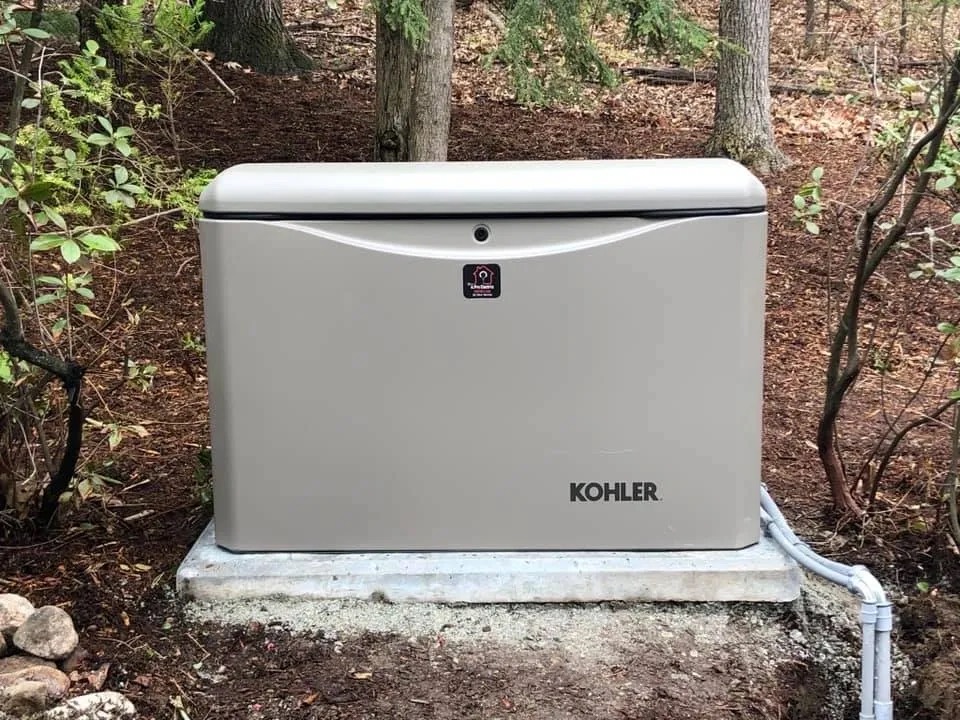
Residential Electrician in Henniker, NH: Generator Installation and Backup Power
A licensed master electrician based in Henniker for standby and portable generator installation. Sized from the circuits, sited for the hill and the snow, wired through a transfer switch, permitted and commissioned under load.
Generator Installation for Henniker Homes on the Hills and Along the River
A Town of Hills, Trees and Overhead Lines
Henniker is not flat. It sits in the Contoocook River valley with hills rising on all sides, and Craney Hill alone reaches 1,402 feet. Much of the town is wooded, and much of the electrical supply reaches houses on overhead lines running through those woods.
That combination is the usual cause of an outage in this part of New Hampshire: a branch or a tree across a line on a road that climbs, in weather that makes it hard to get to. A house at the top of a hill road, a mile from the next, is a house where an outage may be a long one.
This business is based in Henniker, so these are roads we drive regularly. The generator question is one we are asked about here more than almost anything.
Water, Heat and a Ski Area on the Hill
What a generator protects in a country house is the same short list in every case, and the order matters.
Water first. A drilled well runs on an electric pump, and no power means no water, no flushing and no way to run a washing machine. In winter the same outage can freeze a pipe. The well pump is the first circuit on almost every generator we install, and it shapes the sizing, because a pump draws far more to start than to run.
Heat second. Most heating systems need electricity to run controls and circulation pumps whatever they burn, and a boiler that cannot circulate is a boiler that cannot protect a house in January.
Then refrigeration, lighting and a few outlets. Henniker also has a ski area on Craney Hill, and a winter storm that takes down the lines for a day is a good illustration of how much of the town runs on one supply.
Student Houses and Rentals: a Different Case for Backup Power
A landlord thinking about a generator is asking a different question from a homeowner.
A house let to students is occupied by people who will not read a manual and who may not be present when an outage starts. What the owner wants is that the heat stays on, the pipes do not freeze and nothing in the building fails in a way that becomes a claim.
For a rental that usually argues for a smaller, simpler installation: a transfer arrangement that carries the heating controls and a few essentials, and not the whole house, because the point is to protect the building and not to preserve a normal evening. A critical loads panel is built for exactly that, and costs a good deal less than backing up everything.
Gas in the Street, or a Tank in the Yard
The fuel question decides the whole installation and should be settled before a unit is chosen.
A standby generator runs on natural gas or propane. Where piped natural gas runs to the street, it is the simplest supply. Where it does not, the generator runs from a propane tank, which has to be sited, sized and connected to its own rules.
A house through a three-day outage uses more fuel than anyone expects, and a tank sized for convenience can run low in the middle of one. We establish what is on your road at the first call, because the answer changes both the cost and the equipment.
Where It Goes, and Where the Snow Goes
On a hill property the siting is a real decision, and it has two halves.
The standard half is the same everywhere: a level pad, clear of the house, of openings and of anything combustible, by the manufacturer's distances, with exhaust pointed away from windows and doors.
The Henniker half is the slope and the snow. A level pad on a hillside can need a retaining edge. A unit placed where the plow banks, or under a roofline that sheds, is buried in February, which is when it is needed. We decide siting by walking the property and thinking about where the water and the snow go, and not from a drawing.
Portable, Standby, and What Each Costs
A portable generator is the lighter option. A proper portable hookup, with an inlet and a transfer arrangement, is about $650, for a household that can start a machine in the cold and feed it by hand.
A standby unit starts itself and runs the house automatically, which is the case for a household that is away, elderly, or simply does not want to be doing it at three in the morning. Installed, typically $10,000 to $20,000 depending on size and location, with the unit included.
Both go through a transfer switch, which disconnects the house from the line before the generator connects, so that power cannot flow back out onto wires someone may be working on. An extension cord through a window is not an installation.
The generator sizing tool gives a first answer. The calculation at the house, from the real circuits, gives the right one.
Servicing, and Who Repairs It
A generator needs looking after, and who does that is the question to ask before you buy and not in five years.
Scheduled servicing and everything electrical is ours: oil and filters on the manufacturer's schedule, the battery, the load test and the transfer switch. When a fault is genuinely inside the engine it goes to a generator specialist we work with, who sells and services these machines as their trade and administers the warranty.
That is deliberate and it is a benefit. One call, the electrical side handled here, the engine covered by somebody who does nothing else. Generator servicing explains what a visit covers.
What a Henniker Generator Installation Covers
- A circuit-by-circuit load list, with the well pump's starting load counted
- The fuel question settled first: what is on your road, and tank sizing where it is propane
- A level pad sited for clearance, the slope and where the snow goes
- Transfer switch or critical loads panel at the service
- Feeder and control wiring from the generator to the house
- Grounding and bonding, and any gas or propane connection by the right trade
- Commissioning under real load, with the transfer timed in both directions
- Permit, inspection and a scheduled service arrangement afterwards
When a Henniker House Should Think About a Generator
- A drilled well, and no water when the power is out
- A house up a hill road where outages tend to be long
- An outage that has lasted more than a day, more than once
- A rental that must not freeze while nobody is there
- Someone in the house who depends on equipment or on heat
- A portable generator on an extension cord, which is the thing to replace
Generators & Backup Power in Henniker Questions, Answered
Do I Need a Standby Generator or Is a Portable Enough?
It depends on who is home and for how long. A portable with a proper hookup, about $650, suits a household happy to start a machine by hand. A standby, typically $10,000 to $20,000 installed, starts itself, which matters if you are away or elderly.
Will a Generator Run My Well Pump?
Yes, if it is sized for it. A pump draws far more to start than to run, and a generator sized for the running figure can stall on the start. We count the starting load when we size.
Do I Need Natural Gas, or Will Propane Do?
Either works. What matters is which is available on your road, which we establish first. Where there is no piped gas, a propane tank is sited, sized and connected to its own rules.
I Own a Student Rental. Is a Generator Worth It?
Often, in a smaller form. The aim is to keep the heating controls running so the building does not freeze, not to preserve a normal evening. A critical loads panel does that for far less than backing up the whole house.
How Long Does Installation Take?
The electrical work is usually a day or two. The longer parts are the pad, the fuel connection and any permit timing. On a hillside the pad can add to it.
Do You Service the Generator Afterwards?
Yes. Scheduled servicing and everything electrical is ours. Engine repair and warranty work go to a generator specialist we work with.
Do I Need a Permit?
Yes. The work is permitted under the master license and inspected by the town, and a gas or propane connection is its own trade and sign-off.
Can I Run the Whole House on It?
You can, but most households do not need to. A critical loads panel backs up what matters, usually the well pump, heating controls, refrigeration and some lighting, and the cost comes down accordingly.
Guides on Generators & Backup Power
Standby Generators: What They Cover and What They Do Not
Whole-house against essential circuits, automatic against manual, and what a transfer switch is for.
Getting a Home Ready for a New Hampshire Winter
Outage backup, heat cables for ice dams and frozen pipes, winter heating load, and outdoor power before the snow.
More Electrical Work in Henniker
Electrical Panels & Service in Henniker
A licensed master electrician based in Henniker for panel replacements and service upgrades, from the frame houses around the village to the farmhouses up the hills.
Wiring & Rewiring in Henniker
A licensed master electrician based in Henniker for rewiring and older wiring: nineteenth-century frame houses near the village, farmhouses up the hills, and rentals that have been added to for decades.
24 Hour Emergency in Henniker
A licensed master electrician based in Henniker for emergency electrical repair, around the clock: burning smells, a main that will not reset, a mast pulled off the house, a circuit that has gone dead.
All generators & backup power work covers the service without the local detail, and the service area page sets out the towns around Henniker we work in regularly.