

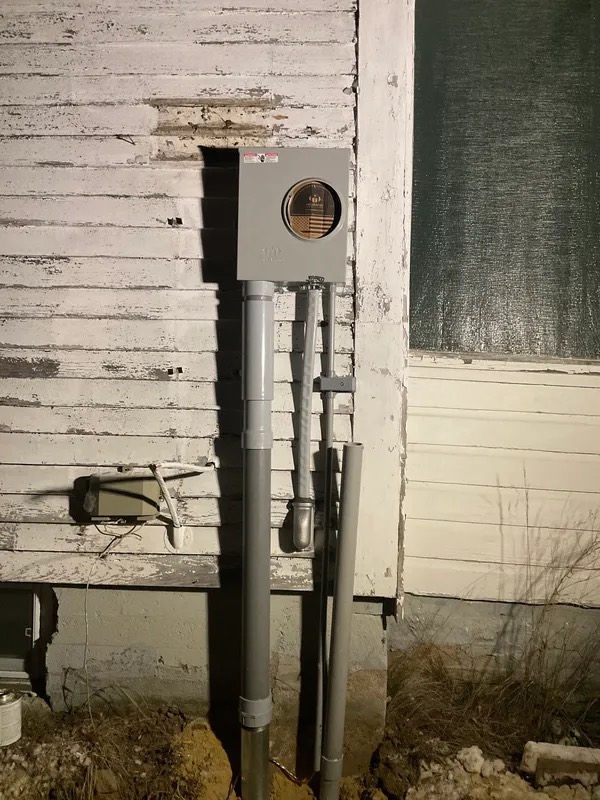
Outdoor EV Charger Installation in New Hampshire
For a driveway rather than a garage. Weatherproof from the panel out, sited where the plow will not find it, and built for a New Hampshire winter.
Installing an EV Charger Outdoors at a New Hampshire Home
What Changes When the Charger Lives Outside
An outdoor EV charger installation is the same circuit as an indoor one with every part of it rated for weather, and that difference runs the whole length of the job rather than stopping at the unit.
Most chargers are rated for outdoor use, so the unit is rarely the constraint. What changes is the wiring method, the enclosures, every penetration through the building and how the run gets from the panel to a position that may be nowhere near the house.
The second change is mechanical. An indoor charger lives in a controlled space; an outdoor one lives with snow loading, ice falling from a roof edge, road salt and a plow operating within feet of it several times a winter. None of that is unusual here and all of it is designed around rather than hoped about.
The third is the route. A garage installation usually runs within the building. An outdoor one frequently means a trench, a bollard or a pedestal, and those are the parts that decide both the price and the time of year the work is practical.
Wall Mounted Against a Pedestal
Where there is a wall within reach of the parking position, mounting on it is simpler and cheaper. The run stays above ground, there is no trench, and the wall carries the weight.
The question is whether the cable reaches the charge port with the car parked as it is actually parked. A charger on the house wall and a car parked twenty feet down the driveway is a combination that does not work, and moving the unit later costs more than siting it properly first.
A pedestal is the answer where there is no wall in reach. The unit mounts on a post set in the ground at the parking position, which means a trench from the house and a foundation for the post, and it is a larger job as a result.
It is also the more robust answer for a driveway that is plowed, provided the post is sited and protected sensibly. A unit at the right height on a solid post is easier to defend than one on a wall at the end of a long, awkward cable.
Getting the Circuit There: Trenching and Conduit
A pedestal or a detached position means the circuit goes underground, and how it does that is a decision with cost attached.
Direct burial cable at the required depth is the simpler method and suits a straightforward run across open ground. Conduit costs more and takes longer, and it buys something real: the ability to pull a new conductor later without digging the driveway again. On a run that passes under anything permanent, conduit is worth the difference.
Depth is set by the wiring method and what the run passes under, and a driveway crossing has its own requirement. None of it is negotiable and all of it is inspected.
The trench itself is usually the largest single item in an outdoor quote, and it is worth understanding what drives it. Length is obvious. Less obvious is what the route crosses: open lawn is straightforward, a gravel driveway is manageable, a paved driveway means cutting and making good, and mature tree roots mean hand digging where a machine would otherwise take an hour. Each of those changes the figure, and each of them is visible on a site walk and invisible on a phone call, which is the whole reason an outdoor installation is quoted after seeing the property rather than before.
The practical constraint in this state is the season. Trenching is straightforward in September and genuinely difficult once the ground has frozen, which is the argument for arranging an outdoor installation in the fall rather than in January when the car arrives.
Snow, Plows and Where the Unit Actually Goes
This is the part that separates an installation designed for New Hampshire from one that was not, and it is decided by walking the site rather than reading a plan.
Snow is pushed somewhere. A charger sited where the plow piles it spends part of every winter buried, which is inconvenient at best and damaged at worst. Where the pile goes is known to whoever clears the driveway, and asking them is a better method than guessing.
Roof edges are the other hazard and the one people miss. Ice and snow coming off a roof in a February thaw lands with real force, and a charger mounted beneath a roofline without a plan for that is a charger that eventually takes a hit.
Height helps with both. Mounting higher than feels necessary keeps the unit above the pile and above the salt spray, and makes the cable easier to handle with gloves on. Bollard protection is worth considering wherever a vehicle maneuvers close by.
Weatherproofing That Holds up Over Years
Everything outdoors is rated for it, and the rating is only as good as the detail at each junction.
The enclosure and any disconnect are weather-rated, and how the conduit enters matters as much as the enclosure. Water tracking in through a badly sealed entry is the slow failure that appears three winters later, and it is prevented at installation rather than repaired afterwards.
GFCI protection is required and it is not a formality outdoors. It is the protection that matters when somebody is standing on wet ground handling a connector, and nuisance tripping on an outdoor circuit is usually the protection reporting something real rather than misbehaving.
Penetrations through the building envelope get sealed properly from both sides. A hole drilled for a conduit is also a path for water and for heat, and on an older house around Henniker or Warner it is worth doing carefully rather than quickly.
Where the run leaves the building below grade, the same care applies at the point it enters the ground. Water tracking down the outside of a conduit and into an enclosure is a slow failure that looks like a mystery three winters later, and it is prevented with a few minutes of attention at installation rather than diagnosed afterwards.
Load Calculation, Which Comes First Regardless
Where the charger goes changes the run, not the arithmetic. The service still has to carry the load and that is established before anything else.
The calculation weighs the whole house against the service rating. Heating, water heating, range, dryer and air conditioning all count, and on a 100 amp service with electric heat the answer is frequently that a full size EV circuit does not fit.
The options when it does not are the same outdoors as in: a smaller circuit, load management, or a service upgrade for the EV load. The first two are cheaper and frequently sufficient, and overnight charging has hours to spare.
Distance adds one more consideration outdoors. A long run drops voltage, so conductor size is set by the distance as well as the load, and a run to the far end of a driveway may need a larger conductor than the same load on a garage wall. That is established with the load calculator and a measured route rather than estimated.
Permits, Inspection and Underground Work
An outdoor EV circuit is permitted and inspected like any other, with one addition: underground work is inspected before it is covered.
That means the trench is open when the inspector sees it, which has to be scheduled rather than assumed. Backfilling before inspection means digging it out again, and it is the most avoidable delay on this kind of job.
The permit is pulled in the town and carries a licensed electrician’s name. Austin Provencher is a New Hampshire master electrician, the tier that can pull permits and take responsibility for the work.
Utility locates come before any digging, and they take time. On a property with a private well, a septic system and a buried propane line, knowing where all of it runs is not optional, and it is another reason the survey happens before a date is promised.
Living With an Outdoor Charger Through Winter
It works, and it works better with a few habits formed early.
Charging is slower in deep cold because a cold battery accepts charge more slowly, and the car may spend part of a session warming its pack first. That is the car rather than the installation, and preconditioning while plugged in is the answer.
None of that changes what the circuit delivers. The charger is supplying the same current it always did, which is worth knowing before calling an electrician about a car that seems slower in January. Where charging genuinely stops rather than slows, that is a fault and worth looking at properly rather than waiting for spring.
Cables stiffen and are handled more roughly as a result. Hanging the cable rather than leaving it on the ground keeps it out of the ice and the salt, and a holster at the unit is a small addition that extends its life considerably.
Clearing snow from around the unit is a two minute job that prevents the larger problem, particularly where it sits near where snow is piled. A household that forms that habit in the first winter tends to have no trouble afterwards, and the EV charging page covers what the installation itself involves.
Salt is the slower problem and the one nobody thinks about until the third winter. Road salt carried in on a vehicle and thrown up by plowing is corrosive to everything it settles on, and a connector left hanging at knee height in a driveway collects it all season. Hanging the cable higher, and rinsing the connector occasionally, costs nothing and meaningfully extends the life of the one component that is handled every single day.
What an Outdoor Installation Costs and Why It Varies
The unit is a fixed cost. Everything else depends on how the circuit gets from the panel to the parking position, and outdoors that spread is wider than for any other kind of EV installation.
A wall mount on the outside of the house, close to the panel, is barely more expensive than a garage installation. Weather-rated fittings and sealed penetrations add a little, and the run is short.
A pedestal at the end of a driveway is a different job. Trenching, conduit, a foundation, utility locates and two inspections rather than one, and the price follows the distance fairly directly. Conduit over direct burial adds cost at installation and saves considerably if a second conductor is ever needed.
Ground conditions are the variable nobody can quote blind. Ledge is common across much of New Hampshire, and a run that hits it becomes a different excavation. That is why an outdoor quote follows a site visit rather than a phone call, and why the EV charging page and the load calculator only cover the half that can be worked out in advance.
Restoring the ground afterwards belongs in the conversation too. A trench across a lawn settles over a season and a trench across a finished driveway needs making good properly, and which of those applies changes the price more than most people expect.
What an Outdoor EV Installation Covers
- Site walk to establish parking, snow piling and plow routes
- Load calculation and conductor sizing for the distance
- Trenching, conduit or direct burial where the run goes underground
- Pedestal and foundation, or weather-rated wall mounting
- Weather-rated enclosures, GFCI protection and sealed penetrations
- Utility locates before any digging
- Permit, underground inspection before backfill, and final inspection
When You Need an Outdoor Installation
- There is a driveway but no garage
- The car parks too far from the house for a wall mount to reach
- The garage is full and the car lives outside
- You want the charger where the car actually parks, not where the panel is
- A previous quote ignored where the plow puts the snow
EV Charger Installation Questions, Answered
Can an EV Charger Be Installed Outside in New Hampshire?
Yes. Most units are rated for outdoor use and the cold does not damage them. What matters is the wiring method, the weatherproofing at every junction, and siting the unit clear of piled snow and roof ice.
Does the Charger Need a Cover or an Enclosure?
Not usually, since outdoor-rated units are built for it. A roof or hood is sometimes worth adding where the unit sits under a roof edge that sheds ice, which is a mechanical problem rather than a weather one.
How Deep Does the Trench Have to Be?
It depends on the wiring method and what the run passes under, and a driveway crossing has its own requirement. It is inspected before backfilling, so the trench stays open until the inspector has seen it.
Is an Outdoor Installation More Expensive?
Usually, and the difference is the route rather than the unit. A wall mount within reach of the parking position costs much the same as a garage install; a pedestal at the end of a driveway means trenching and a foundation.
Will Snow Damage It?
Not the unit itself, but being buried by a plow can. Siting it clear of where snow gets piled, mounting it higher than feels necessary, and adding bollard protection where vehicles manoeuvre close by all prevent that.
Can I Do This in Winter?
A wall-mounted installation, usually yes. Anything needing a trench is genuinely difficult once the ground is frozen, which is why an outdoor installation is far better arranged in the fall.
Guides on EV Charger Installation
More EV Charger Installation
Tesla Wall Connector Installation
The circuit, the load calculation and the install for a Wall Connector you have bought.
240 Volt Outlet for EV Charging
A NEMA 14-50 on its own circuit, for a charger that plugs in.
Detached Garage EV Charging
Feeder sizing, voltage drop and whether a subpanel earns its place.
Two Vehicle EV Charging
Load sharing, one circuit or two, and avoiding an upgrade you may not need.
All ev charger installation work, including what a full installation involves and what it costs.